The Tuckman Team Lifecycle
The Tuckman Team Lifecycle
The previous unit got the one-on-one feedback right: structurally clean, emotionally survivable, with a path forward both of you actually believe in. But teams aren't a stack of one-on-ones. A team has its own developmental arc, and the move that works in week two falls flat in week twelve. The same direct report who needed scaffolding in October can feel micromanaged by January. What changed isn't them, it's the stage. This unit is about reading that arc and leading from it.
Reading the Stage From the Behaviors in the Room
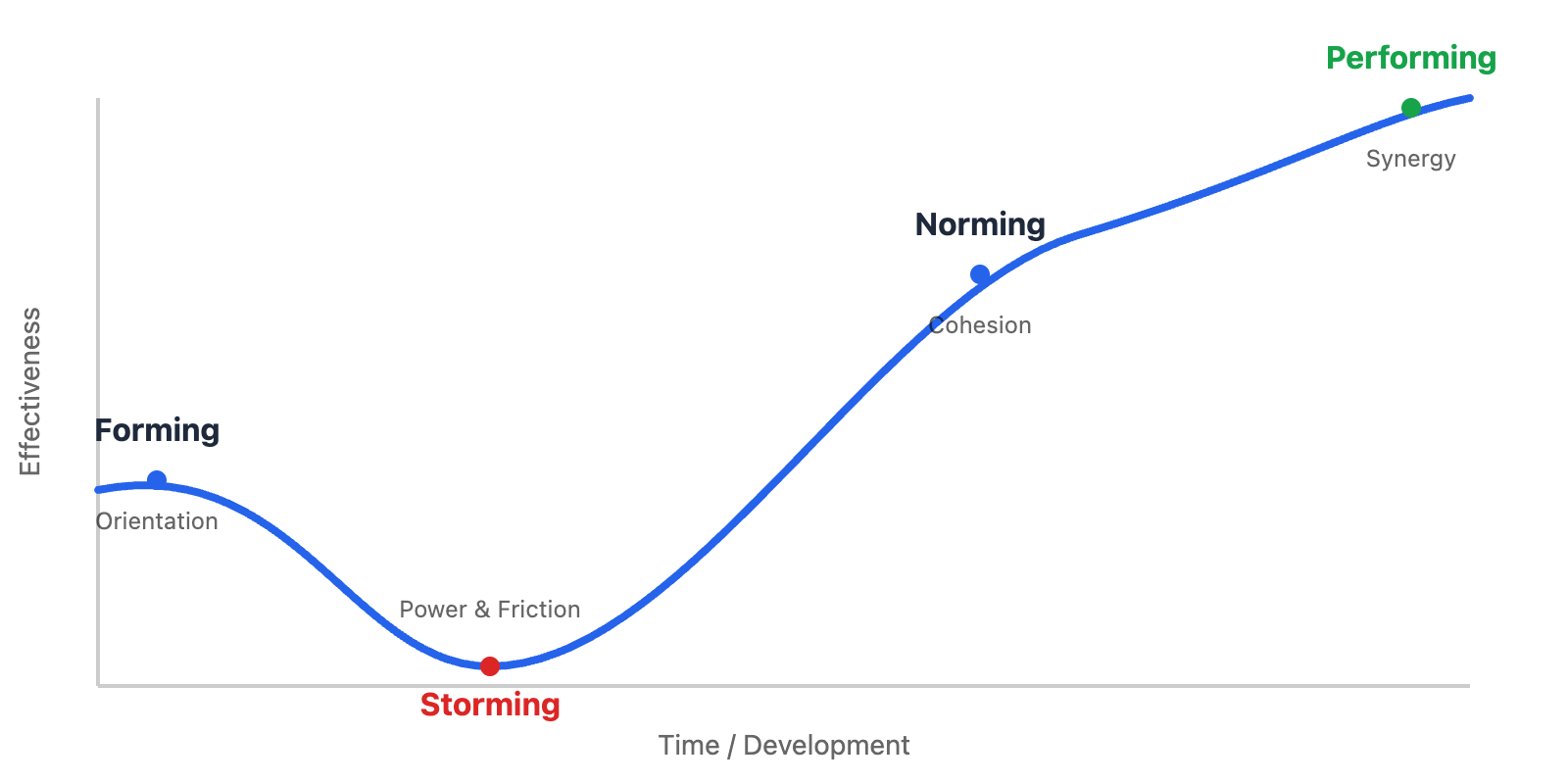
Bruce Tuckman's Forming, Storming, Norming, Performing model is decades old and still the most useful diagnostic you have for what your team needs from you this week. The trick is to stop guessing from how the team feels and start reading what the team does.
Forming looks polite. People are oriented outward, asking clarifying questions, deferring to you, hedging in standup. Disagreements get muted into "interesting point" or routed back to you for a decision. Energy is cautious. Storming looks like friction. Subgroups form. Disagreements stop being routed to you and start playing out sideways, in Slack threads, in tone, in who-gets-invited-to-which-meeting. People challenge process, role definition, and sometimes each other. Decision rework climbs. This is the stage where managers most often misdiagnose: they read it as a personality problem ("Dan and Natalie just don't click") when it's actually the team negotiating norms.
Norming looks like the friction has paid off. People reference shared agreements ("the way we usually scope this"), debates resolve faster, and the team starts policing its own behaviors without you in the room. Performing looks like you're barely needed for execution. The team makes its own calls, surfaces risks early, gives each other feedback, and asks you for air cover and direction-setting rather than answers.
- Jake: I think we're in Norming. Standups feel calm again.
- Nova: What did the last three planning meetings actually look like?
- Jake: Quiet, mostly. Fewer arguments than a month ago.
- Nova: Quiet because they've aligned, or quiet because they've stopped trying?
- Jake: ...I'd have to go check who's actually talking.
Notice that "calm" is not a stage. Calm can mean Norming, and it can mean a Storming team that has gone underground. Diagnose from specific behaviors over a two-week window, not vibes.
Leading What the Team Actually Needs
Each stage demands a different version of you, and the most common managerial failure is running the wrong playbook for the stage you're in. Forming wants a directive leader. People need clarity about goals, roles, and decision rights, and they need you to provide it. Light facilitation, heavy structure. The mistake here is faux empowerment: handing a Forming team an open-ended question and treating their silence as alignment.
Storming wants a coaching leader who holds the line. The friction is necessary, not pathological, and your job is to keep it productive rather than suppress it. That means surfacing disagreements early, naming the elephant before it metastasizes, and protecting the team from the temptation (yours and theirs) to retreat into politeness. The mistake is mediating every conflict yourself. Do that and you become the bottleneck, the team never builds its own muscle, and Storming drags on for months.
Norming wants a delegating partner. Your moves shrink. You start asking "what does the team think?" instead of answering. You let small decisions go to the team without your blessing. Stay directive too long here and you actively push the team backward. Performing wants a barrier-remover. You step out of the operational center and into the role of resourcing, unblocking, and connecting the team to context they can't see from where they sit. The mistake is the opposite of the Norming one: walking away too far. Performing teams still need you, just for different things.
Catching Regression Before It Hardens
Stages aren't a one-way ratchet. A reorg, a departure, a new hire, a shift in scope, a public failure: any of these can knock a Performing team back into Storming overnight, and a Storming team back into a wary Forming. The signals are subtle at first. A teammate who used to push back goes quiet. A standup that used to surface risks turns into status reporting. Slack threads get shorter. The two people who used to disagree productively now route around each other.
When you spot regression, the move is not to wait it out. It's to name what you've observed, in specific behaviors, and create a small intervention proportional to the slip. For a single teammate, that's a one-on-one where you bring the observation, hold the silence, and ask what's actually changed. For the whole team, it's often a half-hour retro on the new dynamic with one explicit question on the table. The intervention you don't want to make is the one most managers default to: a generic team-building exercise. That treats symptoms and confirms to your team that you're not actually paying attention.
The takeaway is that your team has a stage right now, and your job is to read it from behaviors, match your leadership to what that stage needs, and stay alert to the regression signals that mean the stage just shifted under you.
Three practices sit ahead. First, a quick pattern-spotting check where you'll match observable behaviors to the stage they signal. Then you'll draft the diagnosis-and-adaptation memo a skip-level would actually act on, complete with what you'll do more of, less of, and stop entirely for the next 60 days. Finally, a live one-on-one where the regression is real and the test is whether you can surface it without rescuing the person from the discomfort.
