Constructive Feedback Conversations
The Constructive Feedback Conversation
SBI gives you the words. The conversation gives you the rest: how you walk in, what you do when their face changes, how you get out without leaving a mess. The previous unit got the feedback structurally clean. This one gets it through a real human in a real room, including the part where they push back, go quiet, or tear up, and you still leave with a path forward they actually believe in.
Setting the Stage and Navigating What You Can't Script
The conversation starts before you open your mouth. Three setup choices do most of the work. First, the location: a private room, not a glass conference room on the main floor, and not a coffee shop where they can't react honestly. Second, the time: never the last fifteen minutes of their day or right before a high-stakes meeting they need to be sharp for. Third, the warning: a brief, neutral heads-up like I'd like to talk about how the last sprint went, can we grab 30 minutes tomorrow afternoon? Surprise feedback triples the threat response. A short runway lets their prefrontal cortex show up to the meeting.
When you sit down, name the purpose in one sentence and resist the throat-clearing. Something like I want to share some feedback on the deadline pattern this sprint and figure out what we do next together. That sentence does three things at once: it tells them what's coming, it signals collaboration rather than verdict, and it ends the suspense that would otherwise eat the first ten minutes.
Then you deliver the SBI, and something will happen. Not might, will. People react. The four reactions to be ready for are defensiveness ("that's not fair, here's the context"), shutdown (one-word answers, eyes down), tears, and counterattack ("well, you also..."). Your move is the same in all four cases: slow down, acknowledge what's real in their response, and hold the structure. You don't have to win the next sentence. You have to stay in the room.
- Jessica: I mean, I just feel like you're picking on this one thing when I held everything else together.
- Jake: That's fair, you held a lot together this sprint, and I want to come back to that. The thing I want to stay on for a minute is the security review handoff specifically, because that one had a downstream effect I want you to know about.
- Jessica: ...Okay. What was the effect?
- Jake: Legal pushed their review by 24 hours, which moved the client call. I had to flag it to my skip-level. I'm not telling you that to pile on, I'm telling you because you couldn't see it from where you were sitting.
- Jessica: Yeah. I didn't know it had moved that far.
Notice what didn't happen: Jake didn't argue with her framing, and he didn't drop the point. "That's fair, and..." is the move. Acknowledge the truth in the pushback, then return to the specific without softening it into nothing.
If they go silent, let the silence sit. Five seconds feels like a year, but filling it with reassurance ("look, this isn't a big deal") undoes the work. If they tear up, hand them water, give them thirty seconds, and say take your time, there's no rush here. Do not retract the feedback to make them feel better. The kindest thing you can do is stay calm and stay clear. And if the reaction seems to be about something larger than the feedback in front of you, it's appropriate to pause the conversation entirely and pick it up another day.
Closing With a Path Forward They Chose
The end of the conversation is where most managers either over-prescribe or fade out. Both fail. Over-prescribing ("here's what I need you to do: one, two, three") gives you a paper trail and a teammate who will execute the letter without the spirit. Fading out ("so, let's just see how things go") guarantees you'll have this exact conversation again in three weeks.
The move is co-creation. Ask an open question that hands them the pen: Given what we've talked about, what do you think would actually help here? Then wait. They will likely offer something vague at first ("I'll be more careful"). Push gently for specificity: What does more careful look like in practice? What would change in your Monday? Keep going until you have a behavior, not an intention.
Once they've named something concrete, your job is to add what you'll change on your side ("I'll stop pulling you into the parallel ad-hoc requests for the next three weeks"), lock in a check-in date with what you'll each look at ("let's reconnect Friday the 18th, I'll bring the deadline log, you bring how the new pre-merge step went"), and confirm we're both leaving with the same understanding. Ask them to summarize it back. If their summary is fuzzy, the agreement is fuzzy.
Building the Ratio That Makes the Hard Conversations Possible
None of this works in isolation. A team that hears from you only when something is wrong will brace every time you book a 1:1, regardless of how well you run the actual conversation. The research on high-performing teams converges on roughly a 5:1 to 6:1 ratio of positive to corrective feedback, and that ratio is what makes the corrective feedback land instead of bruise.
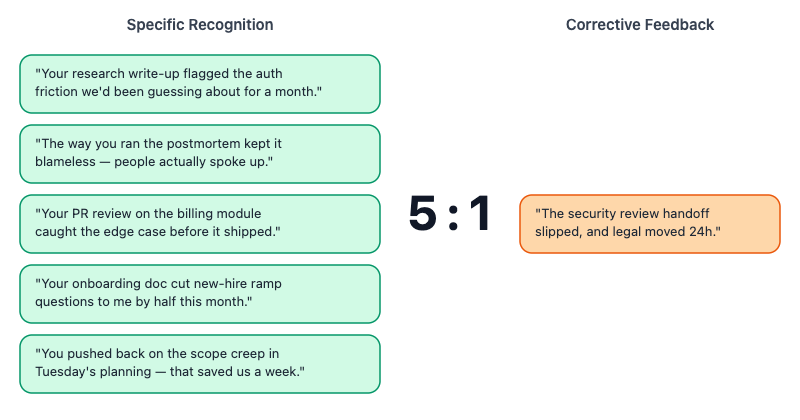
Two cautions, because the ratio is easy to fake. First, generic praise ("great job on the launch, team!") doesn't count. It's noise. The brain processes it as social filler, not recognition. Specificity is what makes it register: name the behavior, name the impact, send it to the person, not the room. "Your customer-research write-up flagged the auth friction we'd been guessing about for a month. That single doc shifted the entire onboarding redesign." That lands. "Amazing work" doesn't.
Second, never staple recognition to a request. The moment a "by the way, can you also..." follows the praise, you've taught your team that recognition is the setup for an ask, and the next genuine piece of recognition you send will be read as bait. If you have a request, send it separately, ideally on a different day.
Build the ratio deliberately. Once a week, ask yourself: who on my team did something specific and good this week that I haven't acknowledged? Then send the message. Two minutes of writing buys you the trust that makes the hard conversation in month four possible.
The takeaway is that the structure of feedback is necessary but not sufficient: what carries it is the room you set, the calm you keep when emotions arrive, the path you build together at the close, and the steady deposits of specific recognition that fund the whole account.
In the following exercises, you'll practice doing a quick judgment check on the in-the-moment moves, the kind of split-second calls that determine whether a teammate stays in the conversation or leaves it. Then you'll run the closing portion of a hard conversation live, where the test is whether you can co-create commitments that hold, followed by drafting a single recognition message specific enough to actually mean something.
