The SBI Feedback Framework
Welcome to the Course
Feedback, conflict, and team dynamics are where most foundational managers either earn trust or quietly lose it. You can be technically excellent and still watch your team go quiet, your best people drift, and your hardest conversations get botched, all because the moves required here are subtle, learnable, and rarely taught. This course gives you the structures and scripts that hold up when the room gets hard.
By the end of this course, you'll be able to:
- Apply the Situation-Behavior-Impact model to deliver feedback that lands without triggering defensiveness.
- Run difficult feedback conversations from setup through closing commitments and follow-up.
- Calibrate a high positive-to-negative feedback ratio with recognition that actually means something.
- Diagnose your team's Tuckman stage from observable behaviors and adapt your leadership accordingly.
- Distinguish task conflict from relationship conflict and intervene at the moment one tips into the other.
- Facilitate a five-step mediation between two teammates without imposing your own answer.
This first unit focuses on the foundation everything else rests on: how to give clear, behavioral feedback that someone can actually hear.
Why Poorly Structured Feedback Hijacks the Brain
Before you learn the structure, it helps to know why the wrong words biologically fail. When a teammate hears "You've been sloppy lately" or "I need you to be more of a team player," their brain doesn't process the content first. It processes the threat first. The amygdala, the brain's threat-detection center, fires before the prefrontal cortex (the reasoning part) gets a vote. Researchers call this an amygdala hijack, and once it fires, the conversation you wanted to have is no longer the conversation you're in.
Three social threats reliably trigger this hijack at work. The first is status: a vague label like "sloppy" or "careless" reads as an attack on identity, not behavior. The second is certainty: when someone can't tell what specifically is wrong or how to fix it, the ambiguity itself is threatening. The third is fairness: feedback that sounds like a verdict rather than a description feels arbitrary, and arbitrary judgment is one of the strongest defensiveness triggers there is.
This is why "you didn't prioritize" lands as an attack while "the deliverable arrived after the security review window closed" lands as information. Same observation, different biology.
The SBI Model
The Situation-Behavior-Impact (SBI) model is the cleanest answer to that biology. You name the Situation (a specific time and context), then the Behavior (only what was observable, no interpretation), then the Impact (the concrete effect on you, the team, or the work). Three components, in that order, every time.
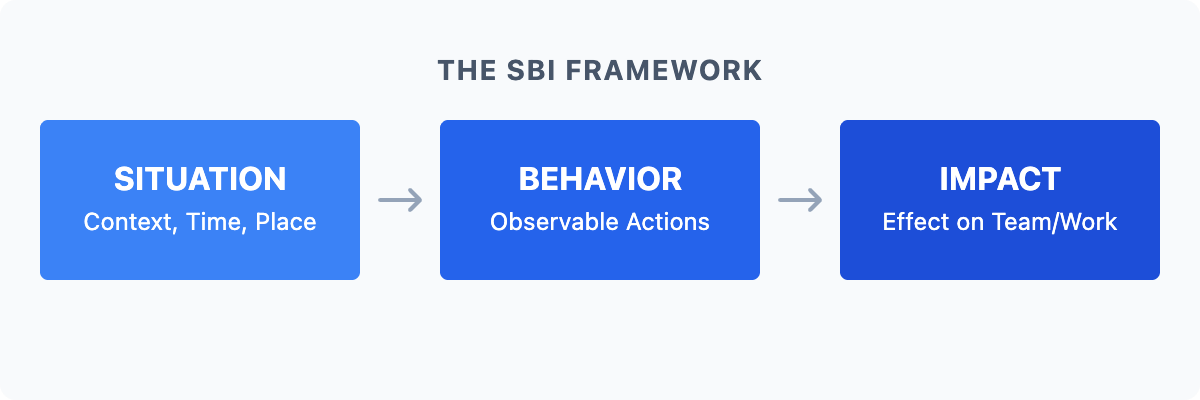
The trap most foundational managers fall into is smuggling interpretation into the Behavior step. Words like "careless," "didn't care," "checked out," "wasn't engaged," or "didn't prioritize" feel descriptive but are actually mind-reading. They're conclusions about someone's internal state dressed up as observations. Strip them out. If a camera couldn't have recorded it, it doesn't belong in Behavior.
Here's the contrast in practice:
- Jake: Hey, I need to flag something. You've been kind of disengaged in standups lately.
- Chris: Disengaged how? I've been there every day.
- Jake: I don't know, it just feels like your energy is off.
- Chris: Okay. Noted.
Notice how fast that closed. Now the same concern in SBI:
- Jake: In the last three standups, when we got to the architecture topic, you didn't share an update or ask a question. The effect on me is I lose visibility into where that workstream is, and the team loses your read on the trade-offs. Can you walk me through what's going on?
- Chris: Yeah, honestly the scope shifted under me last week and I haven't reset my plan. I should have flagged it.
Same situation, totally different conversation. The second version is harder to write but easier to hear, because there's nothing to defend against. The Behavior is observable. The Impact is concrete. The door is open.
Crafting SBI for Real Scenarios
Two scenarios are worth practicing until they're automatic, because you will face them constantly. The first is the missed deadline. The lazy version is "You've been missing your commitments." The SBI version names the specific commitment ("the Tuesday handoff to legal that you committed to in last Monday's planning"), the observable behavior ("the doc was sent Wednesday afternoon"), and the layered impact ("legal's review slipped 24 hours, which pushed the security review into next sprint, and I had to flag the slip to my skip-level"). Notice how the Impact section separates effects on you, the team, and the work rather than collapsing them into a single feeling.
The second is interpersonal friction. This one tempts you hardest into character judgment, because the trigger is often emotional. Resist. Instead of "You were dismissive of Natalie in the design review," try: "In yesterday's design review, when Natalie proposed the queue-based approach, you said 'we already tried that' and moved to the next slide. The effect was Natalie didn't speak again in that meeting, and I think we lost a thread worth exploring." Same concern, no character verdict, fully workable.
The recap is simple: feedback fails biologically when it sounds like judgment, and SBI is the structure that keeps it sounding like description. Hold the line on observable Behavior and you change the conversation you can have.
Three practices sit ahead of you. First, a quick recall check on the threat-response vocabulary so you can articulate the why under pressure. Then you'll draft SBI talking points for a real missed-deadline scenario, the kind you could walk into a 1:1 with tomorrow. Finally, you'll deliver feedback live in a new scenario, with someone pushing back, and find out whether your structure holds when the room gets uncomfortable.
