Mediating Team Conflicts
The Conflict Mediation Process
The previous unit asked you to read your team's stage and lead from it. This one zooms in tighter, into the moment two of your people are stuck in a conflict that's bleeding into the work. Mediation is one of those skills managers either learn deliberately or fake unconvincingly for years. The good news is the move is teachable. The harder news is that the most common managerial reflex (jumping in to decide who's right) is the exact thing that hardens the conflict and quietly tells the team you're the bottleneck for every disagreement. This unit gives you a different muscle.
Telling Task Conflict From Relationship Conflict
Before you mediate anything, you need to know which conflict you actually have. Task conflict is a disagreement about the work: the design choice, the priority, the trade-off, the estimate. It's about ideas and outcomes. Relationship conflict is a disagreement about the person: their character, their motives, their pattern, their tone. It's about identity and trust. Task conflict, handled well, makes decisions sharper and teams smarter. Relationship conflict, left alone, corrodes psychological safety faster than almost anything else you'll encounter.
The diagnostic isn't the volume or the heat, it's the grammar. "I think this architecture won't scale past 10x traffic" is task conflict, even if it's said sharply. "She always blocks the architectural calls she didn't make herself" is relationship conflict, even if it's said calmly. Watch for pronoun and adverb shifts: from "this design" to "she always," from "the trade-off" to "you never." Those are the tells that the conversation just tipped.
- Jake: Milo and Natalie were going at it in design review again.
- Nova: What were the actual sentences?
- Jake: Milo said the proposal had a scaling flaw, then a minute later said "this is the same thing she did on the last project."
- Nova: First one is task. Second one is relationship. Did you redirect?
- Jake: I let it slide because I didn't want to embarrass him.
- Nova: So the room learned that personal comments are tolerated when they're quiet.
Notice how the second sentence in Jake's example crosses a line that the first doesn't. The cost of missing that moment isn't the comment itself, it's what the team concludes about your standards.
Facilitating the Five-Step Mediation
When task conflict has hardened into relationship conflict and the two parties can't unwind it themselves, that's when you mediate. The Five-Step Mediation Process gives you a repeatable structure: set ground rules and establish neutrality, let each party share their perspective uninterrupted, identify shared interests, generate options together, and agree on next steps and follow-up.
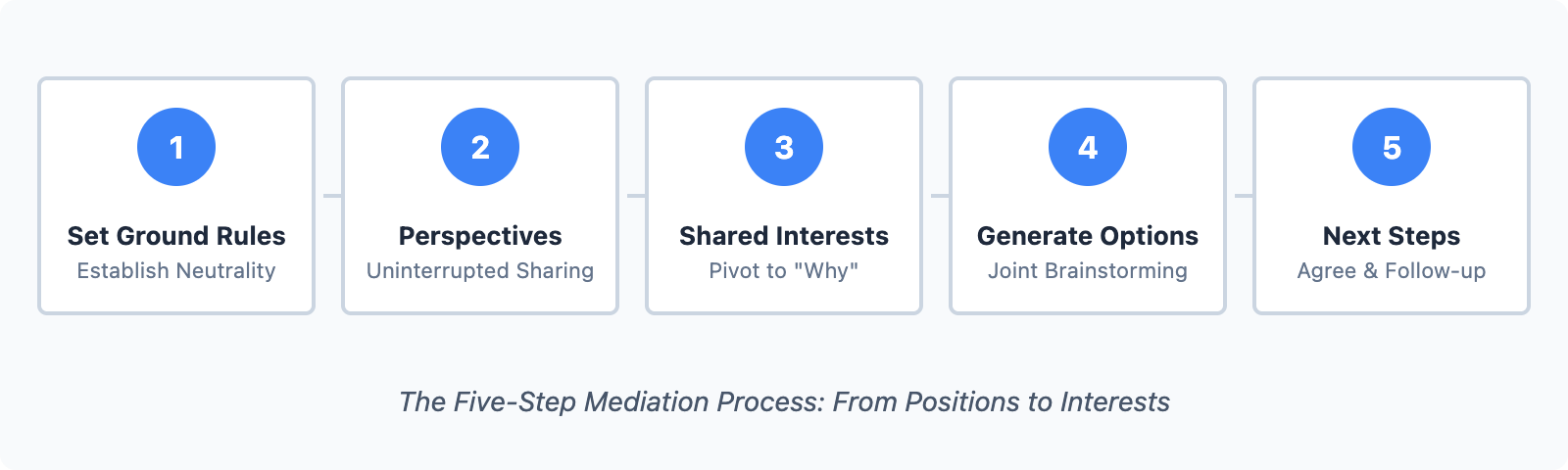
Step one is more than a formality. You name your role (facilitator, not judge), set the rules (no interrupting, focus on behavior and impact rather than character, what's said here doesn't leave the room), and explicitly establish that you're not there to declare a winner. If you skip this, both parties walk in expecting you to ratify their position, and step two collapses into competitive monologues.
Step two is where most managers undermine themselves. Each party gets uninterrupted time to share their view, and your job is to listen and reflect back, not to comment, correct, or smooth. The discomfort of letting someone fully say their piece, including parts that aren't fair, is the price of admission.
Step three is the pivot: from positions ("I want the architecture I proposed") to interests ("I want a design I can confidently maintain in production"). You'll often find the interests overlap by 70 percent, even when the positions feel mutually exclusive. That's the opening.
Step four asks them to generate options together, not pick one. Brainstorming jointly transfers ownership from you to them and makes step five (a concrete agreement with a follow-up date) something they own. The follow-up matters: without it, the agreement decays in two weeks and you're back where you started.
The thing to watch for is your own urge to shortcut the steps. Skipping ground rules feels efficient and costs you the rest of the process. Skipping shared interests feels theoretical and costs you the buy-in. The protocol is the point.
Protecting Task Conflict While Shutting Down the Personal
Mediation is the heavy machinery for when conflict has already gone sideways. Most of your work is lighter and live: in standups, design reviews, and planning meetings, where you're protecting healthy task conflict while shutting down the moment it slides personal. These are different jobs that look similar from the outside.
Encouraging task conflict means you actively pull dissent into the room. You ask "what's the strongest case against this?", you reward the teammate who raises the uncomfortable trade-off, you slow down when the room is too aligned too fast. Teams that don't argue about the work aren't harmonious, they're underperforming. Your job is to make disagreement on substance feel safe and expected.
Shutting down relationship conflict is a different reflex. The moment a comment slides from "this design" to "she always," you intervene right then. Not after the meeting, not in a private follow-up, right then. The script is short and unembarrassing: name the shift ("let's keep this on the design, not the person"), redirect to the technical question ("what's the specific concern about the proposal?"), and move on. Done in two sentences, it protects the working relationship without humiliating the person who slipped, and the room learns the line in real time.
The takeaway is that conflict is not the problem; the wrong kind of conflict is. Your job is to keep task conflict warm and relationship conflict cold, and to know the five-step process when the temperature has already gotten away from you.
Three practices sit ahead. First, a quick judgment quiz where you'll identify exchanges as task, relationship, or the moment one tips into the other. Then you'll walk one party through the five steps in a prep conversation, where the test is whether you can hold the structure when she pushes against it. Finally, you'll facilitate a live team meeting where the line gets crossed at least twice and the redirect has to happen in the moment, without shaming anyone or freezing the room.
