Divisibility by Six
Introduction
Welcome back to Divisibility Shortcuts — you are now on lesson four of five, and the finish line is in sight. Over the previous three lessons you picked up quick tests for , , , , , and , each built on a different feature of the base-ten system. Today's lesson takes a completely different approach: instead of inventing a brand-new trick, you will combine two rules you already know to test divisibility by 6. The payoff is a powerful idea — simpler tests can be stacked together to handle a harder divisor, no extra memorization required.
What Makes 6 Special
Before we state the rule, let's think about what the number is made of:
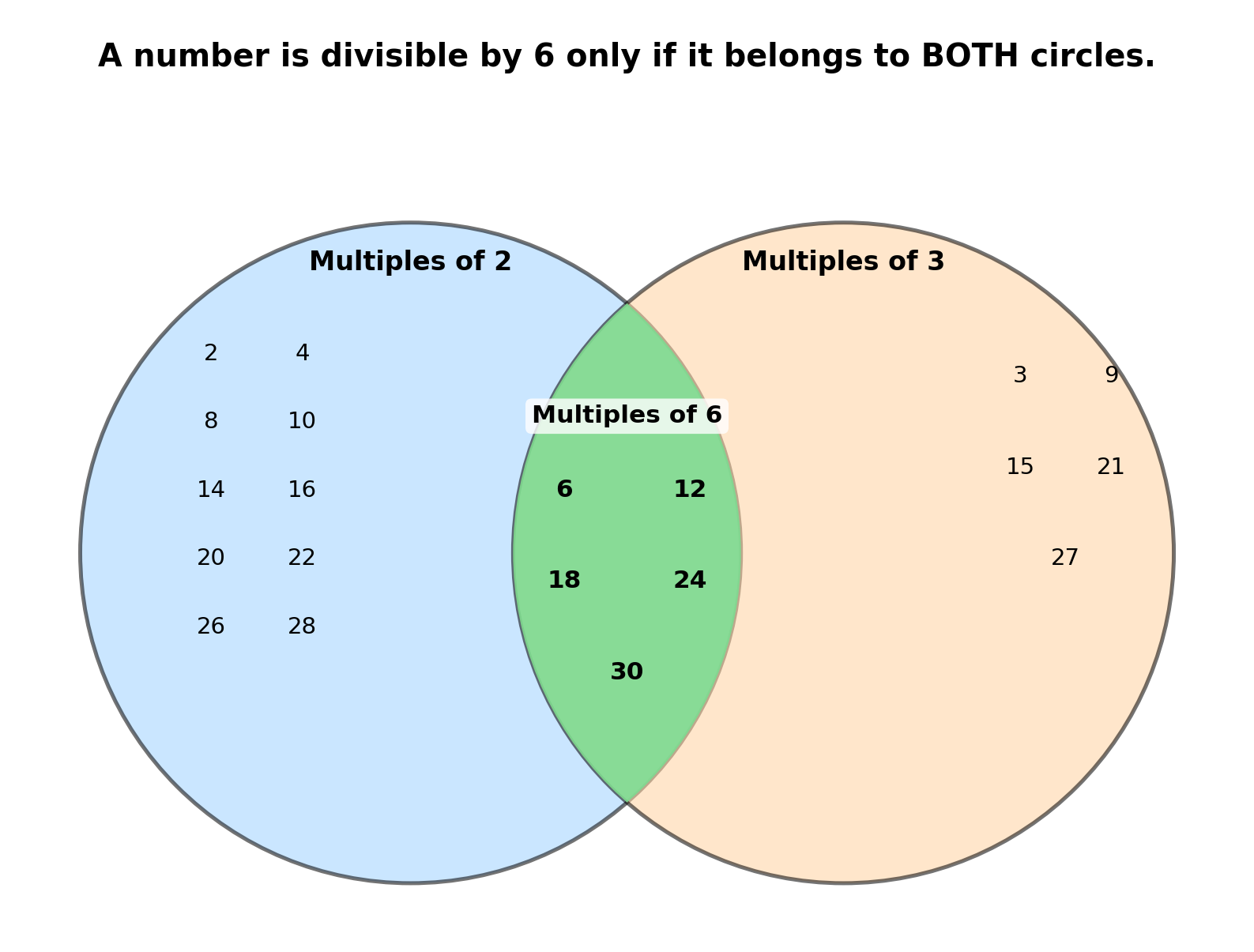
Both and are prime numbers, and you already have a fast test for each one. The insight behind the divisibility rule for is refreshingly simple: if a number can be shared equally into groups of and into groups of , then it can also be shared equally into groups of . We don't need a new shortcut at all — we just need to use two shortcuts we already have, together.
The Combined Rule
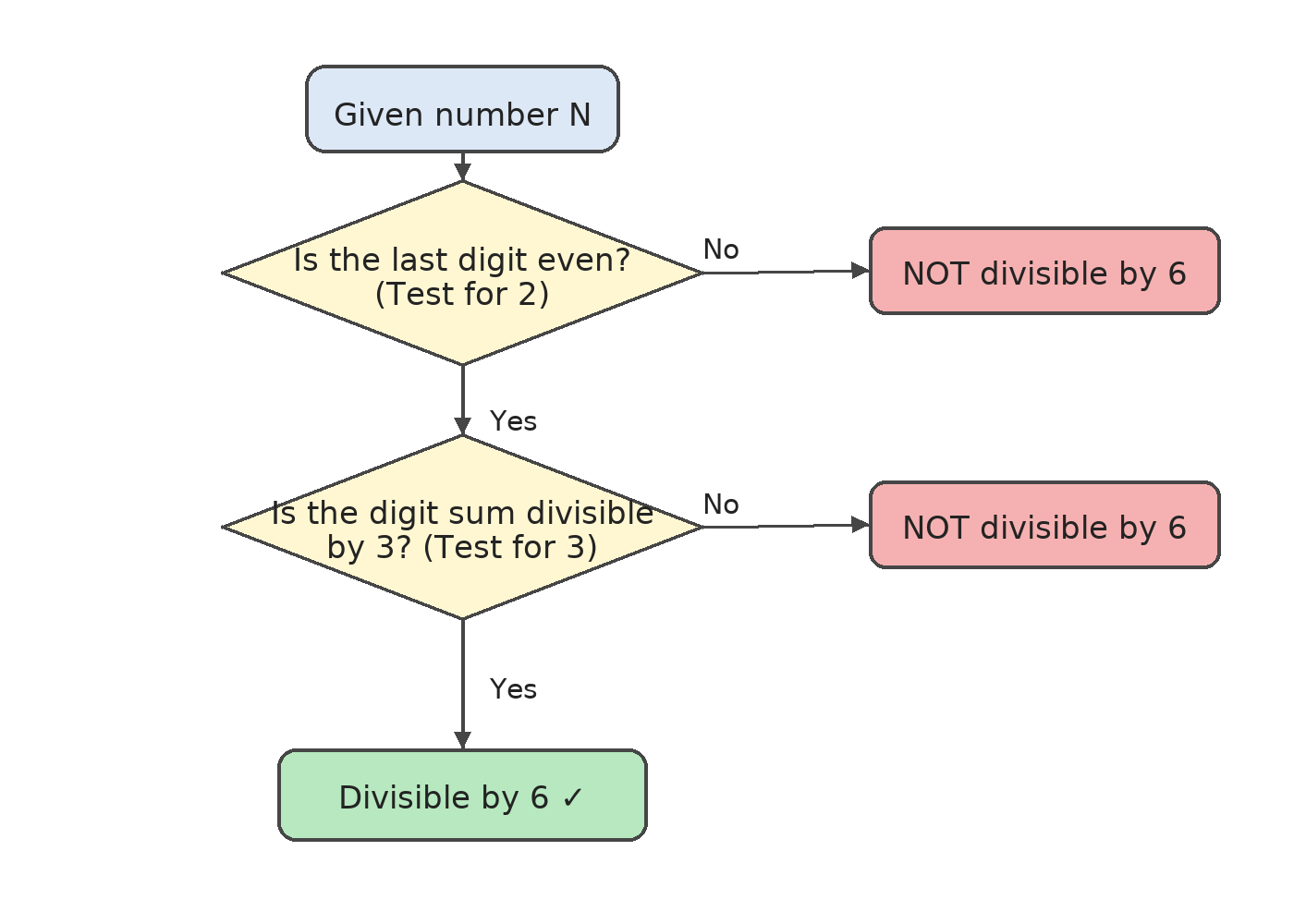
Here is the rule: a whole number is divisible by 6 if and only if it is divisible by both 2 and 3.
To apply it, run two familiar checks in sequence:
- Test for 2 — look at the last digit. If it is even (), the number passes.
- Test for 3 — add up all the digits. If the digit sum is divisible by , the number passes.
If the number passes both checks, it is divisible by . If it fails either one — or both — it is not divisible by .
Why One Test Alone Is Not Enough
It is tempting to think that passing just one of the two tests should be good enough. A quick comparison shows why that reasoning falls apart.
| Number | Divisible by 2? | Divisible by 3? | Divisible by 6? |
|---|---|---|---|
| 14 | Yes (last digit 4) | No (digit sum ) | No |
| 15 | No (last digit 5) | Yes (digit sum ) | No |
| 18 | Yes (last digit 8) | Yes (digit sum ) | Yes |
| 25 | No (last digit 5) | No (digit sum ) | No |
Look at : it is even, but dividing by gives remainder . Look at : its digit sum is divisible by , but remainder . Only , which satisfies both conditions, divides evenly — . Passing one test without the other always leaves a remainder.
Packing Eggs into Cartons of Six
Imagine you work in a warehouse that packs eggs into cartons of . A shipment of 2,154 eggs arrives and you need to know whether they fill an exact number of cartons with none left over.

Step 1 — Test for 2. The last digit of is , which is even. ✓
Step 2 — Test for 3. Add the digits: . Since with no remainder, the digit sum is divisible by . ✓
Conclusion: Both tests pass, so is divisible by . Quick verification: cartons, zero eggs left over.
Now suppose the next shipment contains 2,158 eggs. The last digit is (even — passes the test for ), but the digit sum is , and remainder . The number fails the test for , so it is not divisible by . You would have eggs left over after filling cartons.
Why Combining Two Tests Works
You might wonder: can we always test a product by testing its factors separately? The answer is yes, but only when the two factors share no common factor other than 1. In mathematical terms, the factors must be coprime — their only shared divisor is .
Since and are both prime, they are automatically coprime. That guarantees the following:
This principle extends beyond . For instance, you could test divisibility by by checking and separately, because and those factors are coprime. However, you could not test divisibility by by checking and separately. Even though , these factors share a common divisor (). As a result, a number like is divisible by both and , but it is not divisible by . The combining strategy works only when the component factors are coprime.
Quick-Reference Summary
Here is your updated table with every shortcut covered so far:
| Divisor | What to Check | Key Idea |
|---|---|---|
| 2 | Last digit is even | is divisible by |
| 3 | Digit sum divisible by | Powers of leave remainder when divided by |
| 4 | Last two digits divisible by | is divisible by |
| 5 | Last digit is or | is divisible by |
| 6 | Divisible by both 2 and 3 | and the factors are coprime |
| 9 | Digit sum divisible by | Powers of leave remainder when divided by |
| 10 | Last digit is | Exact match with base |
Notice that is the first entry in the table that combines two earlier rules rather than introducing an entirely new technique. This makes it especially easy to remember — there is nothing new to memorize, only a new way to use what you already know.
Conclusion and Next Steps
In this lesson you learned that divisibility by 6 requires passing two separate tests: the number must be even (divisible by ) and its digit sum must be divisible by . Neither condition on its own is sufficient — both must hold. You also saw the deeper reason this works: because and are coprime, checking each factor individually is enough to guarantee divisibility by their product.
Time to put the two-step check into practice! In the exercises ahead, you will decide which egg quantities fill exact cartons of six, complete partially worked examples that walk through each check, and determine whether real-world shipment sizes pack perfectly into boxes of six.
