Applying All Divisibility Rules
Introduction
Congratulations — you have reached the final lesson of Divisibility Shortcuts! Over the previous four lessons you built a complete toolkit of quick tests: last-digit checks for , , and ; digit-sum checks for and ; a last-two-digits check for ; and a combined two-step check for . Each rule let you spot a specific divisor without performing long division. Now it is time to bring everything together and practice running the full set of tests on a single number, so you can quickly identify every divisor from that applies.
Your Complete Divisibility Toolkit
Think of all seven rules as tools on a belt. Each one answers a single yes-or-no question about a number, and each one takes only a few seconds. The real power appears when you use them all at once on the same number, because in just a minute or two you can learn a great deal about how that number can be split into equal groups.
Here is the full set for easy reference:
| Divisor | Quick Test |
|---|---|
| 2 | Last digit is even () |
| 3 | Digit sum is divisible by |
| 4 | Last two digits form a number divisible by |
| 5 | Last digit is or |
| 6 | Passes both the test for and the test for |
| 9 | Digit sum is divisible by |
| 10 | Last digit is |
Notice that several tests share the same starting step. The checks for , , and all look at the last digit, while , , and all use the digit sum. That overlap is good news: a little bit of work goes a long way.
A Systematic Approach
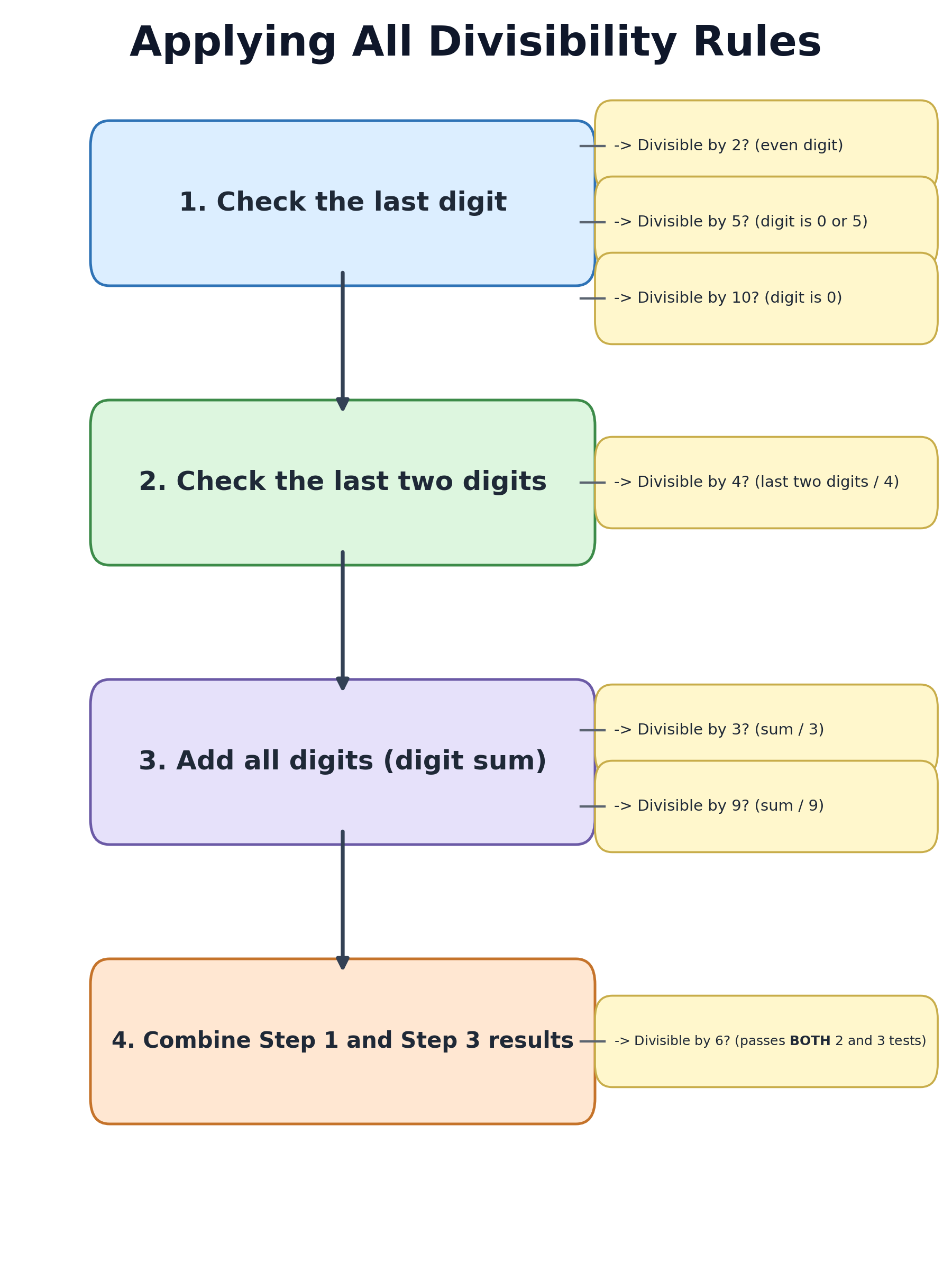
When you need to test a number against all seven divisors, it helps to follow a consistent order rather than jumping around randomly. Here is one efficient sequence:
- Look at the last digit. This single digit immediately tells you about , , and .
- Look at the last two digits. This tells you about .
- Add up all the digits. The digit sum tells you about and .
- Combine results. If the number passed both the test and the test, it is also divisible by .
By grouping the tests this way, you avoid repeating work. You check the last digit once and get three answers; you compute the digit sum once and get two or three answers, since the result depends on the result plus the result you already have.
Worked Examples: Running All Seven Tests
Let's apply the full scan to the number 2,340.
Step 1 — Last digit. The last digit is . Because is even, the number is divisible by . Because the last digit is , it also qualifies for and . Three checks done in a single glance.
Step 2 — Last two digits. The last two digits form . Since with no remainder, the number is divisible by .
Step 3 — Digit sum. Adding the digits gives . Since is divisible by both and , the number passes both tests.
Step 4 — Combine. The number passed the tests for and , so it is also divisible by .
Result: is divisible by all seven divisors — and . That is a remarkably clean number for splitting into equal groups!
Now let's try a number that is less cooperative: 1,578.
Step 1 — Last digit is . The digit is even, so the number is divisible by . It is neither nor , so the number is not divisible by or .
Step 2 — Last two digits: . Dividing gives remainder , so the number is not divisible by .
Step 3 — Digit sum: . Since , the number is divisible by . However, remainder , so it is not divisible by .
Step 4 — Combine. The number passes both the test and the test, so it is also divisible by .
Result: is divisible by and only. Compared with , far fewer group sizes work here — a useful thing to know before you start trying to divide.
When a Simpler Rule Passes but a Stricter One Does Not
As you work through these tests, you will notice that some rules are related but not equivalent. Two pairs are especially important to keep straight.
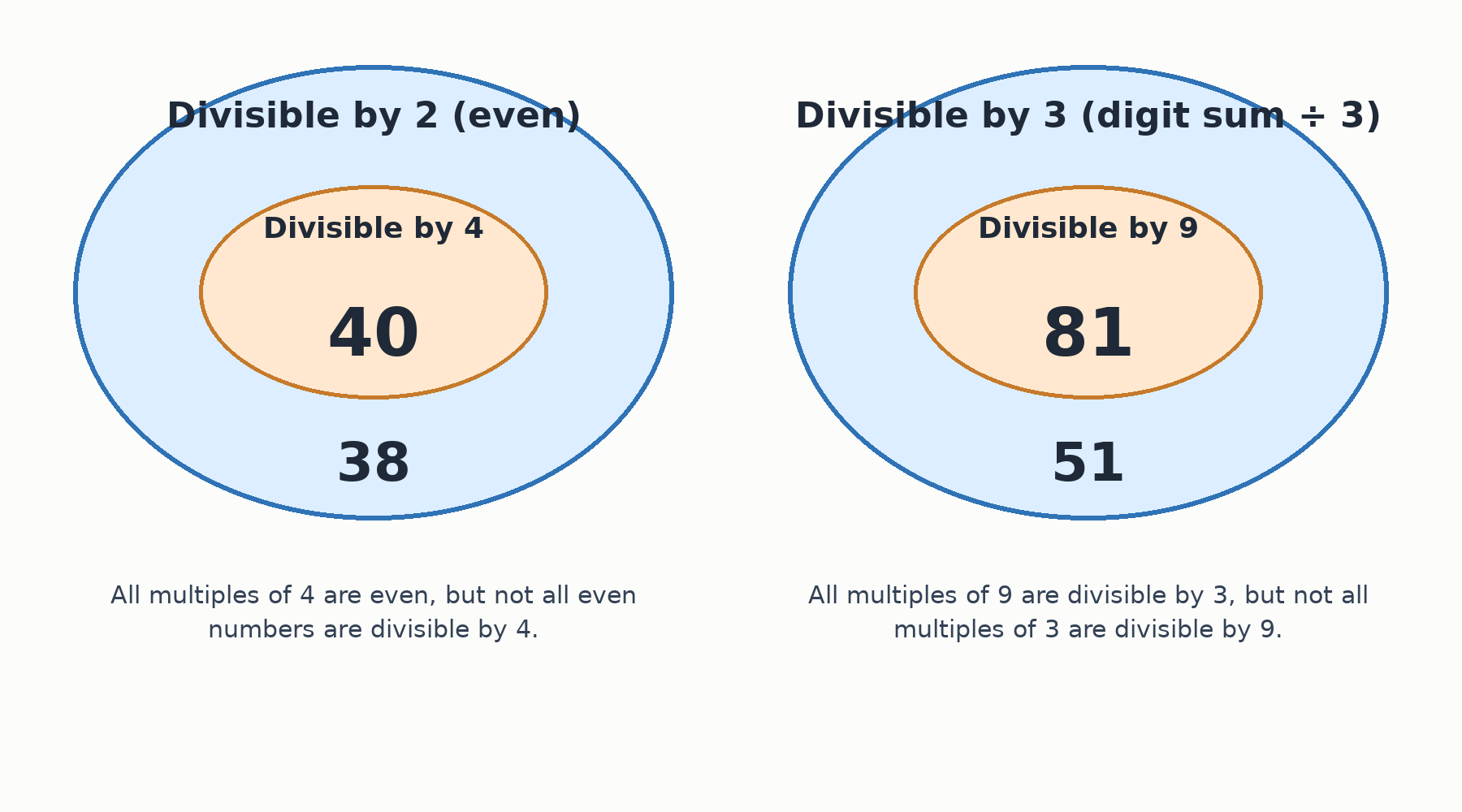
Divisibility by 2 versus 4. Every number divisible by is automatically divisible by , because . However, the reverse is not true. Consider : the last digit is (even), so it passes the test for , but remainder , so it fails the test for . Being even means the number has at least one factor of ; divisibility by requires two factors of .
Divisibility by 3 versus 9. Similarly, every number divisible by is automatically divisible by , since . But a number can pass the test and still fail the test. Take : the digit sum is , which is divisible by but not by . Divisibility by needs one factor of ; divisibility by needs two.
In short, the stricter rule always includes the simpler rule, but passing the simpler rule does not guarantee the stricter one. Keep this asymmetry in mind whenever you see a number that is even but not divisible by , or whose digit sum is a multiple of but not of .
Real-World Application: Splitting a Delivery
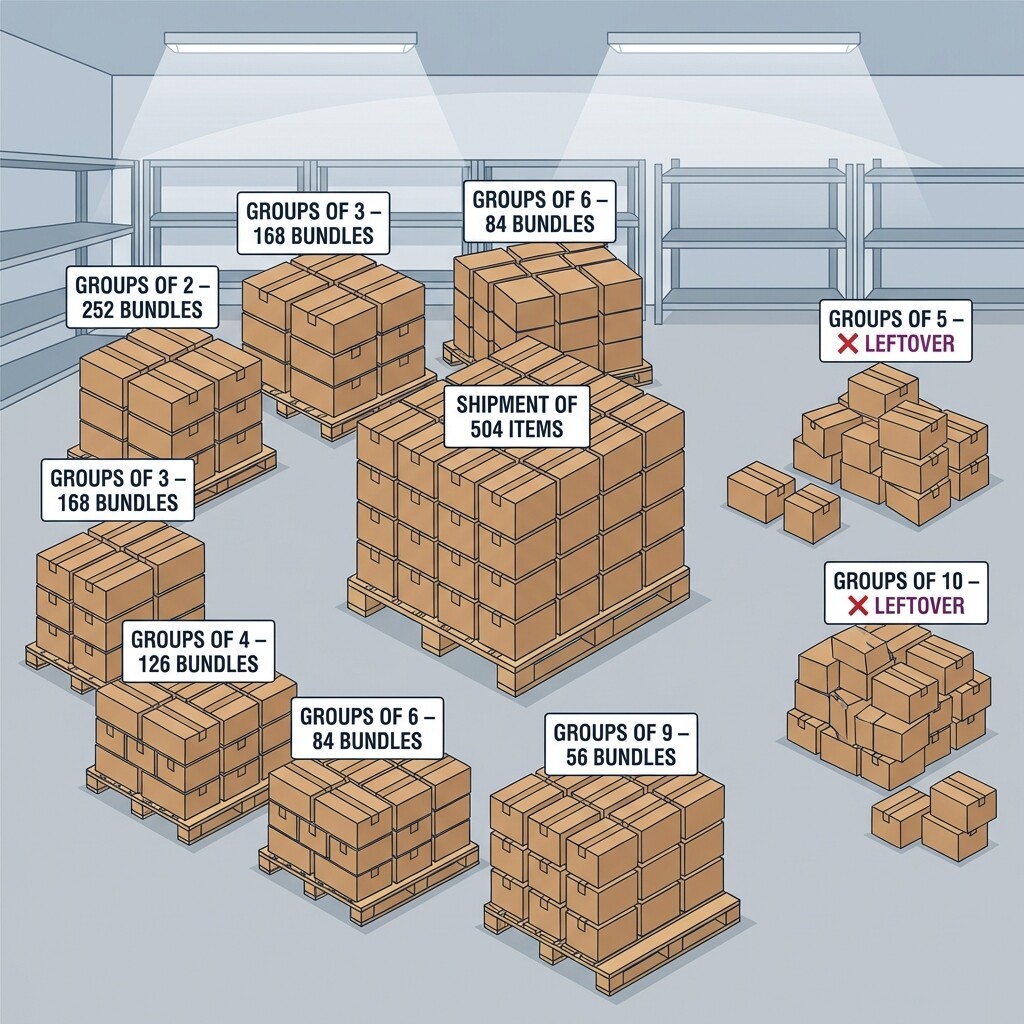
Imagine you manage a small shop and a shipment of 504 items arrives. You want to know which group sizes from would split the delivery into perfectly equal bundles with nothing left over.
- Last digit: . Even → divisible by . Not or → not divisible by or .
- Last two digits: (i.e., ). → divisible by .
- Digit sum: . Divisible by and by .
- Combine: Divisible by both and → divisible by .
So is divisible by and . You could split that shipment into bundles of ( bundles), (), (), (), or (). Bundles of or would leave items left over — and you figured all of that out in under a minute, with no calculator needed.
Conclusion and Next Steps
In this lesson you learned how to run all seven divisibility tests on a single number in one efficient pass. By checking the last digit first (for , , ), then the last two digits (for ), then the digit sum (for and ), and finally combining the and results (for ), you can quickly identify every applicable divisor without performing a single long division. You also saw that passing a simpler rule — like divisibility by — does not automatically guarantee its stricter relative, divisibility by , and the same goes for and .
Now it is time to put the full toolkit to work! The practice exercises ahead will have you sorting stock quantities, filling in divisibility tables, and analyzing real delivery invoices — so you can prove to yourself just how fast and reliable these shortcuts really are.
