Divisibility by 4
Introduction
You have reached the midpoint of the Divisibility Shortcuts course — this is lesson three of five. So far, your toolkit includes two types of tests: the last-digit check for , , and (Lesson 1) and the digit-sum check for and (Lesson 2). Today you will add a third type that falls neatly between the two: a test that looks at the last two digits of a number. The divisor in focus is 4. By the end of this lesson, you will be able to test divisibility by at a glance, and you will understand the place-value reason only two digits are needed.
Why One Digit Falls Short
Recall that divisibility by depends only on the last digit because is divisible by . Can the same reasoning extend to ? A quick check says no: remainder , so is not divisible by . That single fact tells us the last digit alone cannot settle the question.
A concrete example makes this clear. The numbers and both end in , and both are divisible by . But and also end in , and neither is divisible by . One digit simply does not carry enough information — we need to look a little further to the left.
The Last-Two-Digits Rule
Here is the rule: a whole number is divisible by 4 if and only if the number formed by its last two digits is divisible by 4.
To apply it, ignore every digit except the final two, then check whether that two-digit number is a multiple of . A few examples show the rule in action:
| Number | Last Two Digits | Last Two ÷ 4 | Divisible by 4? |
|---|---|---|---|
| 316 | 16 | Yes | |
| 530 | 30 | R | No |
| 1,748 | 48 | Yes | |
| 2,310 | 10 | R | No |
Notice that the size of the full number does not matter. Whether it has three digits, four digits, or twenty, only the last two decide divisibility by .
Why Only the Last Two Digits Matter
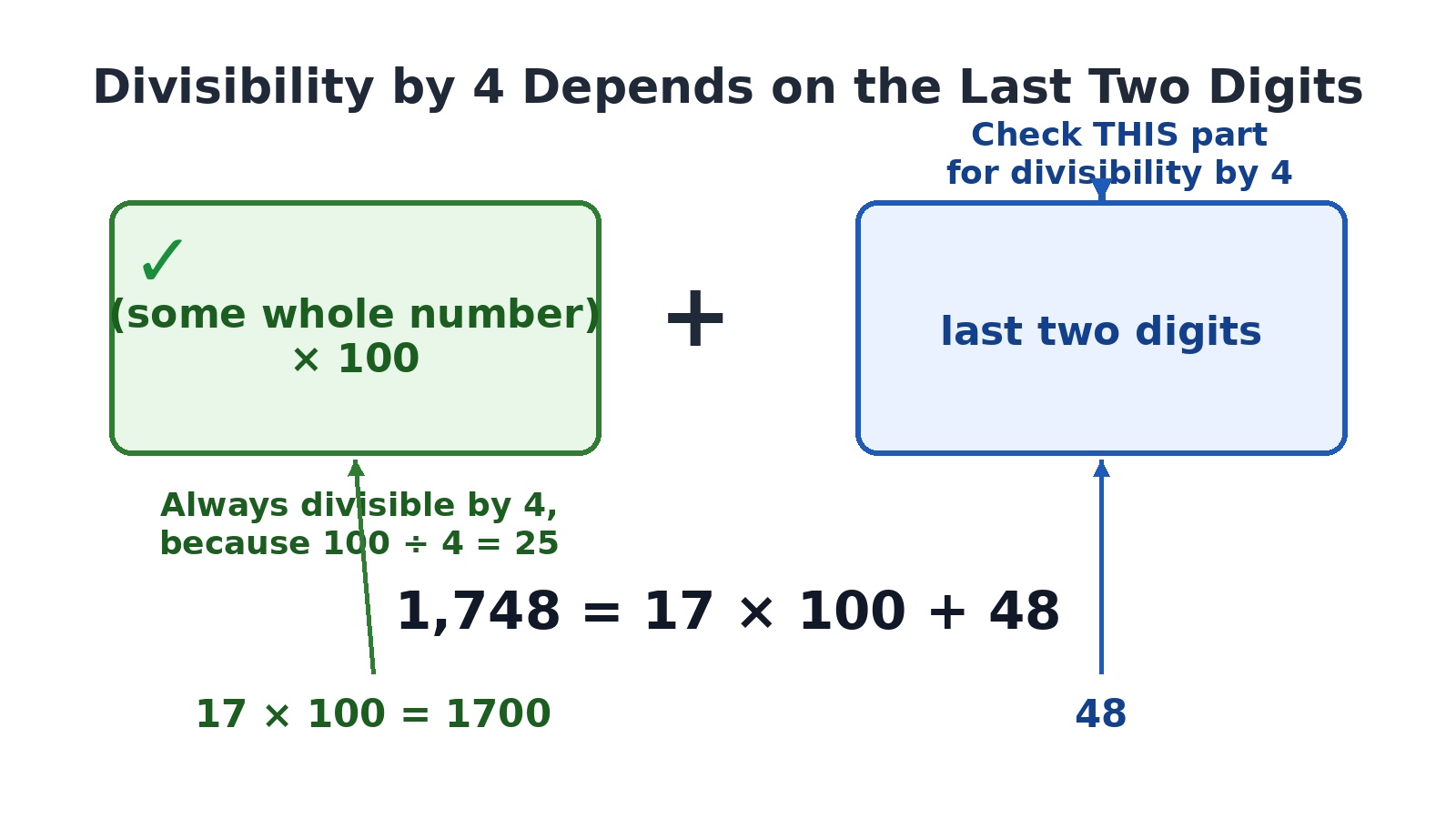
The explanation follows the same place-value thinking we used in earlier lessons, but this time the magic number is 100. Any whole number can be split into two parts: everything from the hundreds place upward, and the remaining last two digits. For example:
In general, every whole number takes this form:
Because with no remainder, the first part is always divisible by , regardless of what that leading portion is. That means the entire number's divisibility by hinges solely on whether the last two digits form a multiple of . The hundreds, thousands, and all higher places are automatically taken care of.
Handling the Two-Digit Check
Knowing the rule is one thing; quickly judging whether a two-digit number is a multiple of is another. Numbers like , , or are easy, but what about less obvious cases such as or ? Two simple mental strategies can help.
Strategy 1 — Halve twice. A number is divisible by when you can halve it twice and get a whole number each time. For : half of is , and half of is . Both results are whole numbers, so is divisible by .
Strategy 2 — Use a nearby multiple of 4. You probably know that is divisible by . Since , and is itself divisible by , the number must be as well. Similarly, , and exactly, so passes the test.
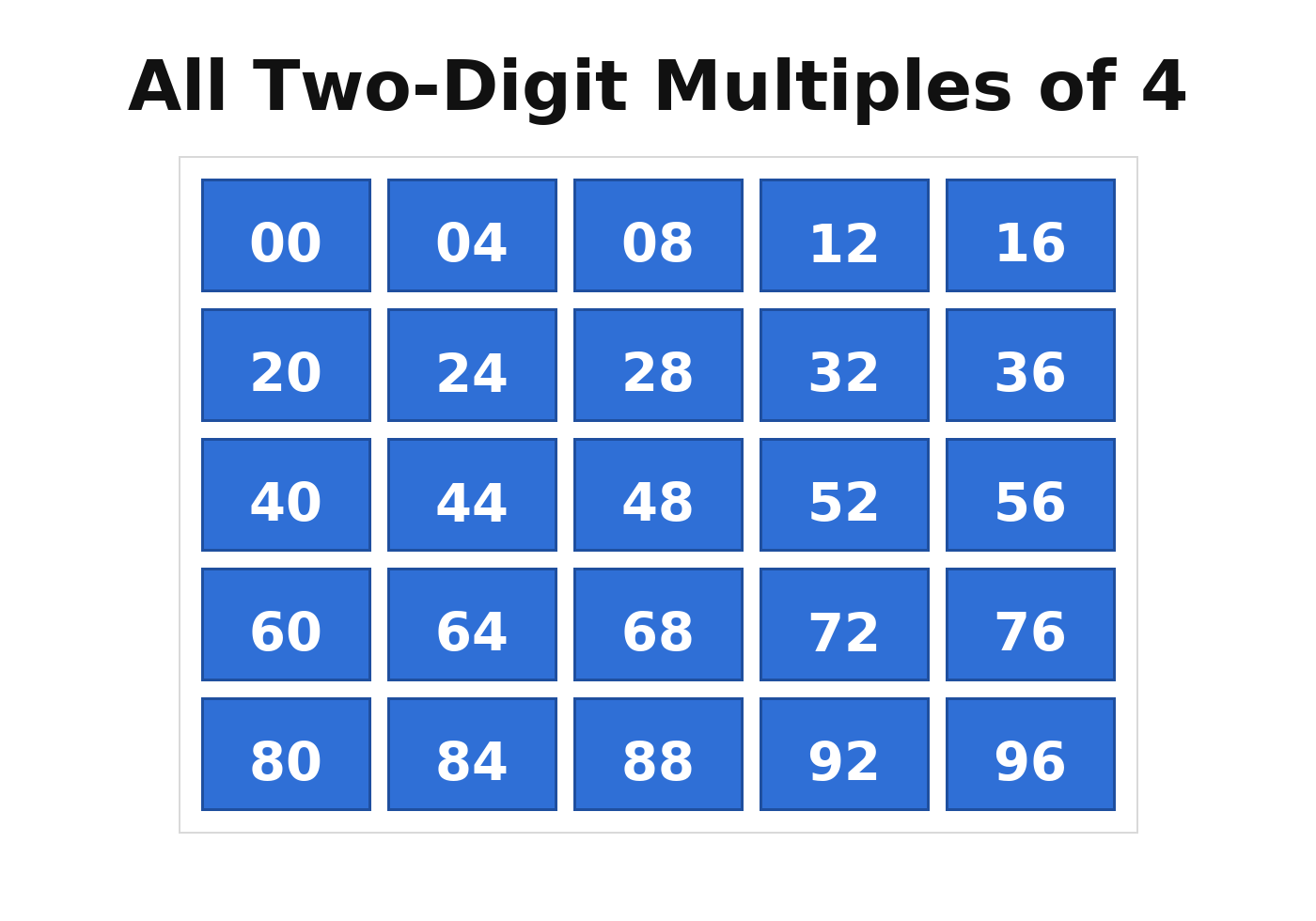
With practice, you will start recognizing the twenty-five two-digit multiples of on sight: , and .
Testing House Numbers on a Street
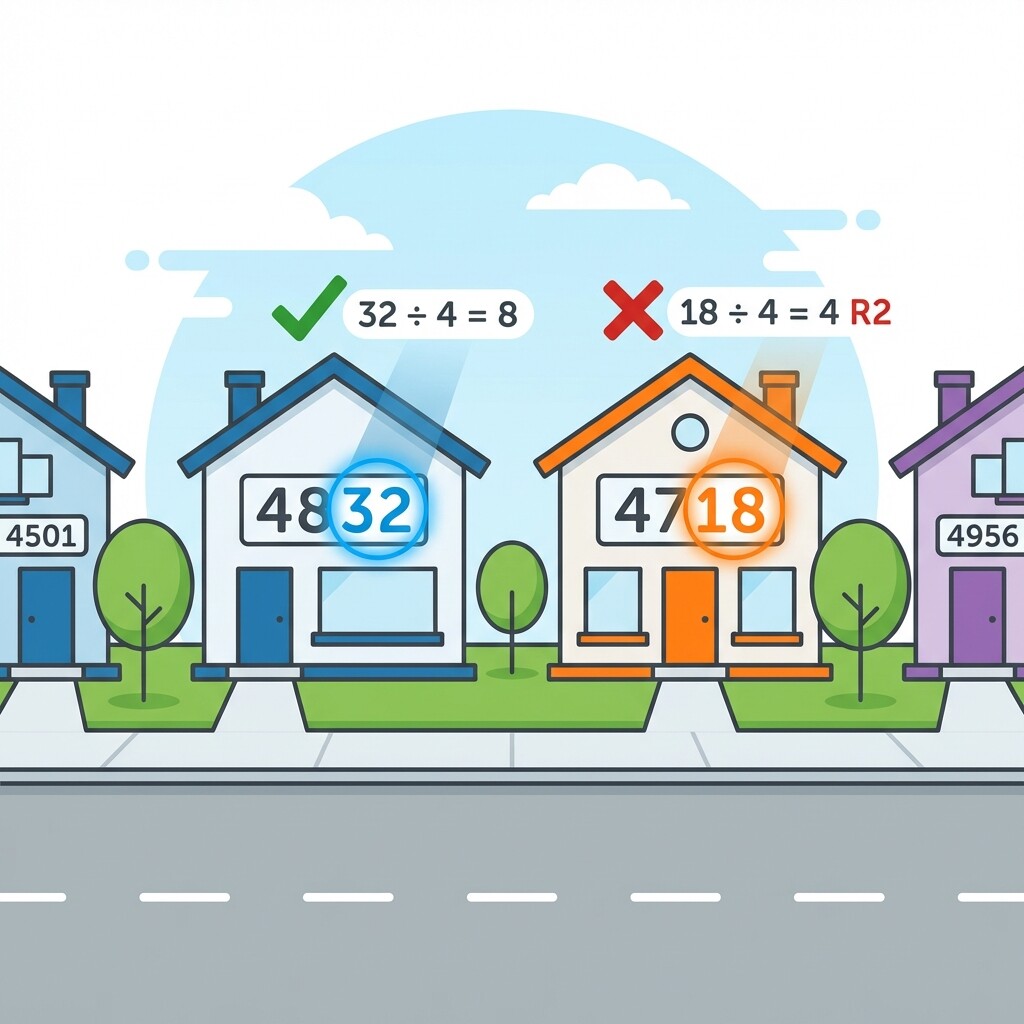
Suppose you are walking down a street and want to know whether house number 4,832 is divisible by . The rule makes this a two-step process.
Step 1 — Isolate the last two digits. The last two digits of are 32.
Step 2 — Test the two-digit number. with no remainder, so is a multiple of .
Conclusion: is divisible by . A quick verification confirms it: .
Now consider house number 4,718. The last two digits are . Since remainder , the number is not a multiple of , and neither is . Two digits, a few seconds of thought, and you have your answer.
Special Cases Worth Noting
A few edge cases are worth keeping in mind as you apply the rule:
- Numbers ending in 00. If the last two digits are , the number is divisible by because with no remainder. For example, and both pass the test.
- Numbers less than 100. When the number itself has only one or two digits, the "last two digits" are simply the number itself. For , check — it passes.
- Quick screening with the even test. Every multiple of is also even, since . So if a number fails the even test from Lesson 1 (its last digit is odd), you can immediately rule out divisibility by without examining two digits at all.
Quick-Reference Summary
Here is how the rule for fits alongside every shortcut you have learned so far:
| Divisor | What to Check | Why It Works |
|---|---|---|
| 2 | Last digit is even | is divisible by |
| 5 | Last digit is or | is divisible by |
| 10 | Last digit is | Exact match with base |
| 3 | Digit sum divisible by | Powers of leave remainder when divided by |
| 9 | Digit sum divisible by | Powers of leave remainder when divided by |
| 4 | Last two digits divisible by 4 | is divisible by |
Each rule exploits a different feature of the base-ten system. The rule for sits neatly between the single-digit checks and the full digit-sum checks, relying on exactly two digits.
Conclusion and Next Steps
In this lesson, you learned that divisibility by 4 depends entirely on the last two digits of a number. The reason traces back to one fact: is a multiple of , so everything from the hundreds place upward is automatically divisible by , leaving only the final two digits to decide. You also picked up two mental strategies — halving twice and comparing to nearby multiples — for quickly testing those two digits.
Now it is time to put the rule to work! In the upcoming practice tasks, you will sort house numbers by divisibility, identify which arena seats qualify for a promotional voucher, and explain in your own words why the last two digits hold all the power.
