Conducting Lean Audience Research
Conducting Lean Audience Research
Last unit ended with a lean research plan: a ranked list of make-or-break assumptions and the fastest way to test each. Now you run it. The good news is that the methods are ones you already touch every week as a marketer; the shift is using them to listen rather than to broadcast.
Matching the Method to the Insight You Need
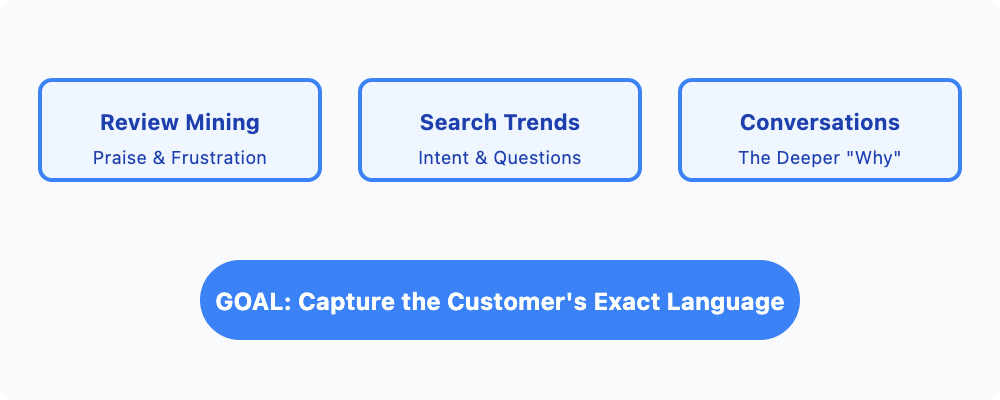 The five Lean Market Research Methods all gather audience evidence without a budget, but each is built for a different question. Social listening (scanning unprompted posts, mentions, and hashtags) is best for live sentiment and the spontaneous language people use when no one is surveying them. Review mining (app stores, Amazon, retailer pages) goes deeper, capturing specific praise and frustration from people at the moment of buying or using. Search trends tell you what your audience actively wants to know, exposing intent and the exact questions forming in their heads. Community forums like Reddit or niche Facebook groups give you candid, peer-to-peer talk, the unfiltered "which one should I buy" threads where no brand is listening. And a handful of informal conversations gets you the why that text alone can't, because you can follow up.
The move is to pick the method that fits the assumption you're testing. If you're checking whether buyers fear a product won't work with their setup, reviews and forums will say so in plain words. If you're gauging how many people are even searching for a solution, search trends answer faster.
Capturing the Words, Not Your Translation of Them
Once you're listening, the discipline that makes or breaks the research is verbatim fidelity: record what people actually said, not your tidied-up version. Build a simple notes structure with four columns: the source, the exact phrase, the underlying need or frustration, and the emotion behind it. The trap is paraphrasing customer language into internal jargon, turning "setup took forever and I almost returned it" into "onboarding friction." The summary feels professional, but you've thrown away the gold: the words your future copy and positioning will reuse.
- Dan: I logged this review as "compatibility concerns during evaluation."
- Jessica: What did they actually write?
- Dan: "I couldn't tell if it would work with my hub, so I almost didn't buy it."
- Jessica: Keep that line word for word. "Couldn't tell if it would work with my hub" is something we can answer in an ad. "Compatibility concerns" isn't.
Notice that Jessica isn't rejecting the insight; she's protecting the customer's exact language so it stays usable downstream. One related discipline: resist interpreting too early. At the capture stage your job is faithful collection, not conclusions. Note the emotion you observe, but don't yet decide what it all means.
Turning Raw Notes Into Patterns
Raw quotes only become useful when you cluster them. Read across your notes and group recurring verbatims into a handful of themes, the patterns that keep resurfacing: "compatibility anxiety," "setup friction," "skepticism about value at the price." For each theme, name the pattern, keep one or two representative quotes in the customer's own words, and state the need it reveals. That is what turns a wall of quotes into something the team can act on.
Aim for a short, skimmable set of themes rather than an exhaustive log, because a busy brand team will adopt three sharp patterns and ignore thirty scattered ones. And carry the customer's phrasing into the summary, since the whole point is to get everyone speaking in audience language instead of internal shorthand.
The throughline of this unit: gather evidence with the cheap methods you already have, capture it in the customer's exact words, then distill it into a few patterns the team can build on. You'll first sort each method to the insight it best surfaces, then mine a real batch of posts and reviews into a notes table, and finally turn that table into a themed summary your team could use tomorrow. As you work through them, hold one habit above the rest: write down what they said, not what you'd have said for them.
