Mapping Audience Assumptions
Welcome to the Course
You already know how to ship campaigns across channels. What changes now is ownership: brand strategy lands on your desk, and the easiest mistake is to start where it's most fun, with the creative. This course moves you in the opposite direction, from assumptions to evidence about who you actually serve, so that every design and message choice rests on something real.
By the end of this course, you'll be able to:
- Explain why effective branding starts with audience evidence rather than creative inspiration
- Surface and prioritize the audience assumptions your brand strategy quietly rests on
- Gather audience insight through lean, low-cost research methods you can run yourself
- Analyze the competitive landscape to find segments rivals leave underserved
- Synthesize findings into validated personas that directly guide brand decisions
This first unit starts at the foundation: the unexamined assumptions you're already carrying about your audience, and how to pull them into the open before they shape a single deliverable.
Why Branding Starts with the Audience, Not the Brief
Picture the moment a new campaign kicks off. The instinct is to open a blank brief and chase a concept that feels fresh. The problem is that a concept only works if it lands on the right person for the right reason, and "feels fresh" tells you nothing about who that person is. Creative inspiration answers "what should we make?" before anyone has answered "who is this for, and what do they actually care about?" When you skip that second question, you're betting the budget on a guess.
Starting with the audience flips the order. You decide what you believe about your buyers, treat those beliefs as claims to be checked, and only then let creative respond to evidence. This is the difference between a campaign that resonates and one that merely looks good in the review meeting.
- Dan: Creative's ready to brief - our buyers are tech-forward early adopters who want the newest features, right?
- Victoria: Where does the "want the newest features" part come from?
- Dan: It's just what we've always said about them.
- Victoria: So it's a belief we haven't actually checked. If we build the whole campaign on it and it's wrong, every ad inherits that mistake.
- Dan: Fair. Let's flag it as something to confirm before we spend a dollar.
Notice that Victoria didn't reject Dan's idea. She simply named it as a belief rather than a fact, which is the move that protects the budget.
Naming the Assumptions That Need Validating
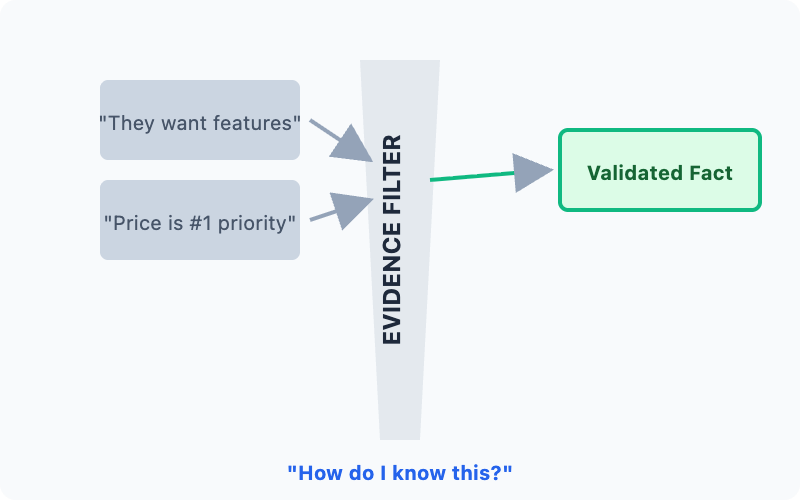
Most audience profiles are a tidy mix of two things: facts you can point to and assumptions you've absorbed over time. The work here is to separate them. A useful way to catch assumptions is to sort them into three buckets. The first is identity, your beliefs about who the buyer is, such as "they're young professionals" or "they're early adopters." The second is needs, what you assume they want from the category, like "they want the latest features" or "they care most about price." The third is motivations, the deeper "why they buy" behind the purchase, such as "they buy to feel ahead of the curve" or "they buy to avoid hassle."
The practical test is simple. For every claim in your current profile, ask: "How do I know this?" If the honest answer is "a few early conversations," "it's what we've always said," or "it feels right," you've found an assumption, not a fact. Write it down in plain language and resist the urge to defend it. Your goal at this stage isn't to be right; it's to make the hidden beliefs visible so none of them slips into the strategy unchecked.
Prioritizing Assumptions and Designing a Lean Test
You'll usually surface more assumptions than you can realistically test, so you triage. Score each one on three dimensions. Risk asks how badly the strategy breaks if the assumption is wrong. Uncertainty asks how confident you genuinely are, setting aside how confident you feel. Impact asks how many downstream decisions ride on it. The assumptions that are both highly uncertain and highly consequential are your make-or-break beliefs, and they go first.
From there you design a lean research plan, which simply means matching each priority assumption to the fastest, cheapest way to get a credible answer. You don't need a commissioned study; review mining, social listening, search trends, and a handful of informal conversations can confirm or kill most beliefs in days. For each test, state plainly what evidence would prove the assumption right and what would prove it wrong, so you can't quietly move the goalposts later.
The core takeaway: a brand strategy is only as sound as the audience beliefs underneath it, so name those beliefs, rank them by what's risky and uncertain, and test the make-or-break ones before any creative spend. Up next is a quick self-check to confirm you can spot the strongest reason branding must begin with audience evidence. Read each option as if a stakeholder said it to you, and ask which one would actually hold up if challenged.
