Analyzing Competitive Landscapes
Analyzing the Competitive Landscape
You've moved from assumptions to audience evidence: the needs, frustrations, and exact words buyers use. But that evidence only tells you who you serve. To decide where you can actually win, you need the other half of the map: who else is chasing the same people, and how. Competitive analysis here isn't cataloguing rivals feature by feature. It's reading the market as a set of segments so you can spot the ones nobody is serving well.
Reading Competitors as Servants of Specific Segments
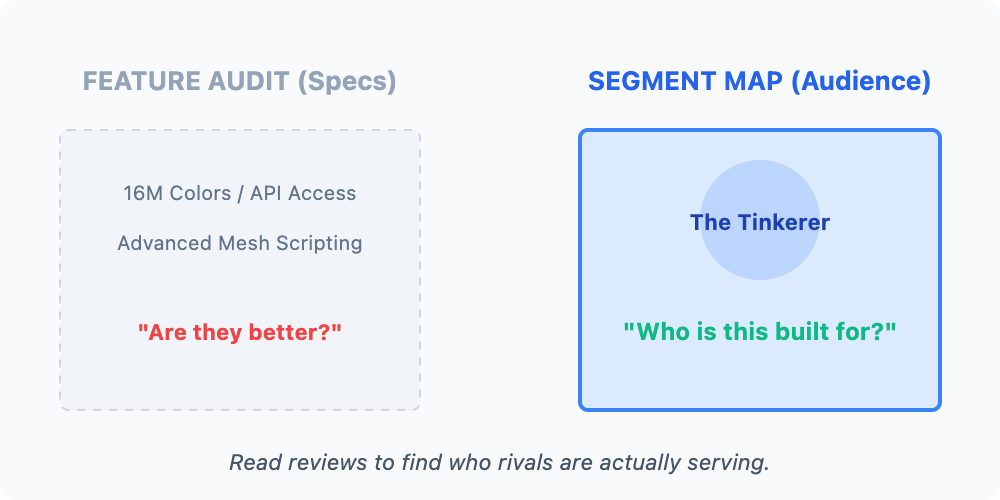
When you look at a competitor, resist the instinct to ask "are they better than us?" Ask instead, "who is this built for?" Every competitor is optimized for a segment, whether they say so or not, and your job is to name that segment from the evidence.
You already touch the four evidence sources weekly. Messaging tells you who their copy is speaking to. Pricing signals whether they're courting premium or budget buyers. Feature emphasis (what they spotlight on the homepage versus bury) reveals what their buyer cares about. And reviews show who actually showed up and what they loved or hated. Read these together and a portrait of "their" customer emerges.
- Dan: Their reviews are glowing. We can't out-feature them.
- Chris: Glowing with whom, though? Read who's writing them.
- Dan: Mostly hobbyists bragging about custom automations and scripting.
- Chris: Right, they own the tinkerers. That also tells you who they're not built for.
- Dan: The people who just want it to work out of the box.
Notice that reviews exposed the real segment faster than the marketing did. Messaging is aspirational; reviews show who genuinely bought and why.
Diagnosing Gaps and Underserved Segments
Once you've pinned each competitor to a segment, zoom out and lay them side by side. You're looking for two things: clustering, where several rivals pile onto the same buyer, and thin coverage, where a segment gets only generic or half-hearted attention. Crowded segments are expensive to enter because you're fighting established players for the same person. The thinly served ones are where opportunity tends to hide.
But beware the empty-space trap. Not every gap is a gift. Some segments sit empty because nobody actually wants what would go there. The discipline is to cross-check each apparent gap against your audience research: a gap is only real if you have evidence that frustrated buyers exist in that space. And ground every claim in something concrete, a specific pricing point, a recurring review complaint, a feature every rival ignores, rather than an impression like "competitors don't care about quality."
Turning Gaps Into Positioning Opportunities
A gap becomes a genuine positioning opportunity only at the intersection of three things: a segment competitors underserve, a need your audience research proves is real, and something you can credibly deliver. Drop any one and the opportunity collapses. An underserved segment with no demand is a dead end. A real need you can't deliver on is a promise you'll break. The opportunity worth pursuing is the one where you can plant a flag competitors can't easily follow you to, because their pricing, their product focus, or their core buyer holds them in place.
So the synthesis to carry: competitive analysis is reading the market as segments to find the spot where real demand and your credible strength overlap with what rivals have left open. This is where it gets concrete, and three practices stack up next. First a quick pattern-spotting check, reading short competitor snapshots and naming the segment each one serves or ignores. Then you'll write a competitive landscape assessment you could actually hand to strategy, tying every claim to evidence and ending on the clearest white space. Finally you'll defend that chosen gap live to a VP who already has a favorite in mind. Start practicing the core move now: every time you open a competitor's page, ask "who is this built for?" before anything else.
