Building Validated Personas
Building Validated Personas
You've got the raw material now: verbatim audience language, recurring themes, and a competitive map showing where rivals cluster and where they leave room. This unit turns that pile of evidence into something the brand team can actually design against: a validated persona. The discipline here is to synthesize without inventing, and then to pressure-test the result before anyone builds on it.
Synthesizing Research Into Segments Beyond Demographics
Your first move is to group your evidence into segments, and the trap to avoid is leading with demographics. Knowing a buyer is a "35-year-old urban homeowner" tells you almost nothing about whether they'll choose you. What actually separates one segment from another are three deeper drivers. Psychographics capture attitudes and values (the buyer who sees technology as a hassle to be minimized versus one who tinkers for fun), and behaviors capture how people actually research and buy (asking a friend versus reading ten reviews).
The third driver, motivation, captures the underlying why: wanting a calm home versus wanting to show off a setup. The test for whether a detail belongs in a segment is simple: does it change a decision? A buyer's age rarely changes your messaging. Their motivation almost always does. So as you cluster your research themes, organize them around these drivers, and pull each one straight from what you gathered: the compatibility anxiety in the reviews, the search behavior in the trends, the gap your competitive analysis exposed.
Applying the Customer Persona Framework
Once a segment is clear, you populate the Customer Persona Framework, which gives a persona five working parts: goals (what they're trying to achieve), pains (what frustrates or blocks them), decision criteria (what tips them toward a purchase), preferred channels (where they look and listen), and language patterns (the exact words they use). The rule that makes this framework powerful instead of decorative: every element traces back to a specific research finding or competitor insight. No orphan details.
- Dan: I put "values cutting-edge tech" as her main goal. Feels right for our buyer.
- Chris: Where's that from? Point me to the line in the research.
- Dan: Honestly, gut. It just fits the smart-home crowd.
- Chris: Then it's a guess wearing a persona's clothes. The reviews kept saying "I just wanted it to work" - that's the goal we can defend.
- Dan: So I trade the assumption for the verbatim.
Notice what Chris is enforcing: a persona element is only as strong as the evidence behind it. When you can't cite a source for a line, it's a hypothesis, not a finding, and it should be flagged as such rather than dressed up as fact.
Validating and Stress-Testing the Persona
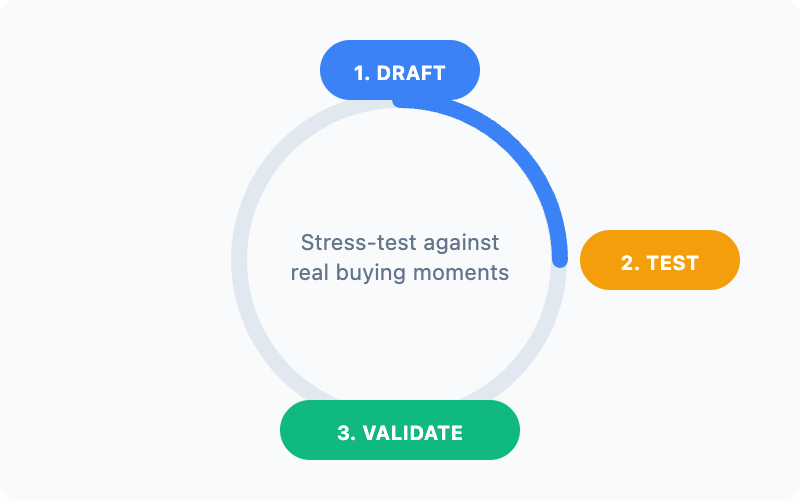
A persona built purely at your desk is still a draft, which is why the Persona Validation Flow adds two steps after you populate the template: validate assumptions through targeted conversations, then stress-test against realistic scenarios before writing the concise summary. Validation means sitting with someone who represents the segment and probing each element against their real experience, without leading them toward the answer you hoped for. If you ask "you research heavily on social, right?" you'll get a polite yes and learn nothing. Ask "walk me through the last time you bought something like this," and the truth surfaces on its own.
Stress-testing goes further by running the persona through a concrete buying moment ("it's Sunday night and you're shopping for smart lights, what happens?") to see whether the goals, channels, and decision criteria hold up under real conditions. Expect at least one element to break. That's the point: catching a wrong assumption now is cheaper than discovering it after a campaign ships.
The takeaway for this unit, and for the whole arc of moving from assumptions to evidence: a persona earns its place only when every element is traced to research and survives contact with a real buyer. Next you'll sort observations into the right segment drivers, build a one-page persona you could hand straight to the brand team, and then run a live validation conversation where the real skill gets tested: asking open enough to let a customer correct you.
