Organized Outcome Lists
Introduction
Welcome back! In the first lesson of Compound Event Probability, we discovered that compound events combine two or more stages, and that the total number of outcome pairs grows quickly through multiplication. We also saw why a casual, off-the-top-of-your-head approach can lead to missed or repeated pairs. Now, in this second lesson, we move from understanding the problem to solving it. You will learn a reliable, step-by-step technique for building an organized list that captures every outcome of a two-stage compound event — and then use that list to calculate probabilities with confidence.
Why a Systematic Strategy Matters
You already know that listing combinations from memory invites two dangers: duplication (writing the same pair twice) and omission (accidentally skipping a pair). Even a modest situation — say options in one stage and in another — produces pairs, enough for mistakes to sneak in unnoticed.
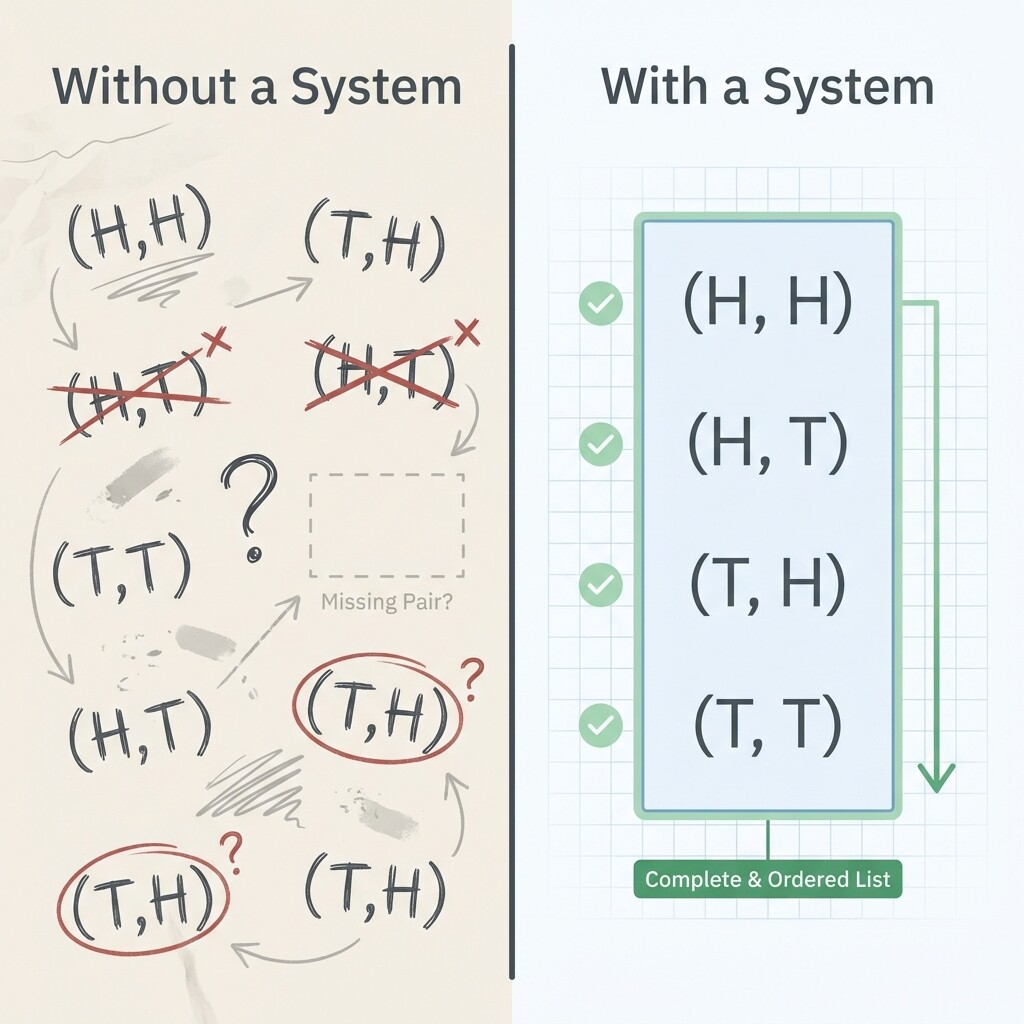
The fix is a simple pattern we will call fix-and-cycle: hold one stage constant, run through every option in the other stage, then advance. This single idea turns a messy brainstorm into a clean, complete list every time. Let's see exactly how it works.
Building an Organized List Step by Step
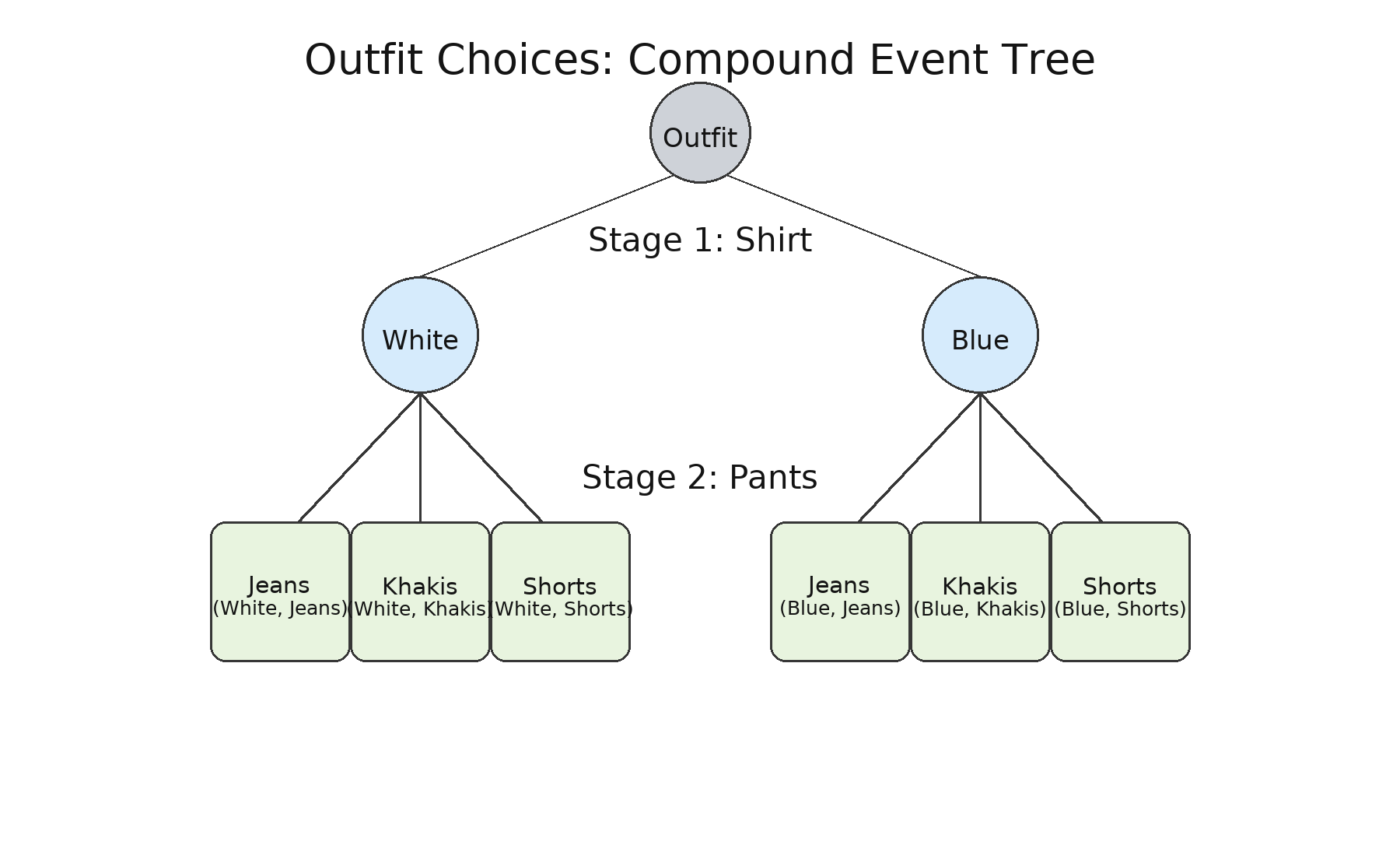
Suppose you are choosing an outfit by picking one shirt from White, Blue and one pair of pants from Jeans, Khakis, Shorts. Here is the fix-and-cycle process:
- Label your stages. Stage 1 is Shirt; Stage 2 is Pants.
- Start with the first Stage 1 option — White — and pair it with every Stage 2 option: (White, Jeans), (White, Khakis), (White, Shorts).
- Move to the next Stage 1 option — Blue — and again pair it with every Stage 2 option: (Blue, Jeans), (Blue, Khakis), (Blue, Shorts).
- Repeat until every Stage 1 option has been used.
The complete organized list looks like this:
| # | Shirt | Pants |
|---|---|---|
| 1 | White | Jeans |
| 2 | White | Khakis |
| 3 | White | Shorts |
| 4 | Blue | Jeans |
| 5 | Blue | Khakis |
| 6 | Blue | Shorts |
Notice the rhythm: the Stage 1 column stays the same while Stage 2 cycles through all its options, then Stage 1 advances. We end up with pairs — exactly the count the multiplication rule predicts. If your list length ever disagrees with that product, you know right away that something was missed or repeated.
A Larger Example: Spinner and Die
Let's apply the same technique to a bigger situation. Imagine you spin a spinner that lands on Red, Green, or Yellow, and then roll a four-sided die showing 1, 2, 3, or 4. Stage 1 (Spinner) has options and Stage 2 (Die) has , so we expect outcome pairs.
We fix the spinner result and cycle through the die:
| Spinner | Die | Outcome Pair |
|---|---|---|
| Red | 1 | (Red, 1) |
| Red | 2 | (Red, 2) |
| Red | 3 | (Red, 3) |
| Red | 4 | (Red, 4) |
| Green | 1 | (Green, 1) |
| Green | 2 | (Green, 2) |
| Green | 3 | (Green, 3) |
| Green | 4 | (Green, 4) |
| Yellow | 1 | (Yellow, 1) |
| Yellow | 2 | (Yellow, 2) |
| Yellow | 3 | (Yellow, 3) |
| Yellow | 4 | (Yellow, 4) |
Exactly pairs — no repeats, nothing missing. The fix-and-cycle pattern scales smoothly: whether Stage 2 has options or , the method stays the same.
From an Organized List to Probability
An organized list does more than just count outcomes — it sets us up to calculate probability. Once the full list is in front of you, the formula is the same one you have used since the very first course:
Let's put this to work with the spinner-and-die list above. Suppose we want the probability that the spinner shows Green and the die shows an even number. We scan the list for pairs that satisfy both conditions:
- (Green, 2) ✓
- (Green, 4) ✓
That gives us favorable outcomes out of total:
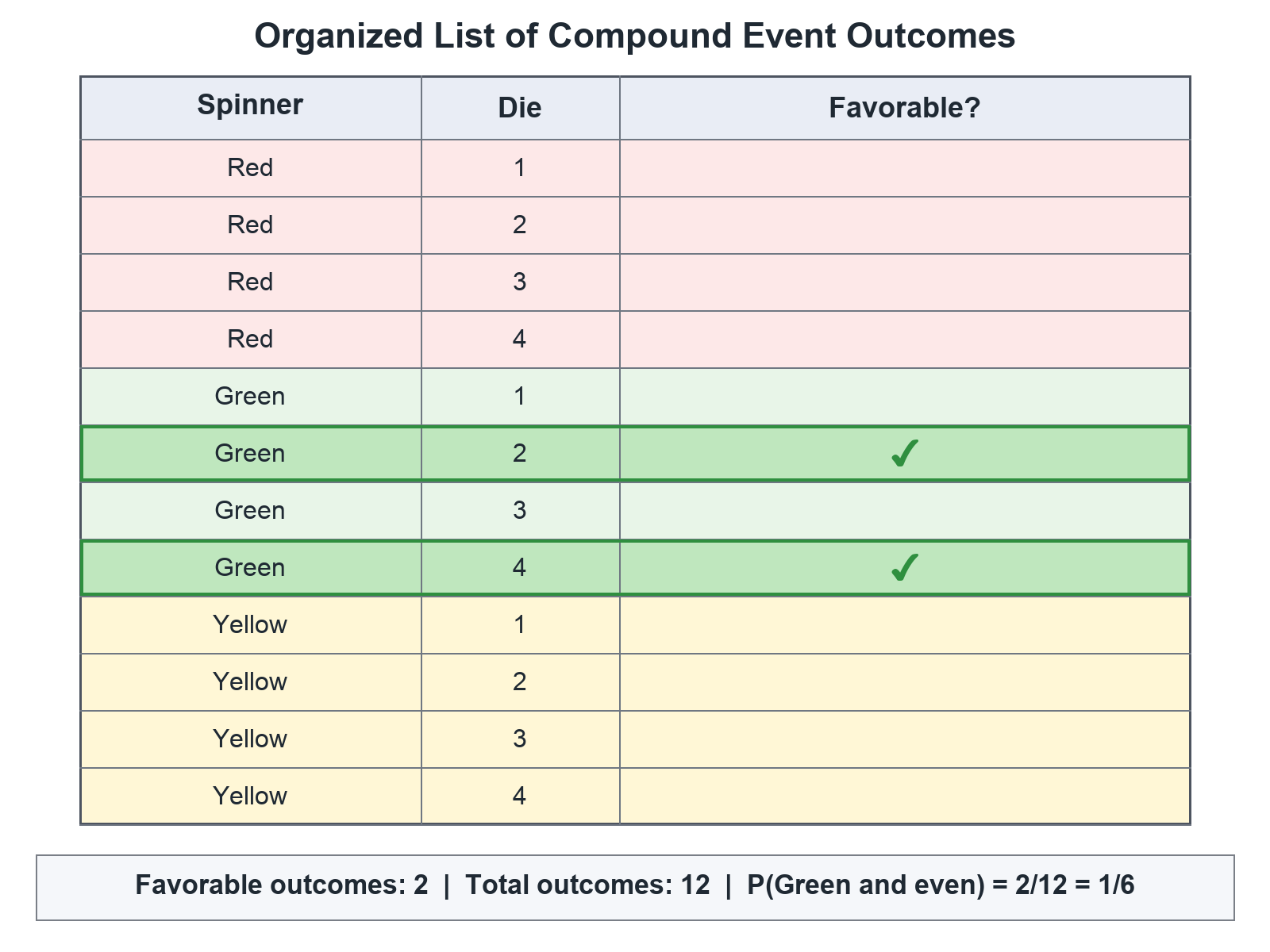
The process is always the same: build the complete list, identify the favorable pairs, and divide. Because the organized list guarantees nothing is missing or repeated, you can trust that the fraction is correct.
Your Go-To Checklist
Here is a quick checklist you can follow whenever you face a two-stage compound event:
- Identify the two stages and list the options for each.
- Multiply the option counts to know how many total pairs to expect.
- Fix the first Stage 1 option and pair it with every Stage 2 option.
- Advance to the next Stage 1 option and repeat until all are used.
- Verify that your list length matches the expected total from Step 2.
- Scan the list for favorable outcomes and compute the probability.
Step 5 is a small but powerful habit. If you expected pairs but only wrote , you know immediately that a pair was missed — no guessing required.
Conclusion and Next Steps
In this lesson, you learned the fix-and-cycle technique for building an organized list of every outcome pair in a two-stage compound event. By holding one stage constant and running through the other, you guarantee that no pair is duplicated or left out. With the complete list in hand, calculating a probability is straightforward: count the favorable pairs, divide by the total, and simplify.
Up next, you will practice this technique hands-on — filling in partial lists, building complete lists from scratch, identifying favorable outcomes, and computing probabilities on your own. Jump into the exercises and see how quickly this method becomes second nature!
