Design a Product Pricing Strategy
Designing a Product Pricing Strategy
In the last unit you learned to diagnose which P a customer insight most affects. Now you'll go deeper on two of those levers: shaping the Product itself and setting its Price. These are the decisions that make or break a launch, and both reward the same discipline you've been practicing: start from what the customer actually needs, not from what's easiest to talk about.
Build the Product from the Core Benefit Outward
Think of any product as three layers. At the center sits the core benefit: the fundamental need the customer hires the product to solve. Around it sit the features: the concrete attributes that deliver that benefit. Wrapping both is the positioning: the distinct space the product claims in the customer's mind.
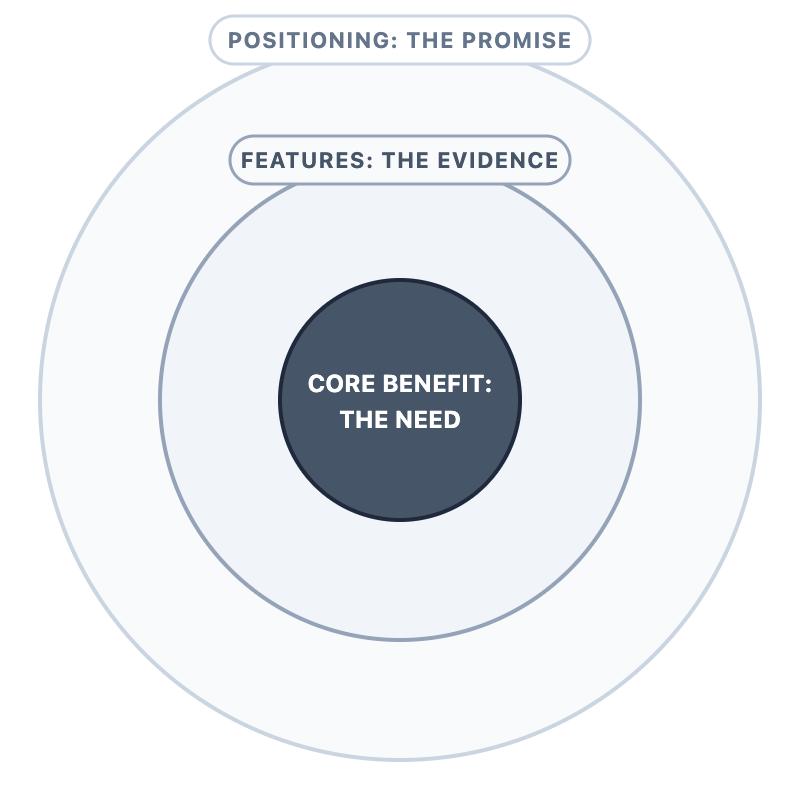
The order matters. When you brief a campaign, you want to name the core benefit first ("the confidence of never running out of power mid-day"), then treat features as the evidence ("12-hour battery, fast-charge case"), and finally frame positioning as the promise you're making versus everyone else. Lead with features and you end up selling a spec sheet. Lead with the benefit and the features become proof points that earn belief. So before you write a word of copy, ask the one question that anchors everything: what job is the customer really hiring this product to do?
Differentiate by Linking Features to Needs
Here's where most differentiation goes wrong: teams list features the competitor doesn't have and call it a difference. But a feature only differentiates if it meets a need the customer cares about better than the alternative.
The move is to take each feature and force it through a single test: which customer need does this serve, and does it serve that need better than the competitor? If you can't name the need, the feature doesn't belong in your messaging, no matter how proud engineering is of it.
- Jake: The new model gets 12-hour battery life, two more hours than anyone else.
- Nova: Which customer problem does that extra two hours actually solve?
- Jake: I guess people who forget to charge overnight before a long commute.
- Nova: Then that's the story: never get caught with dead buds on a full day out. The hours are just the proof.
- Jake: So we lead with the worry we remove, not the spec.
Notice how Nova never argues the feature is bad. She just refuses to let it stand alone until it's tied to a need a real buyer feels. That's the whole technique: feature, then need, then "better than the competitor at that need." Anything that can't complete the chain stays off the marketing roadmap.
Set a Price You Can Defend
