Place and Promotion Strategy
Choosing Place and Promotion Strategy
You've designed the product around its core benefit and set a defensible price. Now the final two Ps decide whether any of that work ever reaches a real buyer: Place gets the product in front of customers, and Promotion convinces them to choose it. Both reward the same instinct you've been building all unit, which is to start from where the customer already is, not from what's convenient for you.
Select Distribution Channels to Reach Your Customers
Your first move is to decide how the product travels from you to the buyer, and you have three broad routes. Direct distribution sells straight to the customer through channels you own, like your e-commerce site, app, or stores, so you keep the margin, the customer data, and full control, but you carry the whole job of driving traffic yourself. Indirect distribution routes through intermediaries like retailers and marketplaces; you trade margin and control for the instant reach and trust those partners already hold.
Cutting across both are digital channels: your own webstore is direct, while a marketplace listing or a social-commerce shop is indirect with a digital face. The choice isn't about which route is best in the abstract, it's about where your target customer already shops. The coach move is to follow the customer: if buyers research and purchase premium gear on marketplaces, dragging them to a standalone site burns budget you can't spare.
Distinguish the Four Promotional-Mix Tools
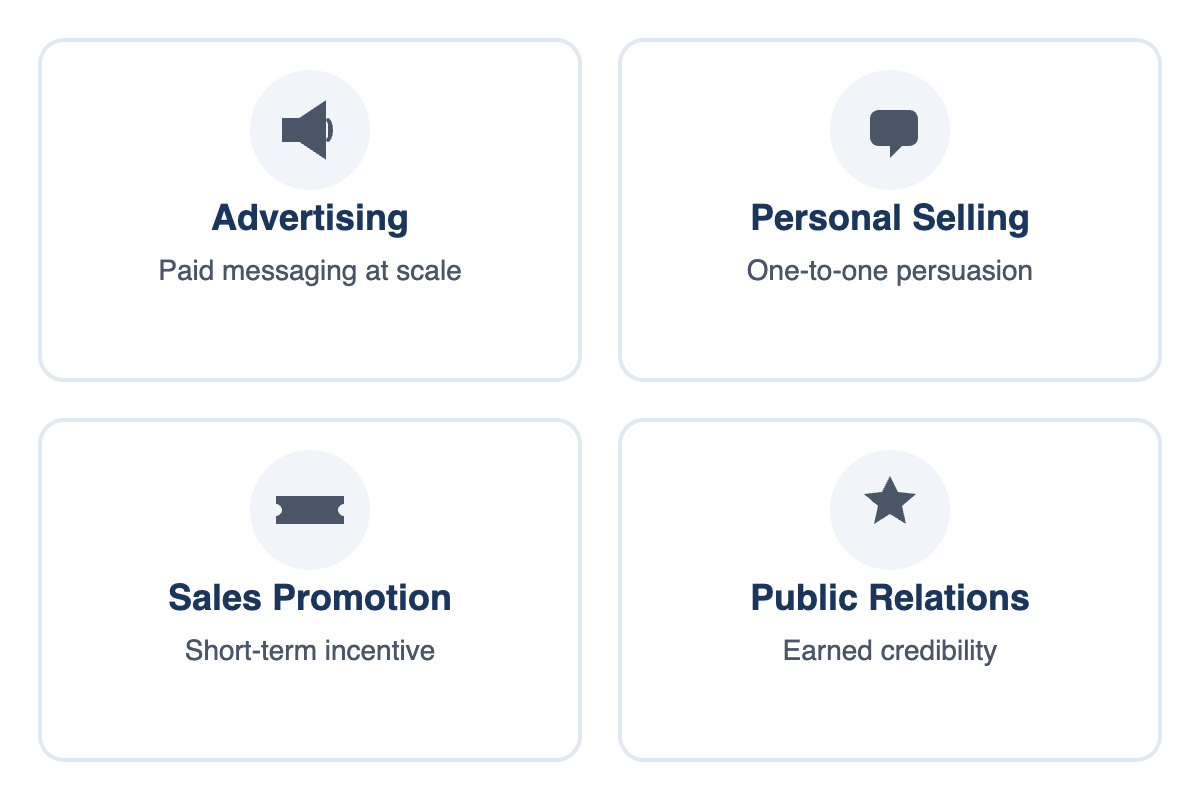
Once the product can be bought, Promotion tells people it exists and why it's worth choosing. The trap is to call all of it "advertising." The Promotional Mix actually holds four distinct tools, each doing a different job on a different timeline.
Advertising is paid, non-personal messaging at scale, like paid social, search ads, and display. Personal selling is one-to-one human persuasion, like a retail demo or a B2B outreach call.
Sales promotion is a short-term incentive to act now, like a launch-week discount or a limited bundle. Public relations earns credibility through third parties you don't pay directly, like a press review, organic influencer coverage, or an event.
- Chris: I put the whole launch budget into advertising, paid social plus the launch-week discount.
- Nova: Those are two different tools, though. The paid social is advertising; the discount is sales promotion.
- Chris: Does the label matter if both push sales?
- Nova: It does, because they do different jobs. Advertising builds awareness over weeks; the discount triggers action in the moment. Blur them and you'll over-fund one and starve the other.
Notice Nova isn't being pedantic about vocabulary. The labels matter because each tool works on a different purpose and timeline.
Coordinate the Tools within Budget and Customer Preferences
You'll never have the budget to run all four tools at full volume, so the real skill is coordination: making them reinforce one another instead of competing for the same dollar. Two principles guide the mix. First, allocate by customer preference, spending where your buyers actually pay attention. If they discover products through tech reviews and social feeds, weight public relations and advertising; if they need a hands-on demo before a big purchase, reserve room for personal selling.
Second, sequence the tools by their job. Public relations and advertising build credibility and awareness in the run-up, sales promotion converts that attention at the launch peak, and personal selling closes the high-value or hesitant buyers. Used in order, each tool sets up the next; used at random, they cannibalize the same budget.
The throughline of this unit is simple: choose Place and Promotion by following the customer, then coordinate your tools so each does the one job it does best. You'll test that judgment across three steps next: a quick quiz to pressure-check your channel choices, a coaching conversation where you help a junior colleague tell the four promotional tools apart, and a coordinated promotional plan you could hand straight to a launch team. So the next time someone says "let's just throw more into ads," pause and ask which job that tool is actually doing, and whether a different tool would do it better.
