Integrate the Mix and Position the Brand
Integrate the Mix and Position the Brand
Across the last three lessons you've stacked up a set of decisions: a core benefit, a defensible price, the channels that carry the product, and a coordinated promotional mix. The risk now is that those choices each feel right on their own but pull in slightly different directions. This unit is about the unifying move that makes them add up to one clear idea in the customer's head.
Claim a Unique Space with a Positioning Statement
Start with the anchor. Before you can check whether your mix holds together, you need a single sentence that says what space you own and for whom. The tool for that is the Positioning Statement, and it follows a standard formula: "For [target customer], [brand] is the [frame of reference] that [point of difference], because [reason to believe]."
Each slot does real work. The target customer keeps you from writing for everyone. The frame of reference names the category the customer is already shopping, so they know what you're an alternative to. The point of difference is the one thing you do better that competitors can't easily claim. And the reason to believe is the proof that makes the difference credible rather than a slogan.
A worked example: "For time-strapped professionals who still want to eat well, Verdure is the meal-kit service that puts a balanced dinner on the table in 15 minutes, because every recipe is chef-designed and pre-portioned." Notice it isn't "the best meal kit." Vague superlatives claim no space. A defensible position names a specific buyer, a specific difference, and a specific reason it's true.
Spot Integration Gaps Across the Four Ps
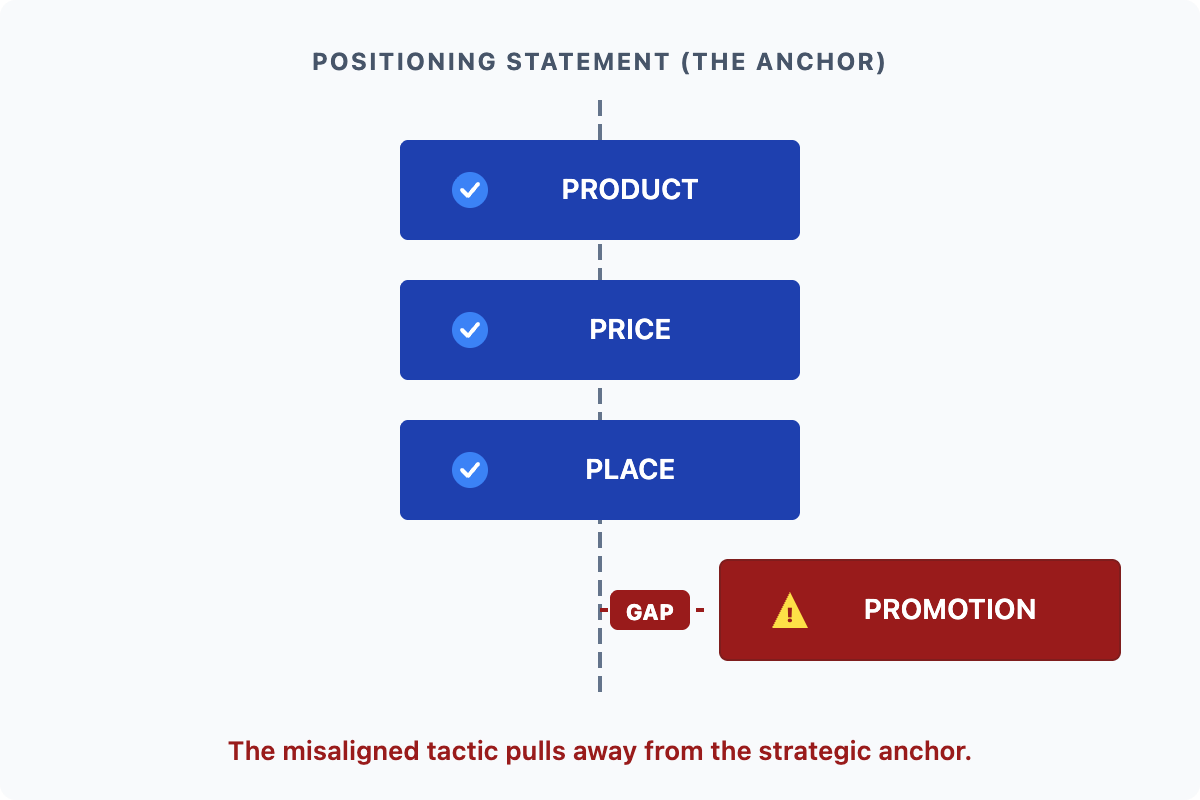
Once the statement exists, it becomes a yardstick. An integration gap is any place where one of your four Ps sends a signal that contradicts the position you just claimed. Your job is to audit each P against the statement and ask one question: does this reinforce the promise, or quietly undercut it?
This is where the symptoms show up. If your position is premium but the product lives on a bargain marketplace next to no-name competitors, Place is fighting the claim. If you promise "effortless" but checkout demands a twelve-field form, the experience contradicts the word. If your point of difference is craftsmanship but every email leads with a coupon code, Promotion is teaching buyers to wait for a discount instead of valuing the quality. None of these are bad tactics in isolation. They're gaps only because they disagree with the position.
Integrate the Mix Behind One Position
Closing the gaps is the payoff. Integration means every P actively repeats the same story, so the customer hears one consistent message at every touchpoint and a competitor can't easily copy the whole package. Premium positioning wants a premium price, a controlled channel, and promotion that builds credibility rather than slashing it.
- Chris: Marketing wants a 30% launch-week discount to hit the first-month number.
- Nova: But our position is "premium audio worth the wait." A fire-sale discount tells buyers the opposite.
- Chris: So we just give up the sales?
- Nova: No, we swap the tool. Lead with a press-review push and a bundle, not a price cut, so the promotion still signals premium.
- Chris: Right, the discount was fighting the position instead of feeding it.
Notice the fix wasn't to abandon the revenue goal. It was to choose a move that reinforces the position rather than contradicts it. That's the discipline of integration: when a tactic and the position disagree, you change the tactic, not the position.
The single idea to carry out of this unit is that positioning isn't a tagline you write once; it's a standard the entire mix has to live up to, and consistency across the 4Ps is itself the competitive advantage. Next you'll pressure-test that idea in three steps: a quick self-check to spot where a campaign's Ps fail to reinforce one another, then drafting a positioning statement and brief you could actually hand to your team, and finally a live conversation where you defend whether the whole mix really delivers the space you've claimed.
