Translating Insights into Strategy
Welcome to the Course
As a Digital Marketing Manager, you're rarely short on insight. Search queries, survey responses, churn data, competitor moves: it all lands on your desk. The hard part is turning that raw material into decisions about what you sell, how you price it, where you sell it, and how you promote it. This course builds that bridge, taking you from customer understanding to a coordinated strategy.
By the end of this course, you'll be able to:
- Diagnose which marketing-mix element a specific customer insight most affects
- Develop a product's benefits, features, and positioning, and set a defensible price across cost-, competitor-, and value-based approaches
- Select distribution channels and coordinate promotional tools within a fixed budget
- Design a positioning statement that claims a unique space in the customer's mind
- Integrate the 4Ps into a strategy that reinforces consistent positioning and competitive advantage
This first unit starts at the source: how customer insight and competitive pressure translate into mix decisions, and how to pinpoint the single lever that matters most.
How Insights and Competition Drive the Mix
When a research finding lands, the instinct is to jump straight to a tactic. Resist it. Every decision across the 4Ps (Product, Price, Place, Promotion) should trace back to two inputs: what customers actually need, and what competitors are already doing.
Customer insight tells you the unmet need or the friction point. Competitive dynamics tell you where you can genuinely win versus where you'd just be matching parity. Read together, they point you to which P to move. Say research shows shoppers trust your quality but feel your checkout is slow and competitors offer next-day delivery. That's not a reason to buy more ads. The insight plus the competitive gap point squarely at Place. The discipline here is letting evidence choose the lever, rather than reaching for the channel you're most comfortable spending in.
Diagnose the Most-Affected Mix Element
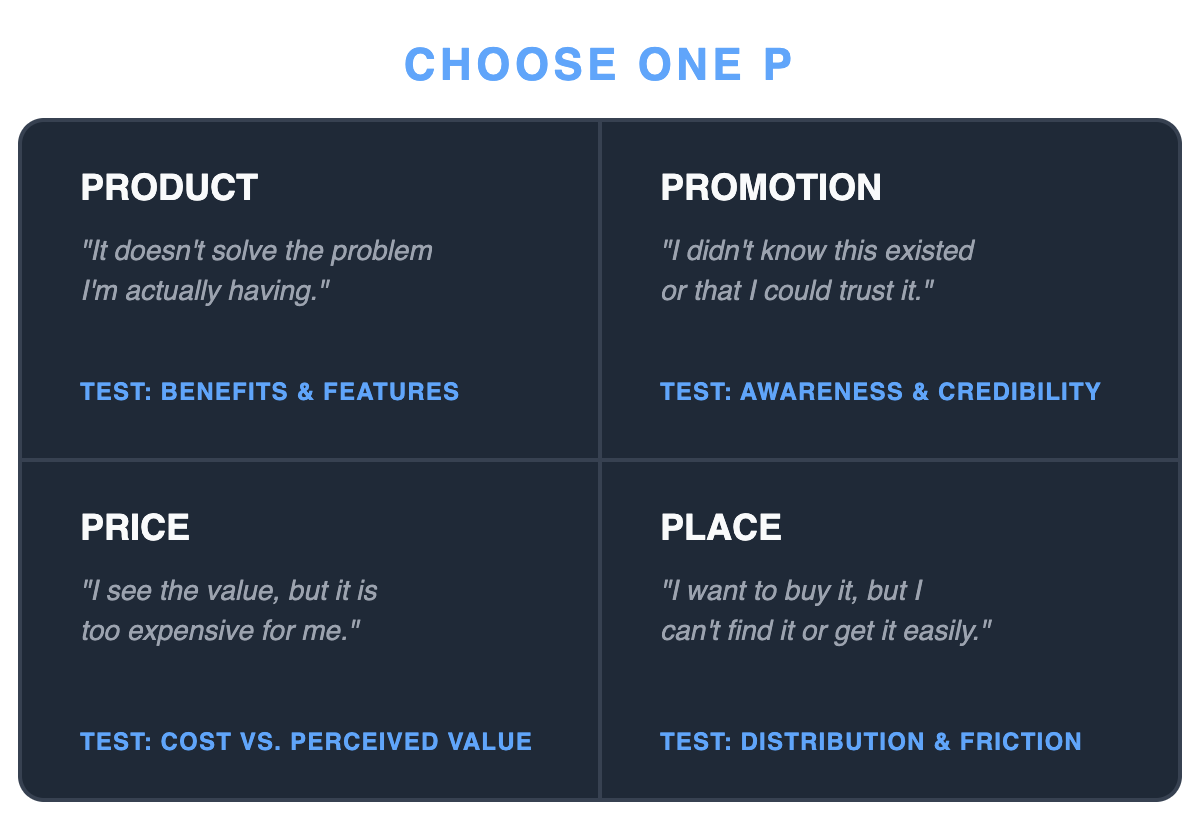
Here's the move that separates a strategist from a tactician: a symptom is not a diagnosis. Customers report what they feel, not which mix element caused it. Your job is to trace the symptom back to the P that owns it.
The test is simple. Ask which single P, if you changed it, would make the complaint disappear. Then rule out the others. A complaint like "I can never find it in stock" feels like it could be anything, but if people are already aware and already want it, awareness (Promotion) isn't the gap. Availability (Place) is.
- Nova: Survey's back. People love the product but keep saying it's "never available when I want it."
- Milo: Sounds like we need more ads pushing where to buy.
- Nova: Maybe, but ask which P actually owns that. If awareness were the gap, they wouldn't say "never available," they'd say "never heard of it."
- Milo: So it's distribution. Place, not Promotion.
- Nova: Right. If we fixed stock and they could find it instantly, the complaint vanishes. That's the test.
Notice Nova's test: identify the one P that, once fixed, makes the symptom disappear. Everything else is surface noise.
Recommend an Adjustment That Aligns Value and Business Goals
Once you've isolated the element, recommend one decisive change, not a menu of options. A strong recommendation does three things: it names the specific adjustment, ties it to the customer value it unlocks, and connects that value to a business goal like revenue or margin. "Add regional fulfillment so premium buyers get reliable two-day availability, protecting repeat-purchase revenue" beats "we should improve distribution."
Then name the trade-off honestly. Faster fulfillment might cost margin; a price increase might lift perceived value but slow acquisition. Stakeholders trust a recommendation more when you state its cost as plainly as its benefit, because it proves you've weighed the decision rather than sold them on the upside.
The throughline of this unit: customer insight plus competitive context tells you which mix lever to pull, and a good recommendation moves that single lever in a way that serves the customer and the business at once. Next, you'll start with a quick quiz to sharpen your judgment on which decisions credibly drive growth, then put the diagnosis skill to work in a live conversation, and finally draft a recommendation memo you could actually send. Start practicing the test from this unit now: whenever a symptom surfaces, ask which one P, if fixed, makes it disappear.
