Predicting Expected Frequencies
Introduction
So far in Building Probability Models, you have learned to define valid probability models, construct both uniform and non-uniform versions, and compute event probabilities. That is a powerful toolkit, and you are now on lesson four of five, which means only one lesson remains after this one.
But here is a question those earlier skills leave unanswered: if you know the probability of an event, how many times should you actually expect it to happen? In this lesson, we bridge the gap between a probability on paper and a concrete prediction you can act on. By the end, you will be able to take any probability model and forecast the expected number of times each outcome will occur over a given number of trials. This is where probability becomes genuinely practical — it lets us set expectations, plan resources, and make informed decisions.
From Probability to Prediction
Knowing that an event has a probability of is useful, but a business owner or project planner usually needs a more concrete answer. They want to know how many times something is likely to happen. For example, if a coffee shop expects customers tomorrow and the probability of someone ordering a latte is , the shop would like to know roughly how many lattes to prepare for.
This is where expected frequency comes in. It translates a probability into a count by connecting the model to a specific number of upcoming trials. The logic is straightforward: if an event should happen of the time, then over trials we would expect it to happen about of times.
The Prediction Formula
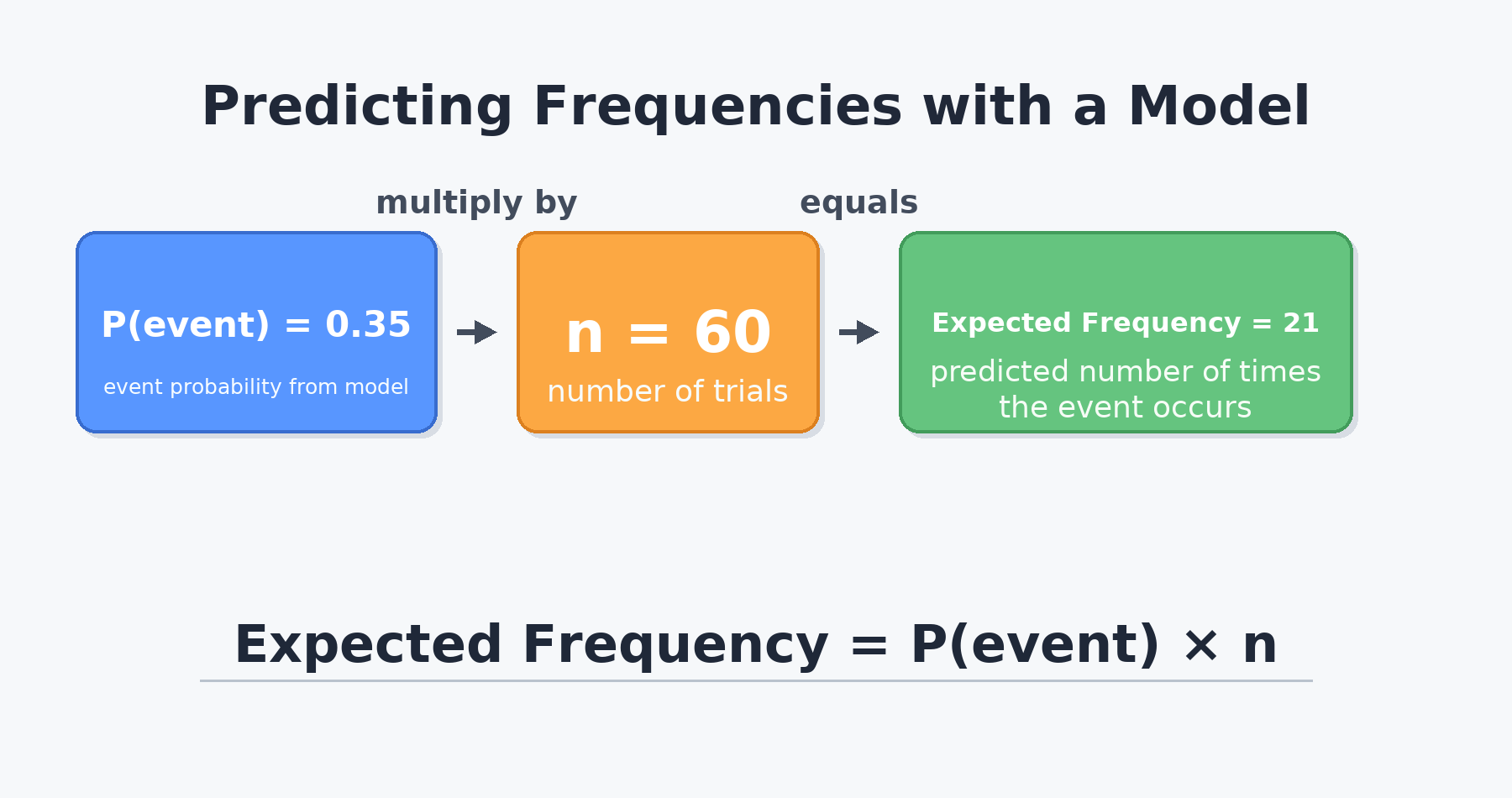
To predict how often an event will occur, multiply the event's model-assigned probability by the total number of trials:
Here, is the probability from our model, and is the number of trials we plan to observe or carry out. The result tells us how many times we expect the event to occur.
Let us try a quick example. Suppose a probability model for a spinner gives . If we spin times, the expected frequency of green is:
We would expect to land on green about 21 times out of spins. That single multiplication is the entire method.
Predicting Late Deliveries: A Full Walkthrough
Let us walk through a fuller scenario. A delivery service built the following non-uniform probability model from its records:
| Outcome | Probability |
|---|---|
| On Time | |
| Late | |
| Missed |
As you practiced in previous lessons, we can quickly confirm this is a valid model: every value is between and , and . Now suppose the company expects deliveries next month. How many do we expect to be late?
We apply the prediction formula:
Out of deliveries, the model predicts about 60 late deliveries. This kind of prediction helps the company plan staffing, set customer expectations, or decide whether to invest in improving its on-time rate.
Predicting Frequencies for Every Outcome
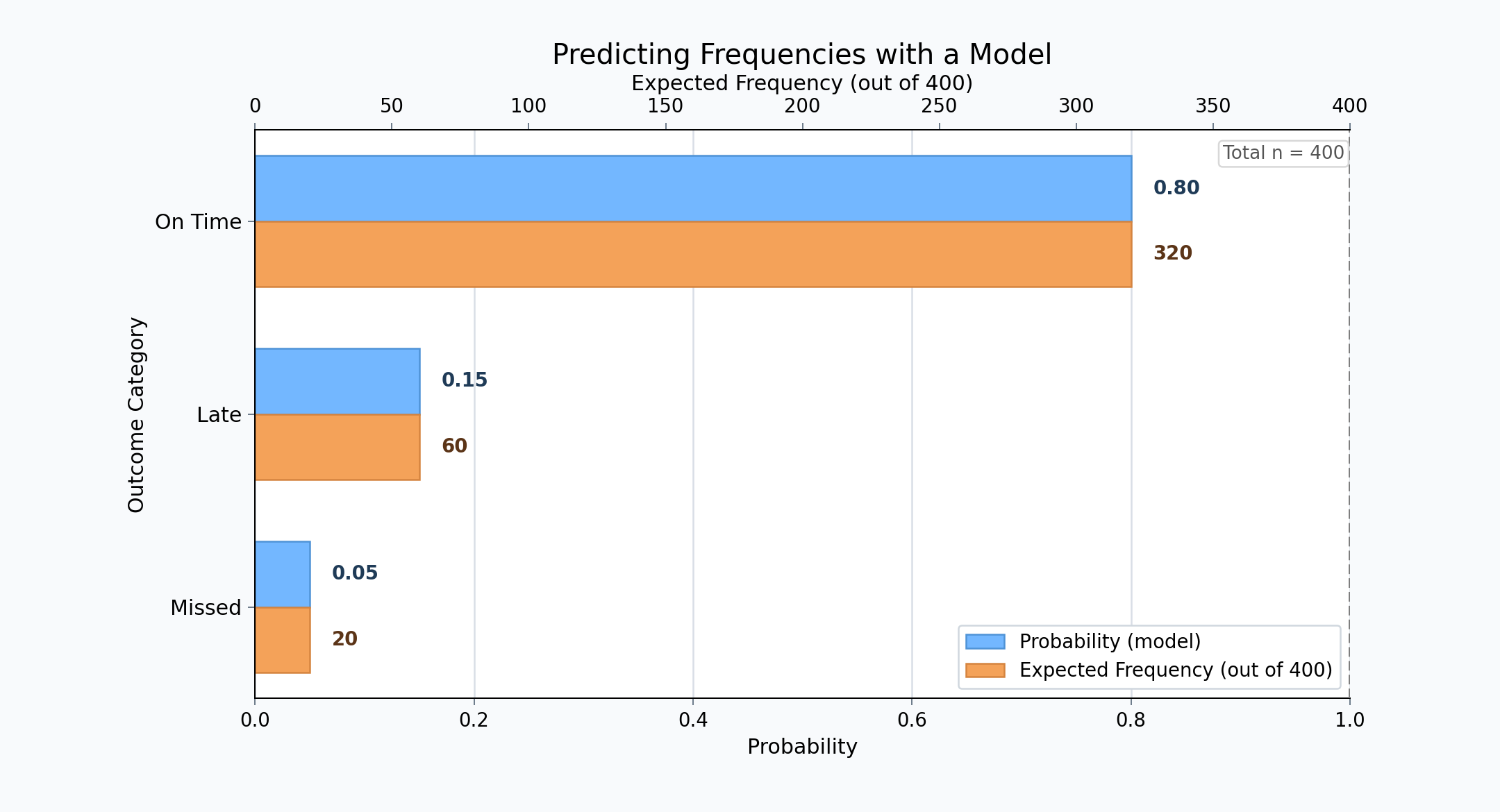
One powerful feature of this method is that we can predict the expected frequency for each outcome in the model, not just one. Let us return to the delivery example with and compute all three:
| Outcome | Probability | Expected Frequency |
|---|---|---|
| On Time | ||
| Late | ||
| Missed |
Notice that the expected frequencies add up to , which equals . This will always happen when the model is valid, up to rounding, because the probabilities sum to . It serves as a handy self-check: if your predicted counts do not add up to the total number of trials, something went wrong in the calculation.
Why Predictions Are Expectations, Not Guarantees
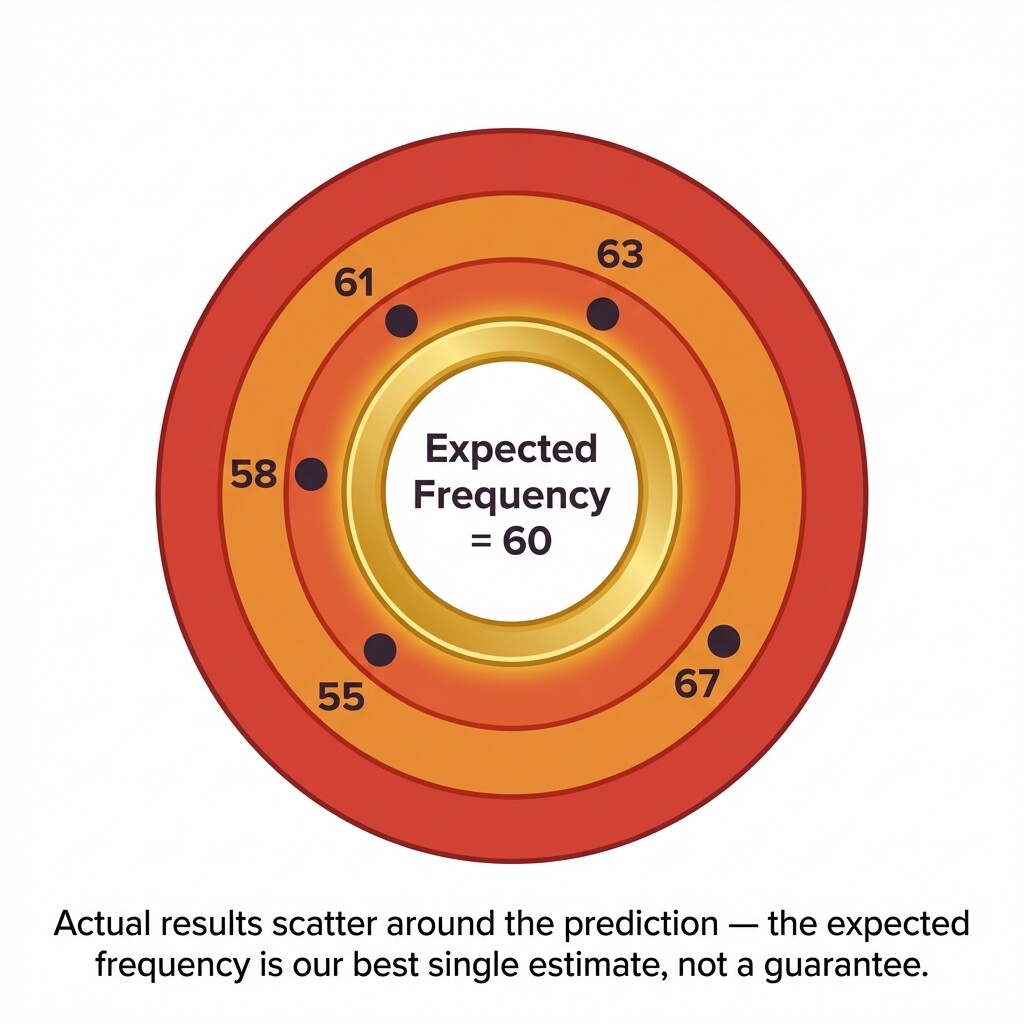
It is important to understand what "expected frequency" really means. It is the number we would anticipate based on the model, but it is not a promise. If the delivery company runs deliveries, they might actually see or late ones instead of exactly , because random variation is always at play.
Think of expected frequency as the center of a target. Actual results will scatter around that center, sometimes a little above, sometimes a little below. Over a larger number of trials, the actual frequency tends to land closer to the prediction — an idea that connects back to the stabilization concept from earlier in this learning path. The model gives us the best single estimate, and that is extremely valuable for planning, even if reality never hits the number exactly on the nose.
Conclusion and Next Steps
In this lesson, you learned how to turn a probability model into a practical prediction tool. By multiplying an event's probability by the number of trials — — you get the expected frequency, a concrete estimate of how many times the event should occur. You can predict a single outcome's frequency or map out every outcome at once, and you can verify your work by confirming the predicted counts sum to . The key takeaway is that these predictions are our best estimates, not exact guarantees.
Up next, you will put the prediction formula to work across several hands-on exercises. You will fill in the building blocks of the calculation, predict outcomes in real-world scenarios, and interpret full sets of predictions while explaining why actual results may differ slightly from what the model forecasts.
