A Vocabulary for Your Emotions
Broaden and Refine Your Emotional Vocabulary 🗣️
Building emotional intelligence starts with the words you use to describe your inner world. Most people default to broad labels like "angry" or "stressed", but these often miss the real story. This lesson draws from Susan David's expertise from the HBR Guide to Emotional Intelligence, where you’ll discover how expanding your emotional vocabulary unlocks greater self-awareness, better decision-making, and stronger leadership. By learning to name your emotions more precisely, you’ll be able to respond thoughtfully rather than react impulsively—an essential skill for any leader.
Emotional agility is about being able to move flexibly through your emotions rather than getting stuck or swept away by them. The first step is to get specific. Instead of stopping at "I'm angry", try to dig deeper:
- Are you actually "frustrated"?
- Could it be "disappointed"?
- Or maybe "anxious"?
Each word points to a different underlying need and suggests a different course of action. For example, "I'm frustrated that my idea wasn't chosen" is much easier to address than a vague "I'm angry".
This practice isn’t just for negative emotions. If you’re "happy", are you "relieved", "proud", or "excited"? The more precise you are, the more effectively you can communicate and set intentions. For instance, saying "I'm excited about this new project" is far more energizing than "I'm happy to be here".
A simple way to build this habit is to pause when you notice a strong emotion and ask yourself for two more words that might describe what you’re feeling. This helps you uncover what’s really going on beneath the surface and gives you more options for how to respond.
- Simone: I’m just so angry after that meeting.
- Matt: Was it just anger, or was there something else underneath?
- Simone: I guess I also felt embarrassed when my idea got dismissed, and maybe a bit anxious about how people see me.
- Matt: So it’s not just anger—it’s also embarrassment and anxiety.
In this exchange, Matt helps Simone move beyond a generic label and identify the more nuanced emotions she’s experiencing. This clarity allows Simone to better understand what’s really bothering her and what she might want to address moving forward.
Consider Intensity and Nuance 🎚️
Not all emotions are felt with the same strength. Sometimes you’re mildly irritated; other times, you’re furious. Accurately gauging the intensity of your feelings helps you respond appropriately. For example, if you label your feeling as "annoyed" instead of "angry," you might choose a quick conversation over a formal complaint.
To get even more precise, try rating your emotion on a scale from 1 to 10. Are you a 3 out of 10 on the frustration scale, or a 9? This helps you avoid overreacting to minor annoyances or underestimating serious concerns.
To help you expand your vocabulary, here are some examples of more specific emotion words:
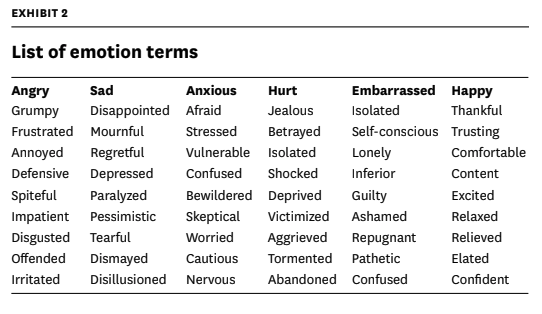
The image above shows a range of emotion terms you can use to describe your feelings more accurately. These are just a few examples—there are many more you can explore.
For instance, instead of saying "I'm happy," you might realize "I'm proud that my team accomplished our goal," which is more specific and energizing. The more precise you are, the better you can understand and communicate your emotions.
Write to Gain Perspective ✍️
Writing about your emotions is a powerful way to process and understand them. Research shows that people who write about their feelings gain clarity, reduce stress, and recover from setbacks more quickly. You don’t need to write a novel. Just set a timer for 10–20 minutes and let your thoughts flow. As you write, you might notice your language shifting from "I'm so angry about what happened" to "I realize I'm actually hurt because I felt excluded". This shift in perspective can help you see solutions and next steps that weren’t obvious before.
You can also use this approach to better understand others. If a colleague seems "hurt", consider whether they might actually be "isolated" or "jealous". Responding to the real emotion, rather than your first guess, builds trust and improves communication.
By expanding your emotional vocabulary, paying attention to the intensity and nuance of your feelings, and taking time to write about your emotions, you build a strong foundation for emotional intelligence. These skills help you better understand yourself and others, communicate more clearly, and respond thoughtfully in challenging situations. Next, you’ll have the opportunity to put these skills into practice through real-world tasks and reflections focused on using precise emotional language in real workplace scenarios.
