Factor Pairs and Lists
Introduction
Welcome back to Foundations of Factors and Multiples! This is the second lesson out of four in the course, so we are well on our way. In the previous course, you learned how to check whether one number is a factor of another by dividing and looking for a remainder of zero. You also saw that every factor relationship can be written in both division and multiplication form. Now we are going to build on that foundation. In this lesson, you will learn how to systematically find every factor of a whole number by working through its factor pairs, and you will discover a reliable way to know exactly when your search is complete.
Factors Come in Pairs
Recall that whenever we confirm a factor relationship, we can express it in multiplication form. For instance, because with no remainder, we can write . Notice that this single check actually reveals two factors of at once: both and .
This is a powerful observation. Every time we find one factor, its multiplication partner comes along for free. Instead of testing numbers one at a time and keeping a messy tally, we can hunt for factors in pairs, which cuts our work roughly in half. That idea is the engine behind this entire lesson.
What Is a Factor Pair?
A factor pair of a whole number is two whole numbers that multiply together to give that number. For example, the factor pairs of are:
| Pair | Multiplication check |
|---|---|
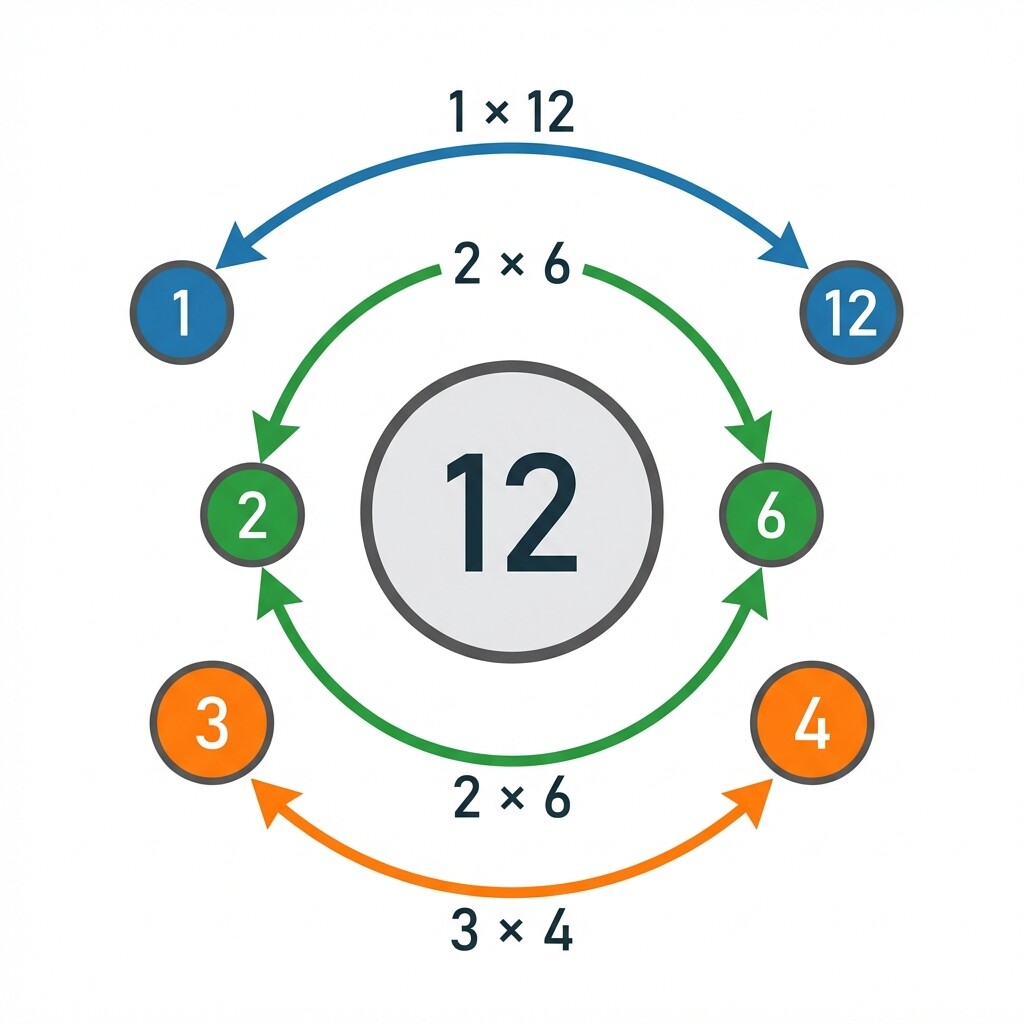
Each pair accounts for two factors at once. From just three pairs we can read off every factor of : . Collecting factor pairs first and then listing all the individual factors from those pairs is the most reliable way to make sure none slip through the cracks.
Finding Factor Pairs Systematically
The key to finding every factor pair is to start at and work upward, testing each whole number in order. Here is the process applied to :
- Start with . , so the first pair is .
- Move to . , remainder . Record .
- Try . , remainder . Record .
- Try . , remainder . Record .
- Try . remainder . Since the remainder is not , skip .
- Try . , remainder . Record .
At step 6 both numbers in the pair are the same. This is our signal to stop — and the next section explains exactly why.
Knowing When to Stop
As we work upward through possible factors, the smaller number in each pair gets larger and the bigger number gets smaller. Eventually the two numbers in a pair will meet (be equal) or the smaller one will exceed the larger one. At that point, every pair has already been found.
Let's see this clearly with the pairs of laid out side by side:
| Smaller factor | Larger factor |
|---|---|
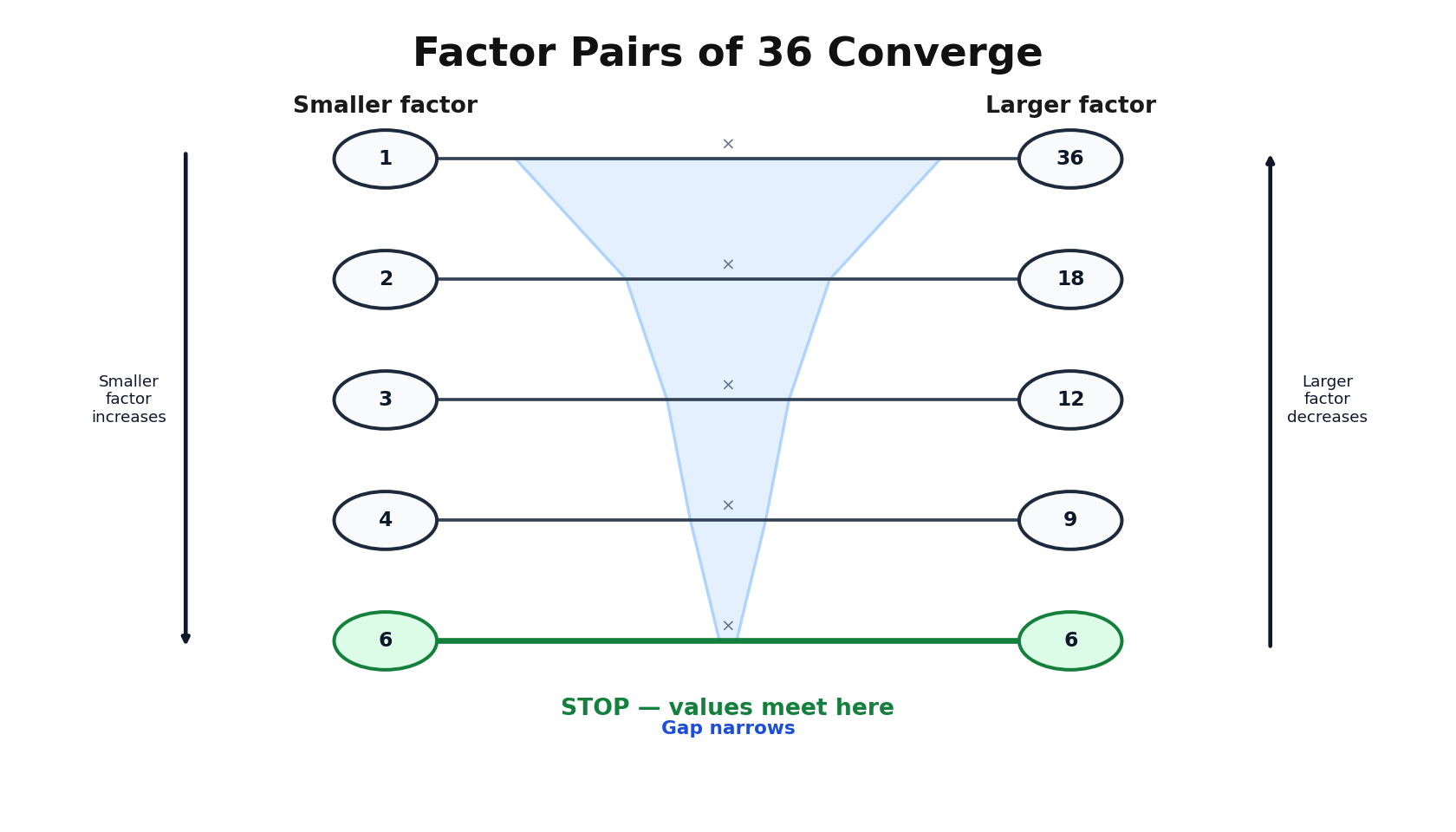
The gap between the two columns keeps shrinking. Once we reach , any number larger than that we might test — say — would just give us a partner smaller than (namely ), and we already recorded that pair as . Continuing past the meeting point would only repeat pairs we have already found.
The rule: keep testing from upward and stop as soon as the number you are testing equals or exceeds the result of the division. When that happens, your collection is complete.
From Factor Pairs to a Complete Factor List
Once all factor pairs are recorded, building the complete, ordered factor list is straightforward. Gather every number that appears in any pair, remove duplicates, and arrange them from smallest to largest.
For , our pairs were , , , , and . Pulling out every individual factor and sorting gives:
Notice that appears twice in the pair but is written only once in the final list. This complete list tells us at a glance every whole number that divides exactly.
Worked Example: Factors of 48
Let's walk through one more example from start to finish with the number .
- → pair
- → pair
- → pair
- → pair
- remainder → skip
- → pair
- remainder → skip
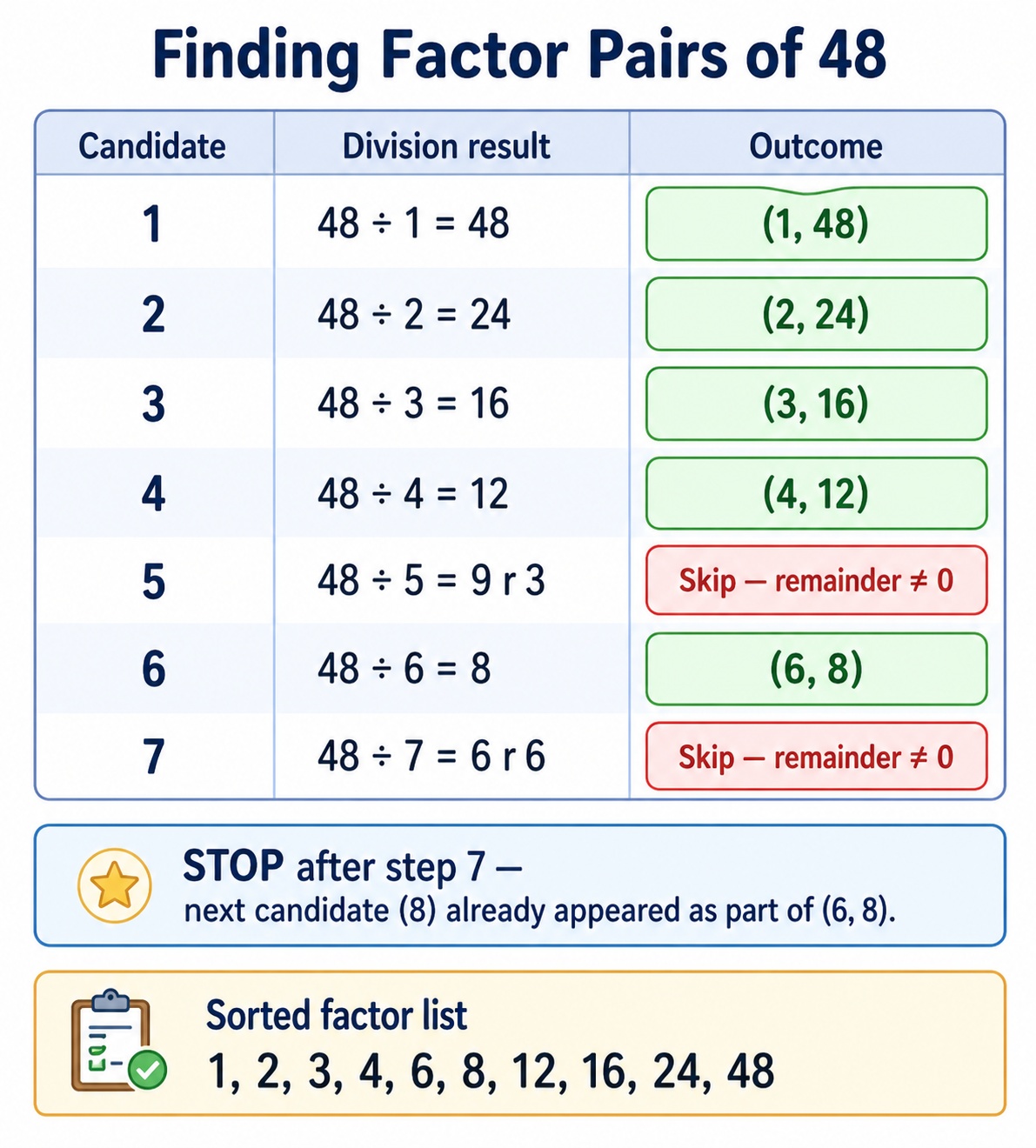
At step 7, even if had been a factor, its partner would be less than (since ), meaning we would only be repeating earlier work. The next candidate, , already appeared as the larger member of the pair . So we stop after step 6.
Reading off and sorting every factor from those five pairs gives the complete factor list:
That is ten factors in total, neatly captured by just five factor pairs.
Conclusion and Next Steps
In this lesson, you learned that factors naturally come in pairs that multiply to give the target number. By starting at and working upward, you can collect every pair without missing any. The search is finished as soon as the two numbers in a pair meet or cross over, because any further testing would only duplicate pairs you already have. From those pairs, building a complete, ordered factor list is simply a matter of gathering, deduplicating, and sorting.
Now it is time to put this method into practice! In the upcoming exercises, you will complete factor-pair tables, count pairs for different numbers, apply the technique to a real-world budgeting scenario, and explain in your own words how you know the search is done. Dive in and see how quickly the systematic approach becomes second nature!
