Factors as Exact Divisors
Introduction
Welcome to Foundations of Factors and Multiples, the first lesson in your learning path! This is the opening lesson out of four in the course, so we are right at the starting line. In this lesson, we will explore what it means for one whole number to be a factor of another. By the end, you will be able to check whether a factor relationship exists, express it using both division and multiplication, and spot the two factors that every positive whole number is guaranteed to have. Let's get started!
Sharing Equally: An Everyday Idea
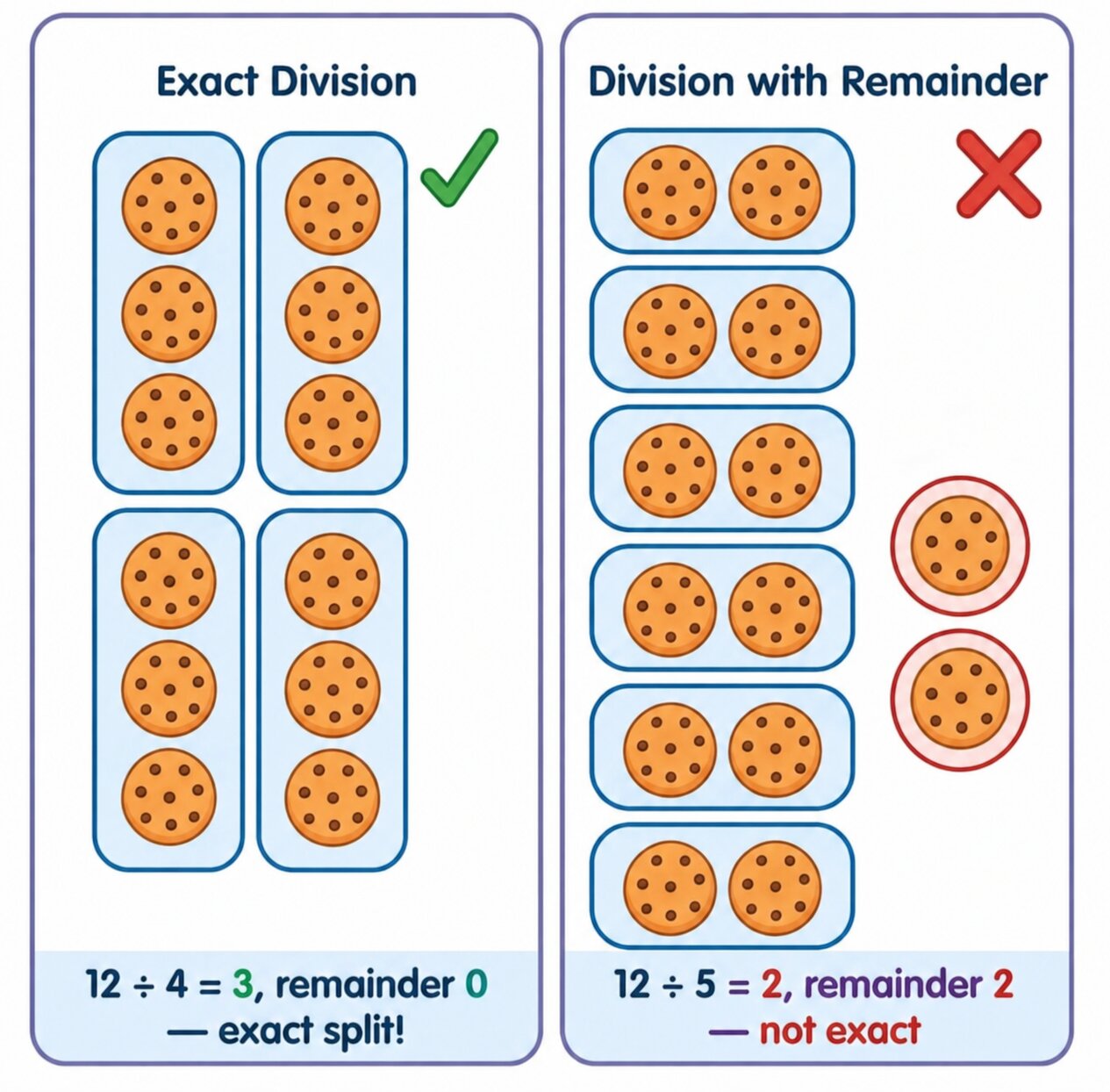
Before we define anything formally, think about a situation you have probably encountered many times: splitting items into equal groups. Imagine you have 12 cookies and want to share them equally among 4 friends. Each friend gets exactly 3 cookies, and nothing is left over. That clean, exact split is the core idea behind factors.
Now imagine trying to share those 12 cookies equally among 5 friends. Each person could get 2, but then 2 cookies remain. The split is not exact, and that leftover tells us something important. Factors are all about whether a division comes out perfectly even.
What Is a Factor?
A factor of a whole number is another whole number that divides it exactly, with no remainder. When we say " is a factor of ," we mean:
Because the result is a whole number with nothing left over, qualifies as a factor of .
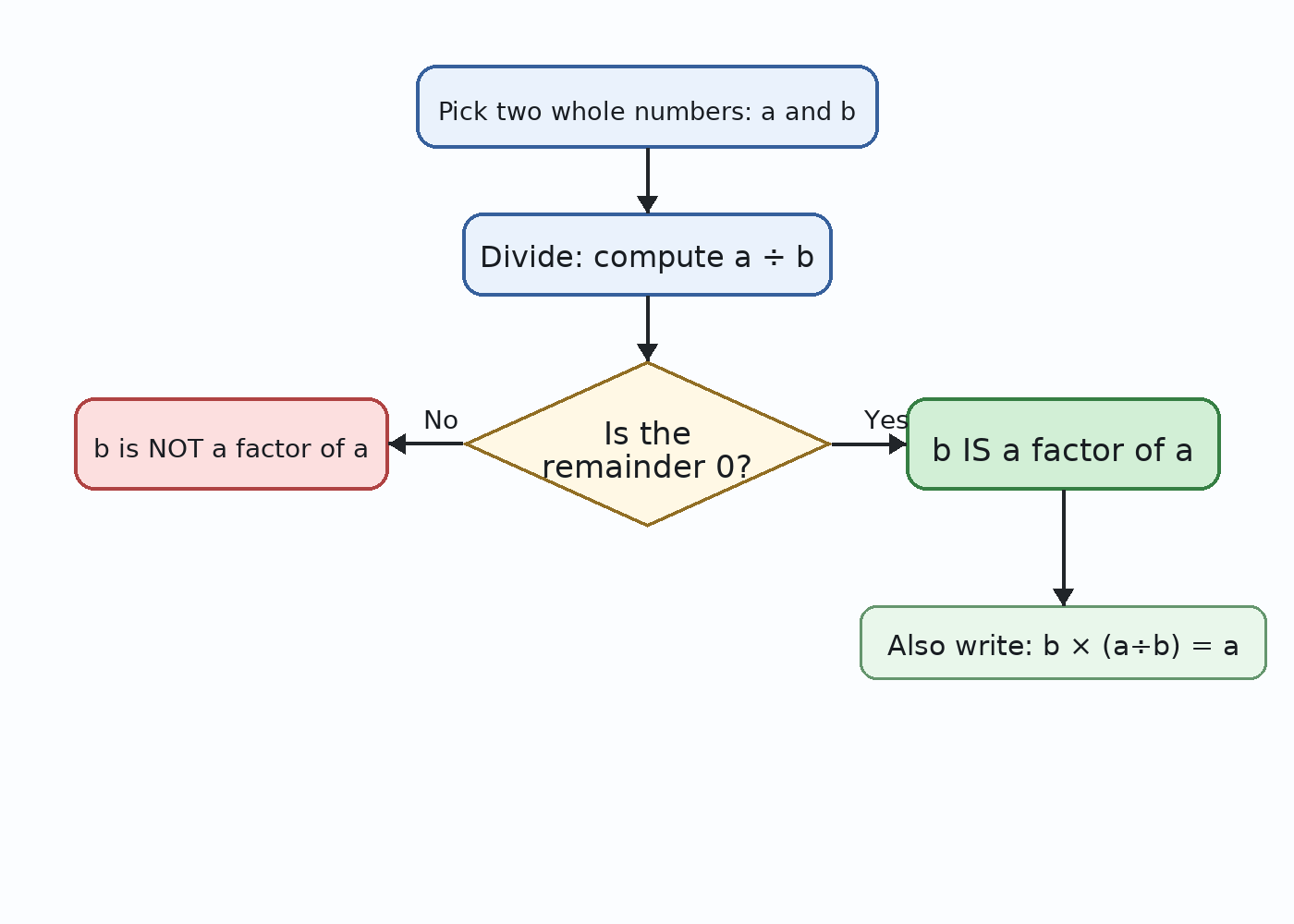
Compare that with . Since there is a remainder, is not a factor of . The test is simple: divide and check. If the remainder is , the divisor is a factor; if any remainder exists, it is not.
Expressing Factors Two Ways
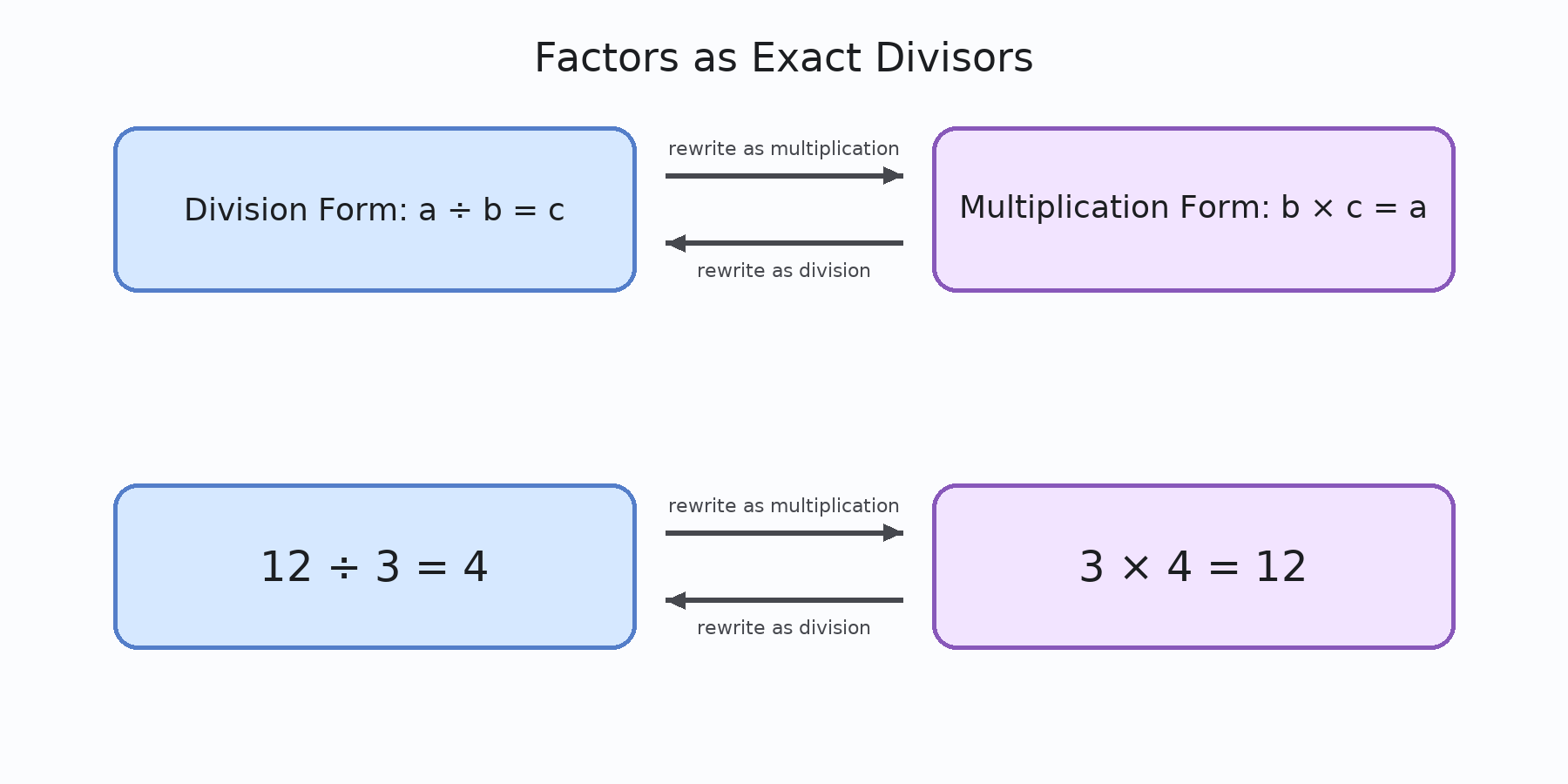
One of the most useful things about the factor relationship is that it can be stated in both division and multiplication form. These two forms say the same thing, just from different angles.
| Division form | Multiplication form |
|---|---|
If gives a whole number with no remainder, we can always rewrite that as . This reveals an important property: factors almost always come in pairs. In the first example, because , both and are factors of . Whenever you find one factor through division, the result (the quotient) is also a factor.
The only exception to this "pairing" is when a number is multiplied by itself—for example, . In that case, is its own partner! We will explore these pairs more in the next lesson, but for now, remember that one multiplication fact usually gives you two factors.
Every Number's Guaranteed Factors
Is there any whole number greater than zero that has no factors at all? Actually, no. Every positive whole number automatically has at least two factors: 1 and itself.
- 1 is always a factor because any whole number divided by gives itself, with no remainder. For example, .
- The number itself is always a factor because any whole number divided by itself equals , again with no remainder. For example, .
This means the smallest possible factor of any positive whole number is , and the largest possible factor is the number itself. Some numbers have only these two factors (we will meet those special numbers later in the course), while others have many more.
Factor Checks in Action
Let's pull everything together with a quick pair of examples. Suppose we want to check whether is a factor of .
- Divide: with remainder .
- Conclude: Because the remainder is , is a factor of .
- Rewrite in multiplication form: .
What about and ? Dividing gives . Because the remainder is not , is not a factor of . There is no whole number you can multiply by to land exactly on .
Notice how the entire decision comes down to one question: is the remainder zero?
Conclusion and Next Steps
In this lesson, we learned that a factor is a whole number that divides another whole number exactly, leaving no remainder. We also saw that every factor relationship can be written in both division and multiplication form, and that every positive whole number has at least and itself as factors. These ideas form the foundation for everything else in this course.
Up next, you will put these concepts into action with a set of hands-on practice tasks. You will test factor pairs, match division statements to their multiplication counterparts, and justify your reasoning in a real-world scenario — jump in and see how quickly these ideas click!
