Multiples and Factors
Introduction
Welcome to lesson three of Foundations of Factors and Multiples — only one more to go after this! In the first two lessons, you built a solid toolkit for taking a number apart: you learned how to verify factor relationships, find factor pairs, and assemble complete factor lists. All of that work answered one central question: What divides evenly into this number?
Now we flip the perspective entirely. Instead of looking inward at what divides a number, we look outward at what a number produces when we multiply. That shift in viewpoint leads us to the idea of multiples and reveals a powerful connection that ties together everything you have learned so far.
Thinking in the Other Direction
So far our focus has been on looking inside a number. Given , for example, we searched for smaller numbers that divide it exactly, and we called those its factors. But every time we wrote a multiplication fact like , we were also saying something about from the point of view of : the number is a result of multiplying by a whole number.
In everyday life, this "outward" view shows up constantly. A bus that departs every minutes creates a schedule at minutes after the route begins. Each of those times is a multiple of . Understanding multiples will let us generate sequences like these quickly and connect them back to the factor work we already know.
What Is a Multiple?
A multiple of a whole number is the result of multiplying that number by any whole number ().
While zero is technically a multiple of every number (because any number times equals ), it isn't very helpful when we are trying to plan a schedule or share items. For this reason, in this course, we will focus on positive multiples — the results of multiplying by and so on.
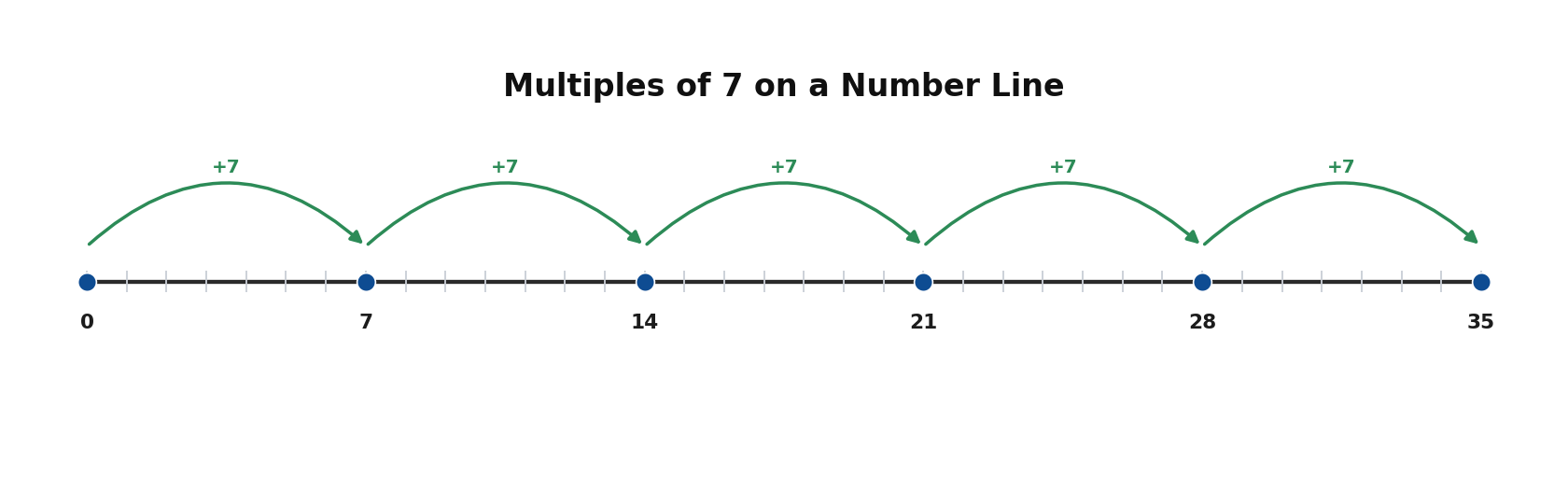
The multiples of (starting with the first positive one) begin:
Unlike a factor list, which is always finite, the list of multiples never ends. There is no largest multiple of because we can always multiply by the next whole number. A few quick observations worth noting:
- The first positive multiple of any number is the number itself, since .
- Every positive multiple of a number is greater than or equal to that number.
- Multiples grow in equal steps. Each new multiple of is exactly more than the previous one.
Generating a List of Multiples
To list multiples, simply start at the number and keep adding it. Let's generate the first six multiples of :
| Multiplier | Calculation | Multiple |
|---|---|---|
So the first six multiples of are . Notice the pattern: each row simply adds another . This makes generating multiples fast, even for larger numbers — if you can add, you can list multiples.
Testing Whether a Number Is a Multiple
Sometimes we do not need to generate a whole list. Instead, we just need to answer a yes-or-no question: Is a multiple of ? The test is straightforward — divide and check the remainder:
Because the division comes out exactly, is a multiple of . Compare that with remainder . The remainder is not zero, so is not a multiple of .
This should feel familiar. Checking for a zero remainder is exactly how we tested whether one number is a factor of another back in Lesson 1. The arithmetic is identical; only the language changes depending on which number we focus on. That observation leads directly to the big idea of this lesson.
The Factor–Multiple Relationship
Factors and multiples describe the same relationship viewed from opposite sides:
- If is a factor of , then is a multiple of .
- If is a multiple of , then is a factor of .
Let's ground this with a concrete example. We know that is a factor of because with no remainder. That same fact, flipped around, tells us that is a multiple of because . The table below shows several more examples of this two-way translation:
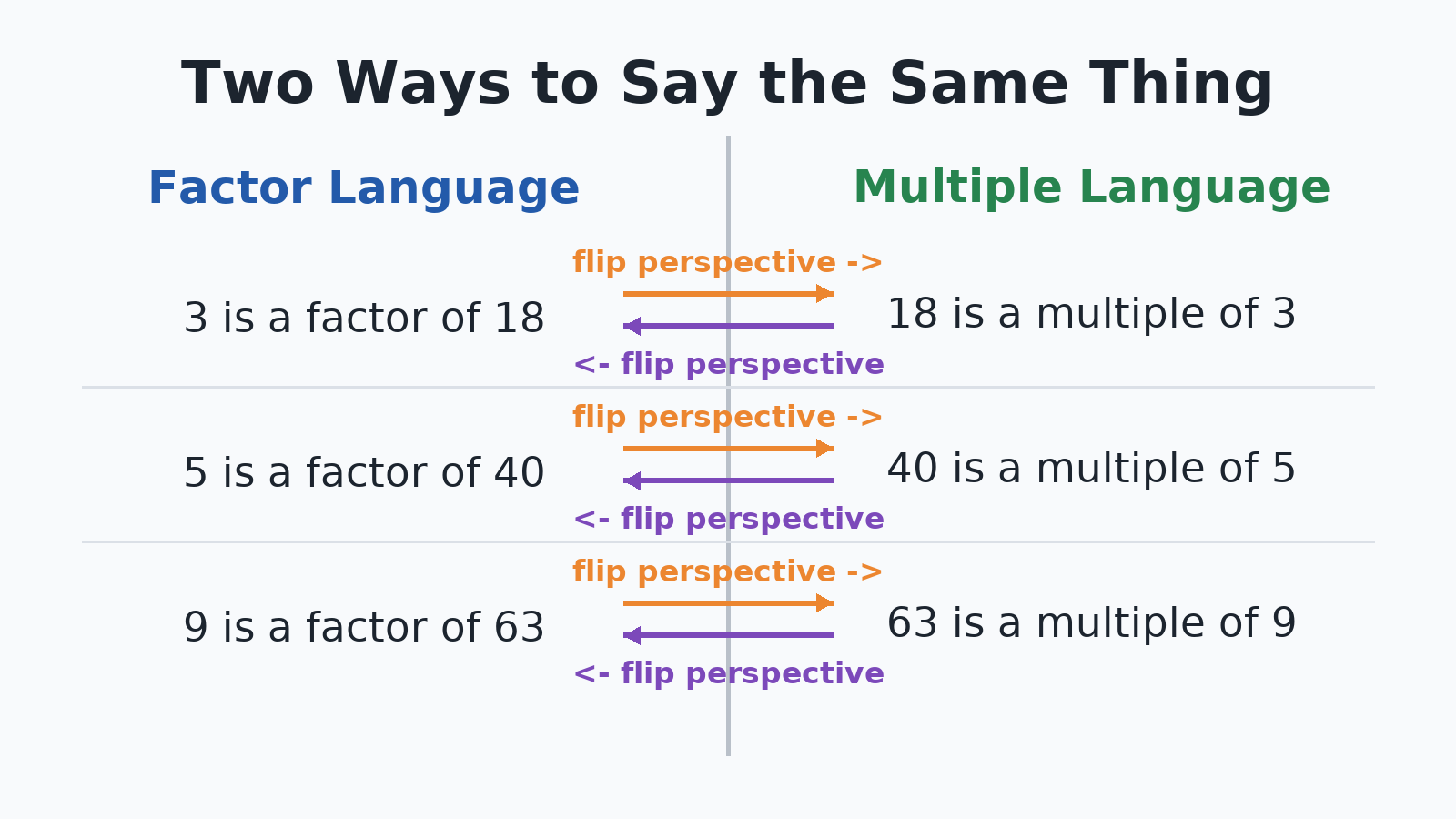
Every row in the table is a single mathematical fact expressed in two ways. Translating fluently between these two forms is one of the most useful skills in this course, because later topics — like finding common multiples and common factors — depend on seeing both sides at once.
Multiples at the Bakery
Imagine a bakery that packages muffins in boxes of . The batch sizes that fill boxes perfectly are — exactly the multiples of . If a customer orders muffins, we can check: with no remainder, so is a multiple of and the order fills complete boxes with none left over.
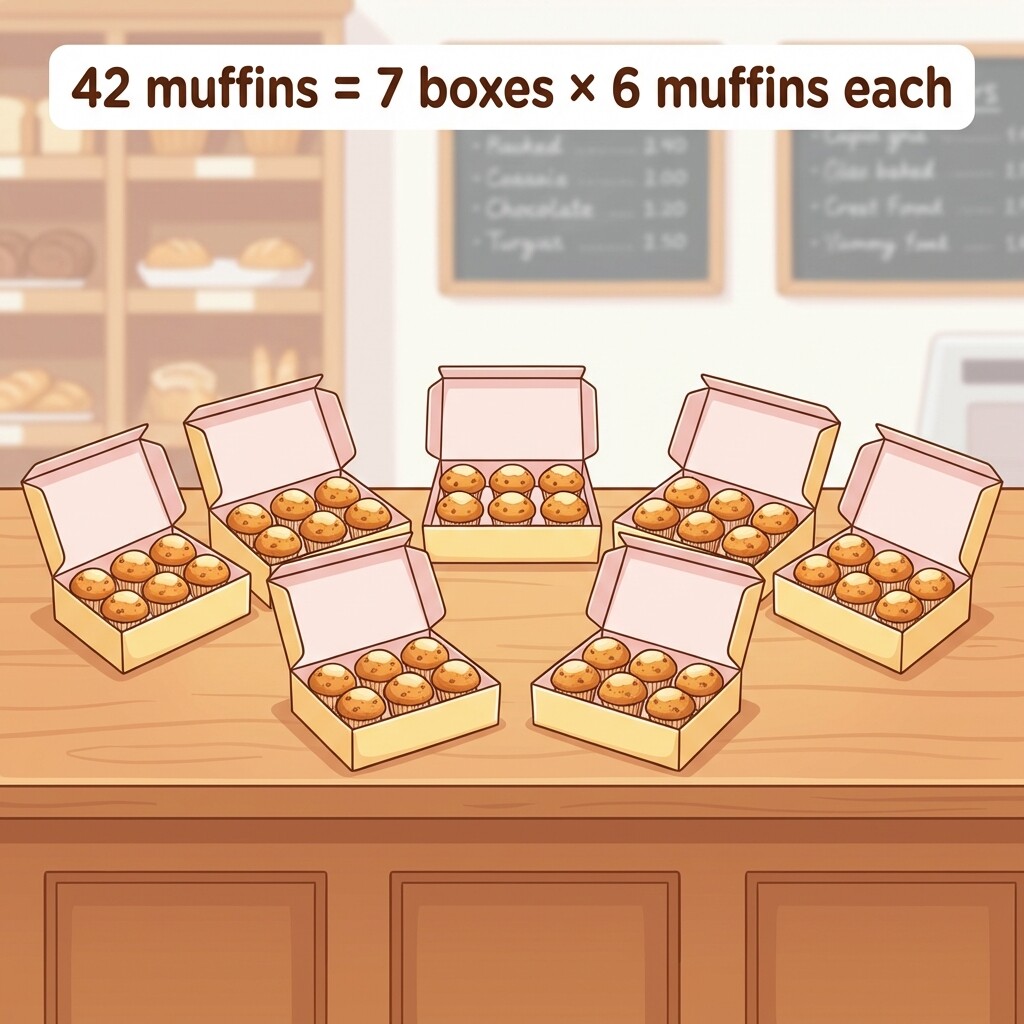
Notice how naturally both perspectives apply here. Saying " is a multiple of " tells us the order fits perfectly into boxes. Saying " is a factor of " tells us the box size divides the order evenly. One situation, two equivalent descriptions — and being comfortable with both makes real-world reasoning faster and clearer.
Conclusion and Next Steps
In this lesson, you learned that a multiple of a number is the product of that number and any positive whole number, and that the list of multiples stretches on forever. You also saw how to generate multiples by repeated addition or multiplication, how to test whether a given number is a multiple by dividing and checking for a zero remainder, and — most importantly — how factors and multiples are two sides of the same coin: if is a factor of , then is a multiple of .
Up next, you will put these ideas to work in a set of hands-on exercises. You will build bus departure schedules from route intervals, judge multiple relationships on the fly, translate between factor and multiple language, and explain a real-world delivery scenario in your own words. Jump in and see how naturally factors and multiples start speaking the same language!
