Four Types of Questions to Achieve Four Different Goals
Four Questions, Four Purposes 🧭
As Tom Pohlmann and Neethi Mary Thomas describe in the HBR Guide to Critical Thinking, your ability to ask purposeful questions shapes the quality of your conversations and decisions. While children are natural questioners, adults often ask far fewer questions—usually because workplace cultures reward quick answers over thoughtful inquiry. Instead of jumping straight to solutions, consider that each type of question moves a conversation in a different direction. When you understand the purpose behind each one, you can guide discussions with intention and avoid common decision-making pitfalls.
There are four question types you’ll use most often:
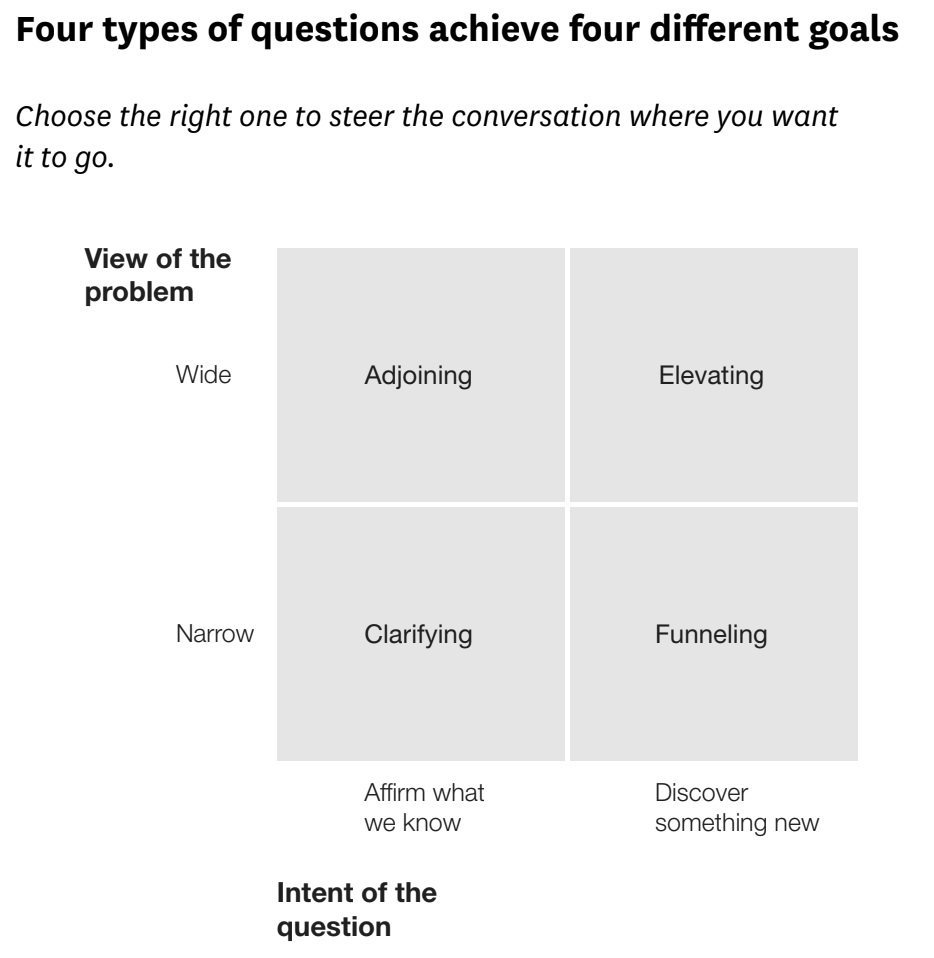
Clarifying questions foster shared understanding. They make sure you’re not talking past each other, surfacing what someone really means instead of assuming you already know. For example: "Can you say more about that?" or "What does that look like in practice?"
Adjoining questions expand the conversation’s scope. They help you explore related topics that may not be getting enough attention. For example: "How would this work with another department?" or "How might our approach change in a different market?"
Funneling questions encourage deeper analysis. They help you dig into reasoning or challenge underlying assumptions by probing for details and causes. For example: "What data did you base this on?" or "How did you rule out other options?"
Elevating questions shift the focus to the bigger picture. They help you reframe the problem or connect dots across multiple issues. For example: "Are we stepping back far enough?" or "What’s the broader trend here?"
Each question acts as a lever, intentionally moving the conversation toward the goal you want to achieve.
Match Questions to Your Goals 🎯
Purposeful questioning is about choosing the right kind of question for the moment. The best question is always context-dependent: start by clarifying, then broaden, deepen, or step back as needed. Use the table below to guide your choice:
| Your Goal | Question Type | When to Use |
|---|---|---|
| Ensure mutual understanding | Clarifying | When language is vague or you sense hidden assumptions |
| Broaden thinking | Adjoining | When the group is converging too quickly or missing context |
| Dig deeper and build rigor | Funneling | When you want to test reasoning or challenge assumptions |
| Reframe or see the big picture | Elevating | When the team is stuck in details or needs strategic focus |
For example, if a team is rushing to a solution:
- Use a clarifying question when terms are unclear.
- Use an adjoining question to surface overlooked factors.
- Use a funneling question to check the logic or depth of their analysis.
- Use an elevating question to zoom out and reconsider the overall direction.
With practice, you’ll quickly spot when shifting your question style can help move the conversation forward and prevent costly misunderstandings.
