Welcome to the Course 🎉

Welcome to Asking Better Questions and Seeking Perspectives! Critical thinking starts with the types of questions you ask. Drawing inspiration from John Coleman from the HBR Guide to Critical Thinking, this lesson will show you how to sharpen your inquiry skills, challenge your own assumptions, and seek new perspectives that expand your thinking.

You'll learn to approach complex problems with curiosity and humility, listen actively to what’s being said (and not said), and craft questions that spark genuine insight. By the end of this course, you’ll be ready to engage uncertainty with better questions and seeking different perspectives—leading not only to smarter decisions, but also to stronger leadership and deeper collaboration.

Hold Hypotheses Loosely 🪶

It’s natural to form an early theory or answer when you face a problem. This approach, sometimes called hypothesis-driven thinking, keeps you moving and helps clarify your options. But there’s a catch: when you become attached to your initial answer, your mind automatically looks for evidence that supports it, while ignoring anything that doesn’t fit. That’s how confirmation bias quietly sets in.

Think of it like wearing tinted glasses. Imagine you put on a pair of blue-tinted lenses and walk around believing everything you see must have a blue hue. You might miss the true colors of the world—even the brightest reds or yellows—because your brain is constantly filtering information through that blue tint. In the same way, when you get fixated on your first answer to a problem, you start filtering every new piece of information to fit that early theory, even if it means overlooking important facts or alternative solutions.
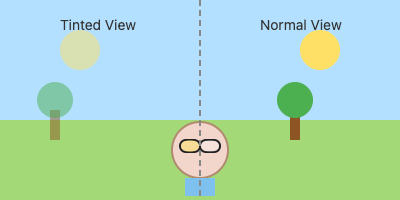
Tinted Glasses Analogy Visual

Instead, treat your first idea as a starting point, not a verdict. Ask questions that challenge your assumptions instead of just confirming them. For example, compare these two responses:

  • “Don’t you think this approach makes the most sense?” (designed for agreement)
  • “What would make this approach fail?” (exploring risks and blind spots)

The second question helps you break out of your own echo chamber and invites others to test your thinking.

This tendency also affects teams. When everyone starts to see things through the same “tinted glasses,” it leads to groupthink, where a group unconsciously favors harmony and consensus over exploring different perspectives. Deliberately consider the counterintuitive or unexpected possibility, and invite others to question the obvious. Involving diverse voices and asking, “What are we missing?” or “If we’re wrong, what might be the reason?” helps break the pattern and encourages richer, more creative solutions.

It’s uncomfortable to reconsider what you believe, but that discomfort is exactly where your best insights happen. Practice seeking out evidence that could prove you wrong, and welcome those moments when a better question leads you somewhere unexpected. That’s the heart of real critical thinking.

Listen to Ask Deeper Questions 👂

The foundation of powerful questions is powerful listening. Active listening means giving your full attention—not just to the words, but to the logic, the feelings, and even the assumptions behind them.

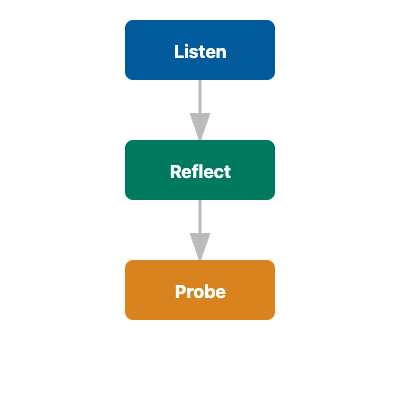
It’s very common to start preparing your next response before someone has finished speaking. This shortcut skips over real understanding and limits what you can learn. Instead, slow down and focus. Listen until you can accurately restate what you heard. The Listen, Reflect, Probe framework helps you slow down, truly understand others, and uncover the substance beneath the surface.

Listen, Reflect, Probe Framework Vertical Flowchart

  1. Listen:
    Give your full attention and avoid thinking ahead to your response; instead, be fully present.

  2. Reflect:
    Before you move on, summarize or restate what you heard. This signals you’re engaged and gives the other person a chance to clarify if needed. For example:
    “I hear you saying the team felt uncertain about the timeline...”

  3. Probe:
    Ask a thoughtful, open-ended follow-up that digs deeper and shows genuine curiosity. Instead of making your own point, invite the other person to expand:
    “Can you tell me more about what created that uncertainty?”

When you practice “Listen, Reflect, Probe,” you naturally collect better information and ask questions that matter more. This not only sharpens your critical thinking but also sets the stage for true collaboration.

Ask Open-Ended Follow-Ups 🤔

Strong critical thinking is built on questions that go beyond yes/no answers. Open-ended questions invite people to share their reasoning, reveal what was considered (and what wasn’t), and surface fresh information. When you ask open-ended questions, you give others permission to explain their thought process, talk through decision points, and express any doubts or trade-offs they faced. You also help create a setting where unexpected viewpoints and hidden assumptions can come to light. This style of questioning not only broadens the conversation, but also uncovers angles and details that may be critical for making a well-informed decision.

Let’s see this in action:

  • Emily: We missed the deadline because the team was just stretched too thin.
  • Tom: I hear you. It sounds like capacity was a challenge. What made the workload feel overwhelming?
  • Emily: We had three projects running, and everyone kept switching between them.
  • Tom: When you saw that happening, what options did you consider?
  • Emily: Honestly, it felt like the deadlines were just locked in.
  • Tom: What would have needed to change for you to raise that concern earlier?

Notice how Tom reflects back what he hears, then asks open-ended questions that invite deeper thinking. Each question builds on the previous answer, encouraging Emily to share more context and ultimately uncovering that the real issue was a lack of empowerment.

Stepping back and “stewing in a problem”—giving yourself time to reflect without rushing to the next task or answer—can also lead to better questions. Sometimes, your sharpest insights and most powerful follow-ups come not in the moment, but after a pause. Allow problems to simmer, letting your understanding deepen before you respond.

By sharpening your ability to question assumptions and listen actively, you will be better prepared to approach challenges with greater insight and perspective. In the upcoming practices, you will put these skills to work: listening closely, probing for clarity, and building question chains that help others and yourself see problems from a new vantage point.

Sign up
Join the 1M+ learners on CodeSignal
Be a part of our community of 1M+ users who develop and demonstrate their skills on CodeSignal