Calculate Area of Triangles
Introduction 🎉
Welcome to Calculate Area of Triangles! In the first lesson, you learned how to calculate the area of rectangles and squares by multiplying their dimensions. This lesson focuses on finding the area of triangles. You will now use what you know about rectangles to understand why a triangle’s area is half of a related rectangle’s area.
By the end of this lesson, you have learned how to:
- Identify the base and matching perpendicular height of a triangle.
- Explain why the area of a triangle is half the area of a rectangle with the same base and height.
- Calculate the area of right, acute, and obtuse triangles using .
- Write triangle area answers with correct square units, including when dimensions are decimals.
Before introducing a new formula, let's build some intuition using what you already know. Imagine taking a rectangle and drawing a straight line from one corner to the opposite corner. That diagonal splits the rectangle into two triangles of equal size. Each triangle covers exactly half of the rectangle's surface.
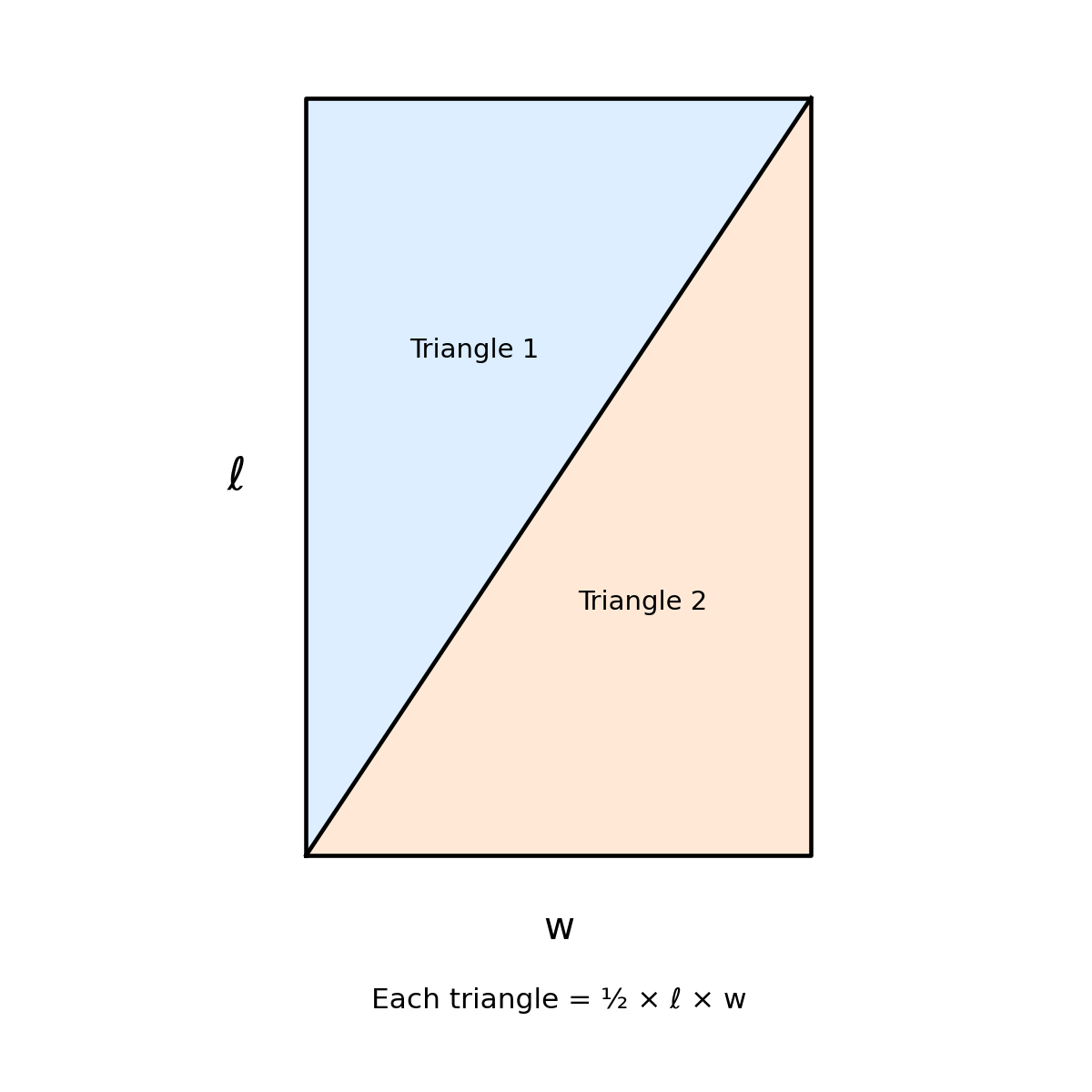
This simple picture is the starting point for why the triangle area formula works the way it does. Since a rectangle's area is , each triangle that results from the diagonal cut must have an area of . The rectangle’s length and width become the triangle’s base and height, so the same two measurements are still important. While this specific diagonal cut forms a right triangle, any acute or obtuse triangle can also be enclosed in or rearranged into a related rectangle or parallelogram. In every case, the triangle uses exactly half of that related area. Keep this "half of a rectangle" image in your mind — it is the key insight for everything that follows.
📐 Identifying the Base and Perpendicular Height
To calculate a triangle's area, you need two measurements: the base and the height. Let's be precise about what each one means.
- The base () is any side of the triangle we choose to measure from. All three sides can serve as a base.
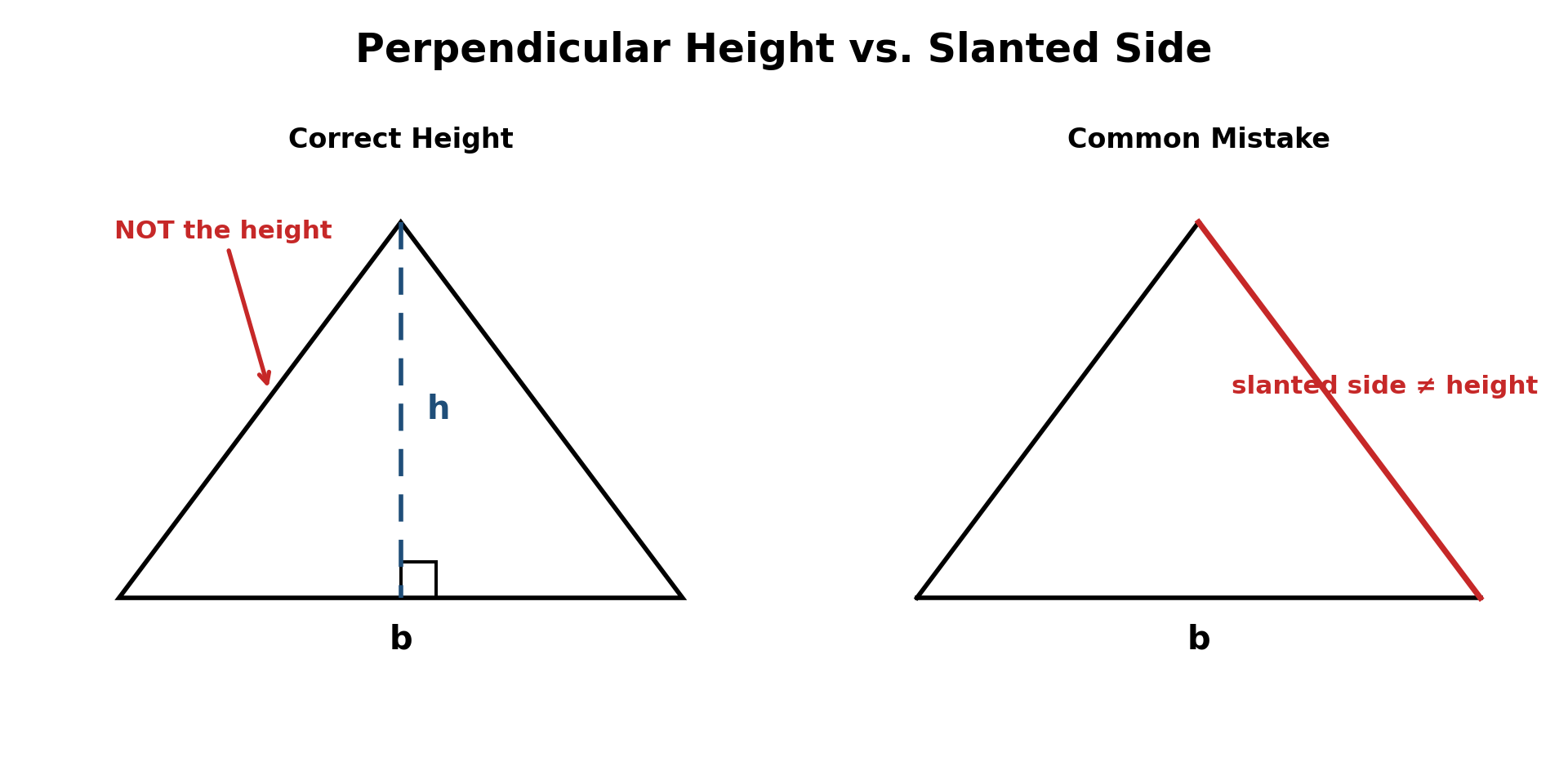
- The height () is the perpendicular distance from the chosen base to the opposite vertex (the corner across from it). Perpendicular means the height meets the base at a angle, forming a square corner like the corner of a piece of paper or a book. This angle shows that the height goes straight away from the base, not along a slanted side.
A very common mistake is treating one of the triangle's slanted sides as the height. Unless that side meets the base at exactly , it is not the height. Always look for the small square symbol that marks this angle. That symbol confirms where the true perpendicular height is. In some triangles the height line falls inside the shape, and in others it extends outside, but it always forms that angle with the base.
🧮 The Triangle Area Formula
With the base and perpendicular height identified, the formula follows directly from the rectangle connection you explored:
Here, is the length of the base and is the perpendicular height to that base. The is there because any triangle can be enclosed by or rearranged into a rectangle that shares the same base and height, and the triangle will fill exactly half of it. And just as with rectangles, area is always expressed in square units (, , , etc.) because you are measuring surface coverage.
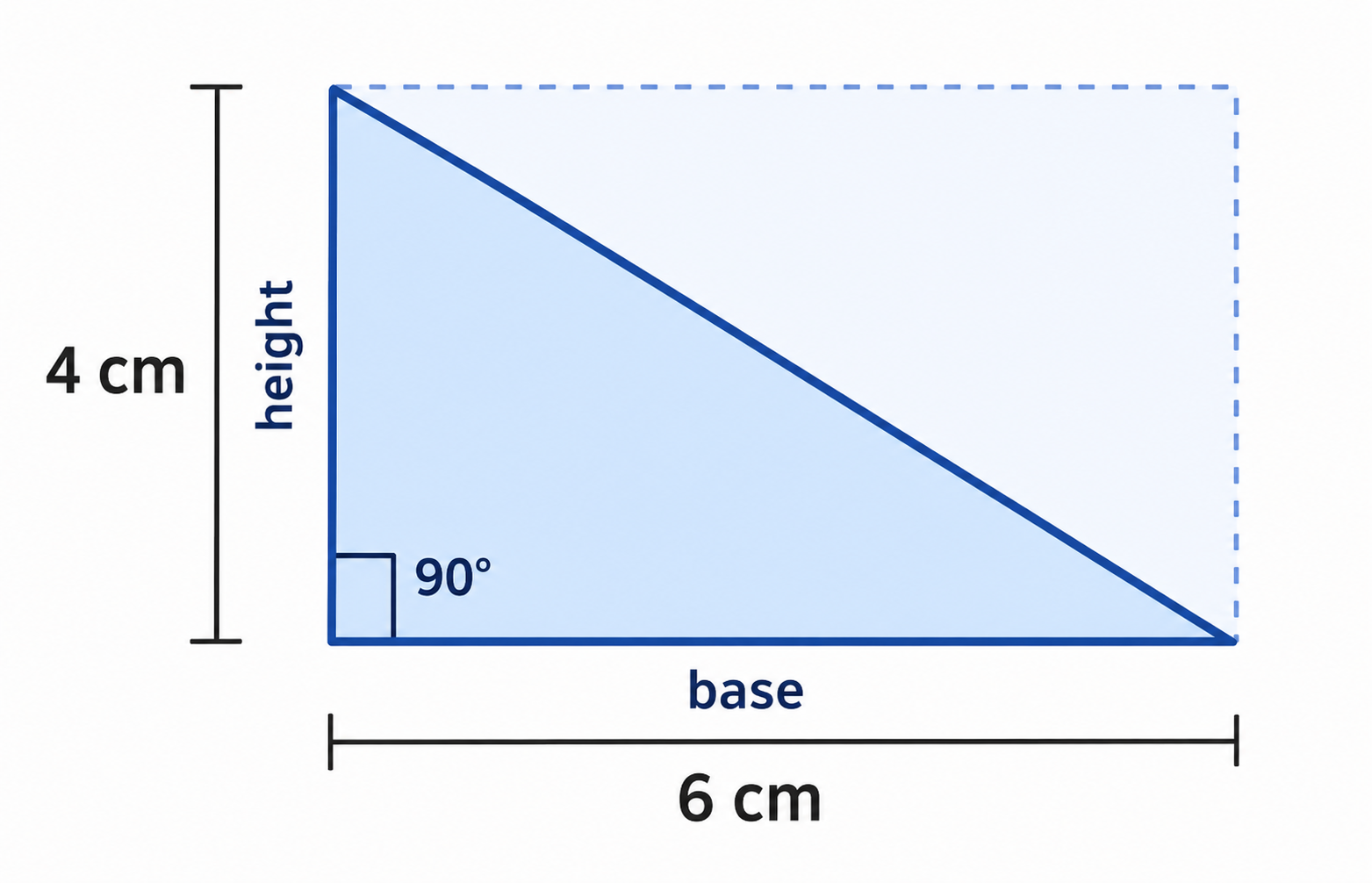
Let's start with right triangles because they are the friendliest case. A right triangle already has two sides that meet at a angle. Those two sides, called the legs, naturally serve as the base and the perpendicular height with no extra work needed.
Consider a right triangle with legs of and :
You can picture this triangle as half of a rectangle. The rectangle's area would be , and the triangle takes up exactly half: .
The same formula works for acute and obtuse triangles. The only thing that changes is where the height line falls.
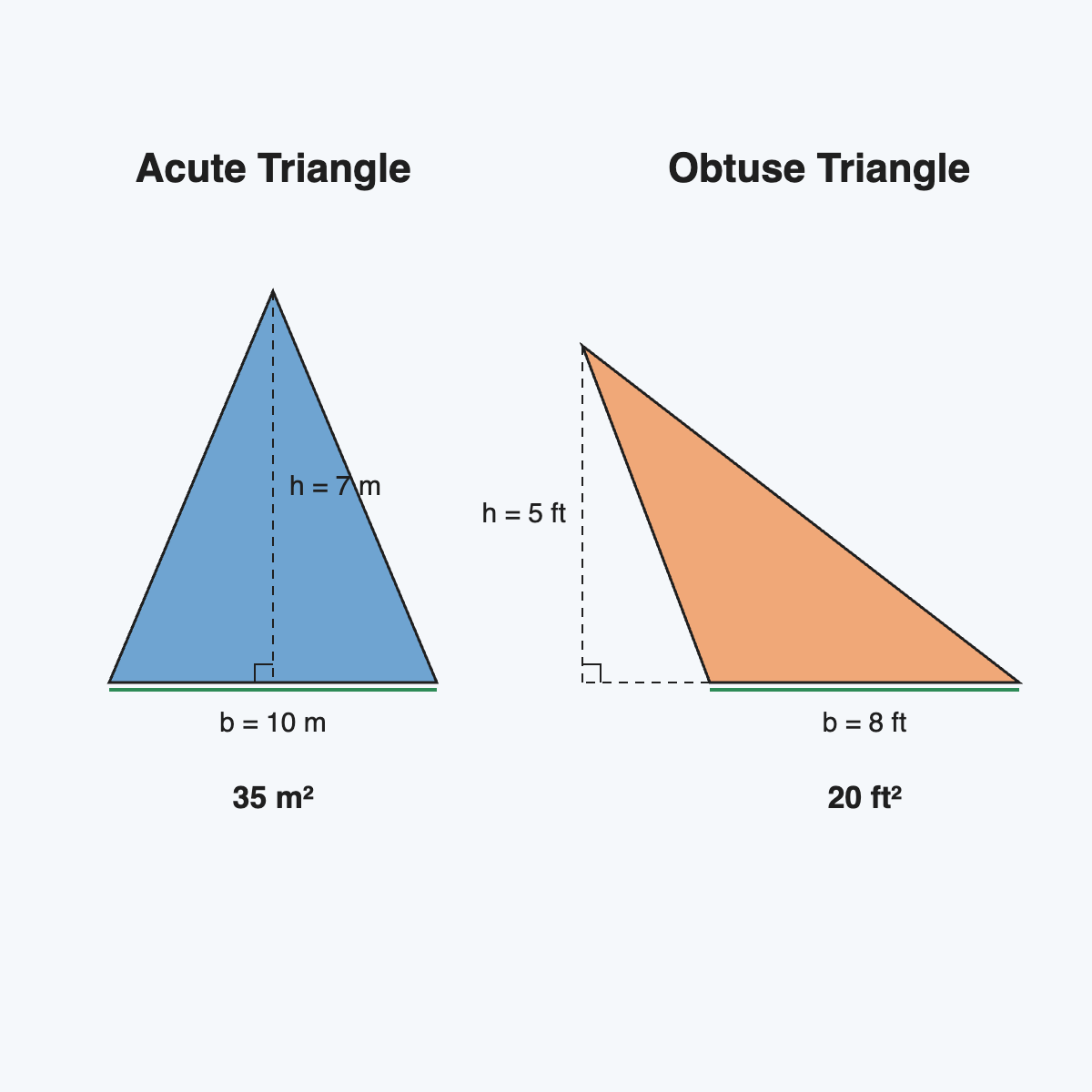
In an acute triangle, every corner is smaller than a square corner (). To find the height, you can draw a line from the highest point straight down so it hits the base at a perfect angle. This perpendicular line lands inside the triangle, much like a support pole inside a tent.
To see why the formula still works here, imagine drawing a rectangle snugly around the whole triangle. The height line splits the acute triangle into two smaller right triangles, and it splits the surrounding rectangle into two smaller rectangles. Each right triangle takes up exactly half of its smaller rectangle. Added together, the entire acute triangle takes up exactly half of the large enclosing rectangle.
For instance, an acute triangle with a base of and a perpendicular height of has an area of:
In an obtuse triangle, one corner is "wider" than a square corner (). Because the triangle leans over so much, the highest point is no longer positioned directly above the base. To measure the height, you have to imagine extending the base line outward with a dotted line. The height then drops from the top vertex straight down to meet that extension at a angle.
Why does the formula hold true for this leaning shape? Look at the large right triangle formed by the height line, the longest slanted side, and the extended base. The obtuse triangle's area is the area of this large right triangle minus the empty right triangle on the outside. When you subtract that empty space, the math simplifies perfectly back to . Just like the others, the obtuse triangle covers exactly half of the rectangular area that shares its true base and height.
Even though this height line falls outside the triangle, the formula stays exactly the same. If the base is and the perpendicular height is :
No matter the triangle type, the rule is consistent: find the base, find its matching perpendicular height, and multiply with .
🖋️ Applying the Formula with Decimals
Real-world measurements rarely come out to whole numbers, but the triangle area formula handles decimals without any extra steps.
Suppose you are calculating the area of a triangular garden bed with a base of and a perpendicular height of :
A quick estimate helps verify: , and half of that is . Your answer of is comfortably close, so you can be confident in the result. Building this estimation habit is a great way to catch calculation errors before they stick.
🛑 Common Mistakes to Watch For
Here are a few pitfalls to keep in mind as you practice with triangles:
- Using a slanted side as the height. The height must be perpendicular to the base. A slanted side will give the wrong answer unless it happens to meet the base at exactly .
- Forgetting the factor. Without it, you are calculating the area of the full rectangle, not the triangle. If your answer seems too large, check whether you included the half.
- Dropping the square units. Your area answer needs a squared label (e.g., , not ) to clearly show you are measuring surface coverage, not length.
Conclusion and Next Steps
The area of any triangle is , and this single formula works for right, acute, and obtuse triangles alike. The critical step is always pairing the correct base with its matching perpendicular height — the one that meets the base at a angle — and expressing the result in square units. The process stays the same whether you are working with whole numbers or decimals.
Now it is time to put these ideas into action! In the practice ahead, you will identify true perpendicular heights, see triangles nested inside rectangles, experiment with changing dimensions, and figure out how much fabric is needed for a triangular banner. Jump in and make the half-base-times-height formula your own!
