Calculate Area of Squares and Rectangles
Introduction 🎉
Welcome to Area of 2D Shapes! In your earlier courses you explored the difference between perimeter, area, and volume, and then learned how to calculate boundary lengths around shapes. This lesson focuses on finding the area of rectangles and squares. You will now move from measuring around a shape to measuring the surface it covers. Instead of counting every unit square one by one, you will learn how rectangle and square area formulas make that process faster.
By the end of this lesson, you have learned how to:
- Describe area as the amount of flat surface a shape covers.
- Calculate the area of rectangles and squares using and .
- Write area answers with correct square units, including when dimensions are decimals.
🟦 What Area Really Means
Area measures the amount of surface a shape covers. Think of it this way: if you were painting a wall or laying tiles on a floor, the area tells you exactly how much paint or how many tiles you need. While perimeter tells you how far around a shape, area tells you how much space it fills on a flat surface.
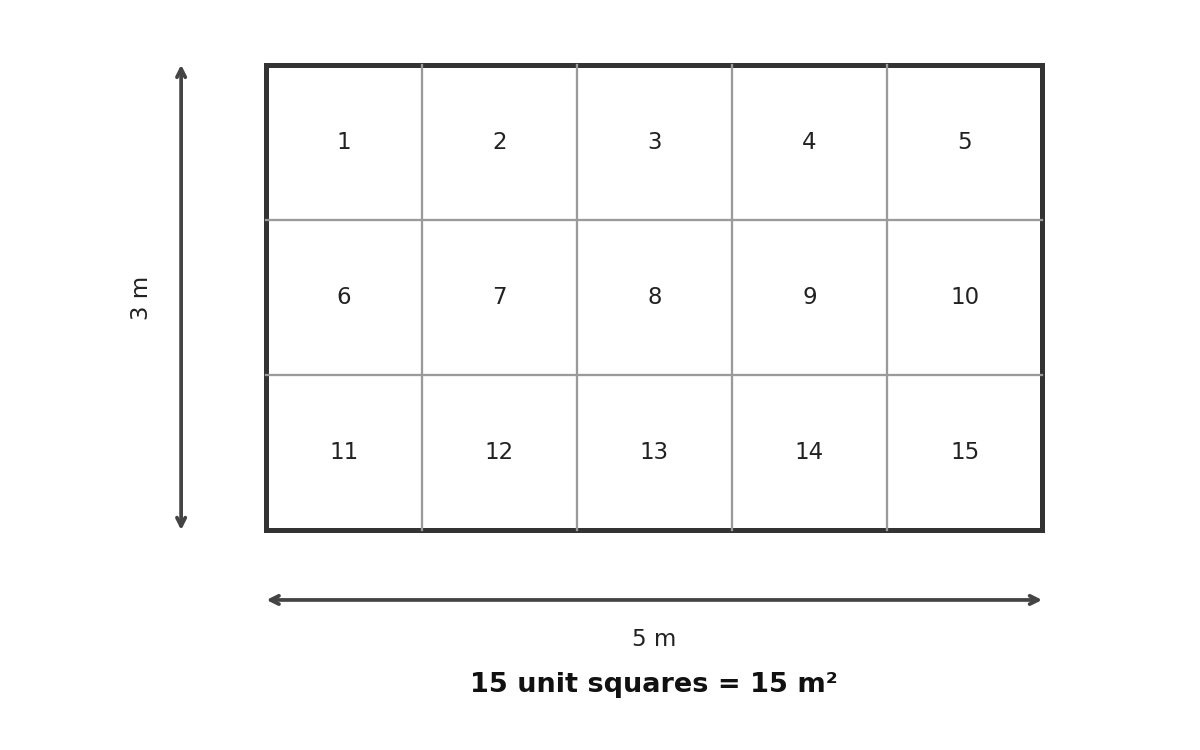
A handy way to visualize area is to imagine filling a shape with small unit squares, each measuring . The total number of unit squares that fit inside the shape, with no gaps and no overlaps, equals its area. This "counting squares" idea is the foundation behind every area formula we will use.
📏 Area of a Rectangle
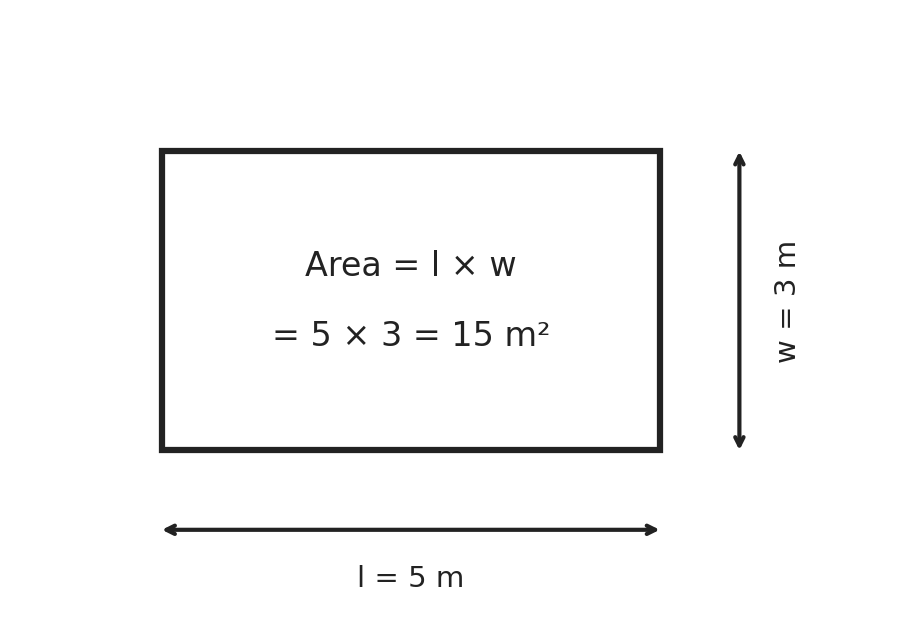
A rectangle has two key measurements: its length () and its width (). Instead of counting every unit square one by one, you can multiply these two dimensions together:
For example, a rectangle that is long and wide contains unit squares, so its area is . Notice how multiplication gives the same answer as counting — just much faster. This shortcut works because each row holds squares, and there are rows, giving squares in total.
⬛ Area of a Square
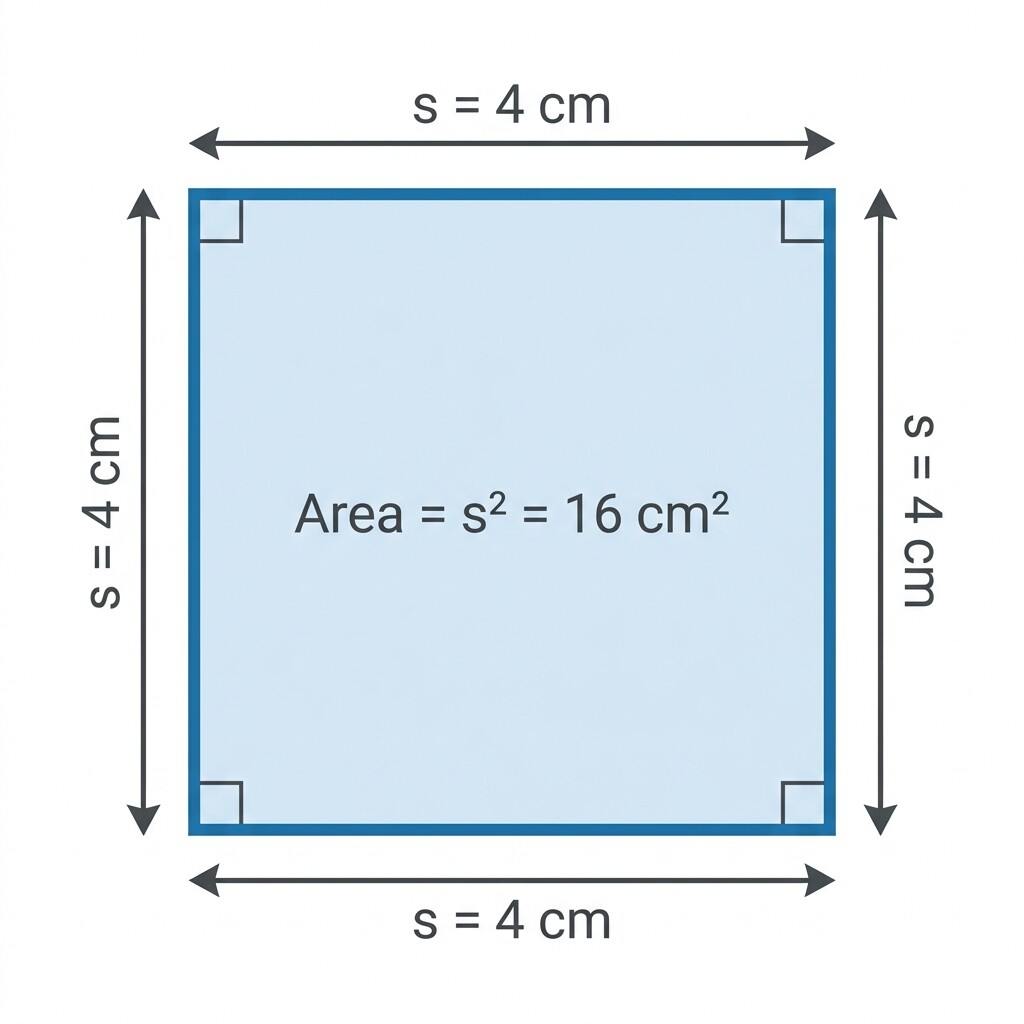
A square is simply a rectangle whose length and width are equal. That common measurement is called the side length (). Because both dimensions are the same, the formula becomes:
For instance, a square with a side length of has an area of . Recognizing that a square is a special case of a rectangle is useful because it means you only need to remember one core idea: multiply the two dimensions together.
🔢 Working with Decimal Dimensions
Not every measurement comes out to a whole number. Floors, tabletops, and screens often have decimal dimensions, but the good news is that the same formulas apply without any extra steps.
Consider a rectangular phone screen that measures by :
Similarly, a square ceramic tile with a side length of has an area of:
This answer may look surprising at first because is smaller than , but it makes sense: the tile is less than meter long on each side, so its area should be less than . To multiply the decimals, think of as , then count the decimal places. Each factor has one decimal place, so the product has two decimal places: .
A quick estimate can also help you check your work. Since is roughly a third of , the product should be roughly a ninth of . Because is close to , an answer near is reasonable. The exact value, , fits that expectation.
✏️ Always Use Square Units
One detail that is easy to overlook is the unit label. Because area counts how many unit squares fit inside a shape, the result is always expressed in square units. The squared unit tells the reader that the answer measures surface coverage, not just distance.
For example, if a rectangle is long and wide, its area is:
The number tells how many square units fit inside the rectangle, and tells what kind of unit squares they are: square meters. Without the squared unit, would describe a length, such as the distance along a line, instead of the amount of flat space covered. Here is a quick reference:
| Dimension unit | Area unit | Written as |
|---|---|---|
| meters (m) | square meters | |
| centimeters (cm) | square centimeters | |
| feet (ft) | square feet | |
| inches (in) | square inches |
Writing instead of would suggest a length rather than an area. Always double-check that your answer carries the squared label so the measurement clearly describes surface coverage.
⚠️ Common Mistakes to Watch For
Even with straightforward formulas, a few pitfalls come up regularly. Keeping these in mind will save you time and prevent errors in the practice tasks ahead.
- Mixing up perimeter and area. Perimeter adds side lengths; area multiplies two dimensions. If your answer seems surprisingly small or large, check which operation you used.
- Forgetting to square the units. A result like describes a length, not a surface. Make sure you write .
- Using mismatched units. If the length is in meters and the width is in centimeters, convert one before multiplying so both dimensions share the same unit.
Conclusion and Next Steps
Let's recap what you have learned. The area of a rectangle is , and because a square is a rectangle with equal sides, its area simplifies to . These formulas work the same way for whole numbers and decimals, and the result must always carry square units to show that you are measuring surface coverage, not length.
Up next, you will put these ideas into action through hands-on practice. You will start by building shapes out of unit squares to see how changing dimensions affects area, then work through guided calculations, and finish by figuring out how much tile is needed to cover a real bathroom floor. Get ready to apply what you have learned!
