Calculate Area of Circles
Introduction 🎉
Welcome to Calculate Area of Circles! In the first two lessons, you learned how to calculate the area of shapes with straight edges, including rectangles, squares, and triangles. This lesson focuses on finding the area of circles. You will now use the radius, diameter, and the constant to understand how much space is inside a curved boundary.
By the end of this lesson, you will have learned how to:
- Identify the radius and diameter of a circle, and convert diameter to radius when needed.
- Calculate the area of a circle using and write answers with correct square units.
🌀 What Makes Circles Different
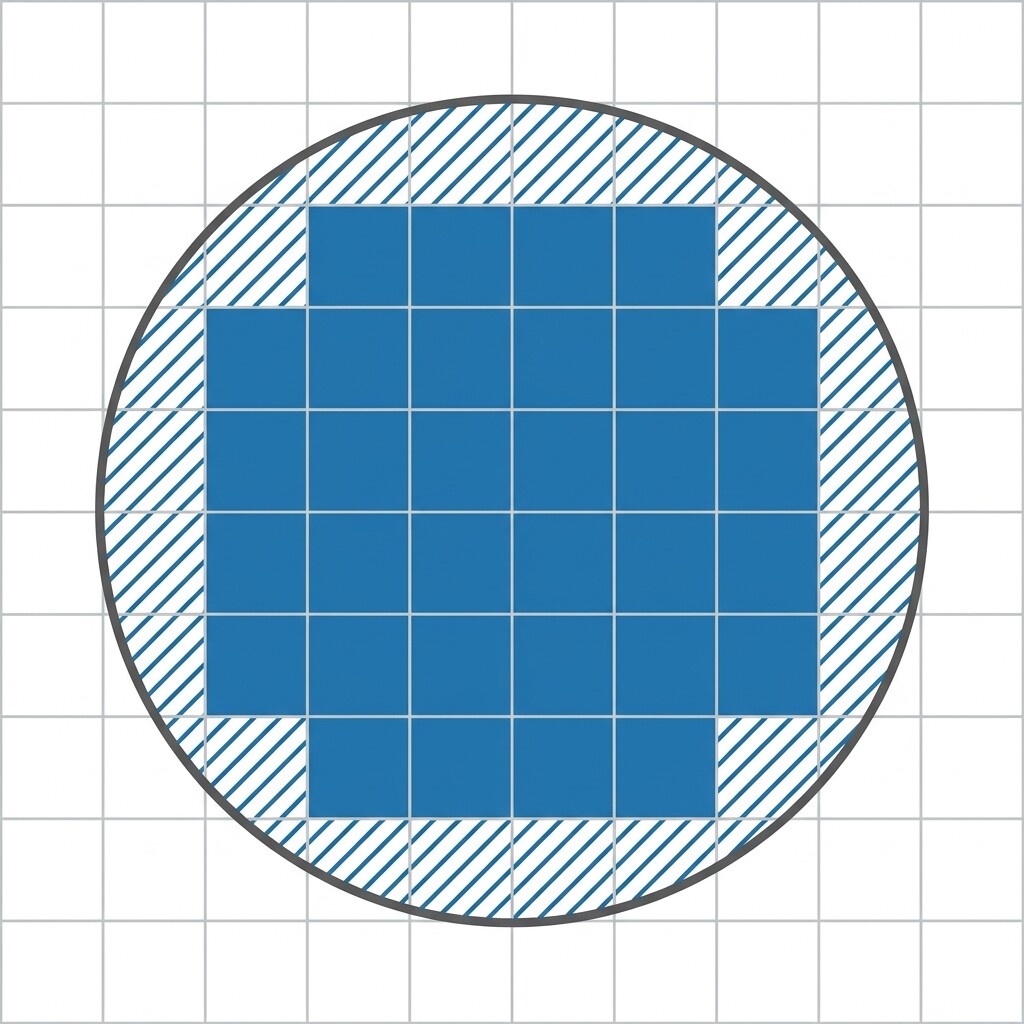
Rectangles and triangles gave you area through straight-line measurements: length times width, or half of base times height. A circle has no straight sides at all, so you need a completely different approach. Instead of two dimensions, a circle is defined by just one key measurement — the distance from its center to its edge, called the radius. Every point on a circle's boundary sits exactly one radius away from the center.
Because the boundary curves, a circle's area does not break neatly into rows of unit squares. Some squares along the edge will be partially inside and partially outside the circle. This is exactly why circles require their own formula, and that formula relies on a famous constant: π (pi).
🥧 Circle Measurements and π
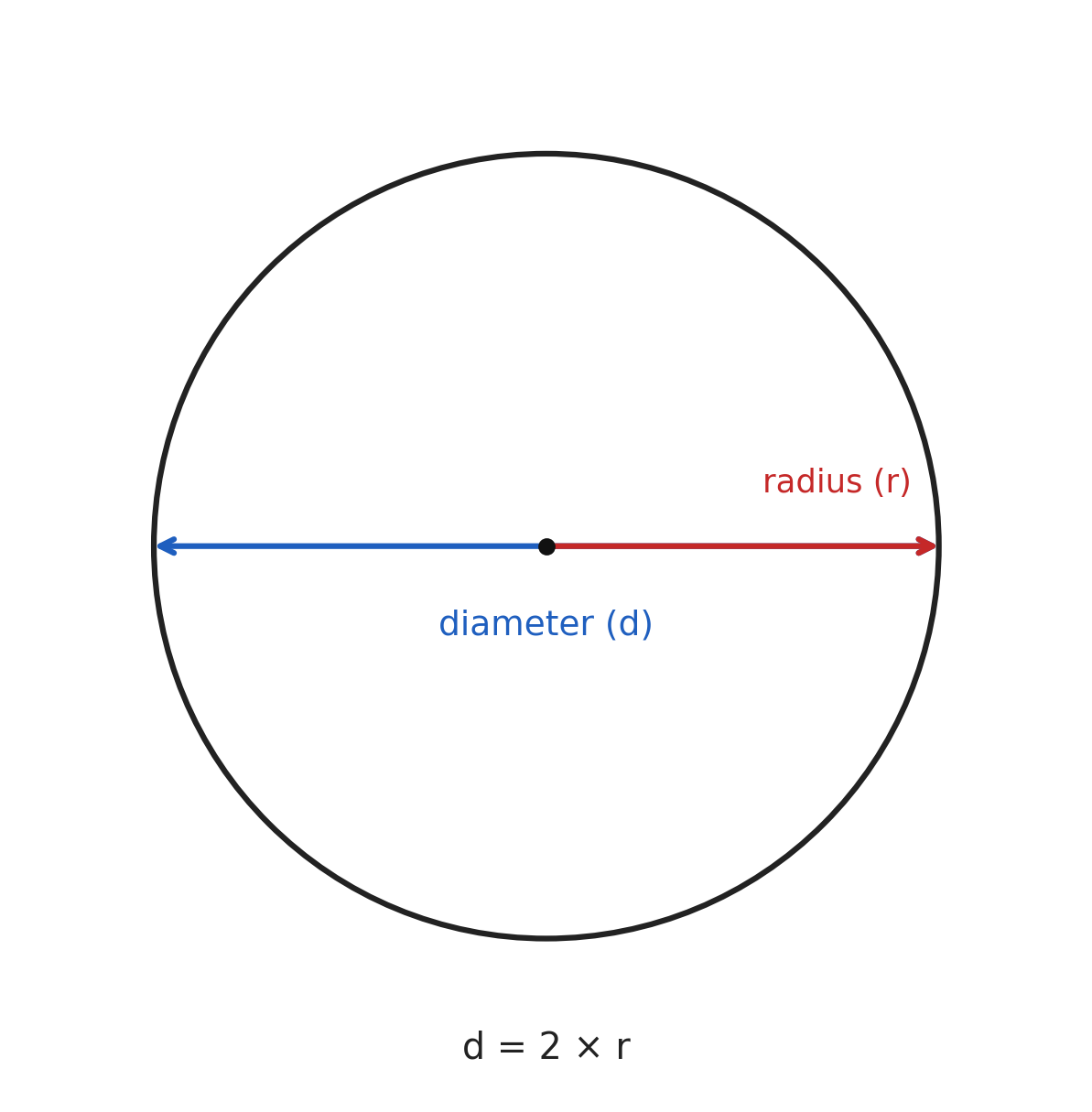
Before calculating area, let’s review the essential components of a circle. Because the area formula specifically uses the radius, you must always check if you need to convert from the diameter first:
- Radius (): The distance from the center to the edge.
- Diameter (): The distance straight across through the center ().
- π (Pi): A mathematical constant approximately equal to 3.14.
If a problem provides the diameter, divide it by to find the radius () before starting your area calculation.
🔵 The Circle Area Formula
With the radius and π in hand, here is the formula for the area of a circle:
The process has three clear steps:
- Start with the radius ().
- Square the radius by multiplying it by itself ().
- Multiply that product by π.
As with all area calculations, the answer is expressed in square units (, , , etc.). Even though a circle has no corners, its area still represents how many unit squares fit inside the curved boundary.
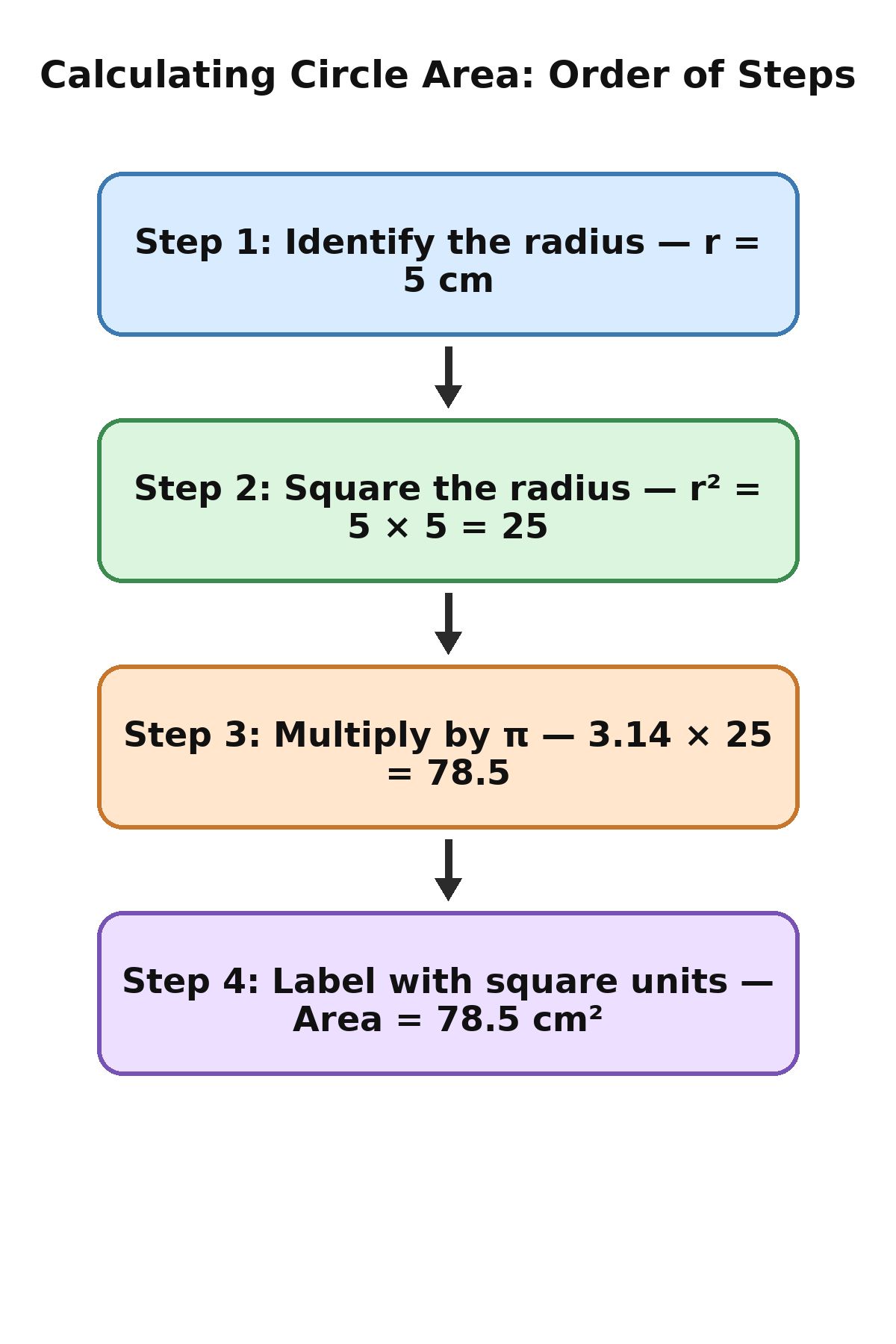
Let's walk through a straightforward example. A circle has a radius of .
- Square the radius: .
- Multiply by π: .
- Attach the square units: .
That means roughly unit squares would fit inside this circle. Notice how we squared the radius first and then multiplied by π. Getting this order right matters — it is one of the most common spots where errors creep in.
✂️ When You Are Given the Diameter
Many real-world problems state the diameter rather than the radius. A dinner plate might be described as " across," or a circular pool might be listed as " in diameter." In these cases, add one extra step at the beginning: divide the diameter by to get the radius.
Let's find the area of a circular rug that is in diameter:
- Convert to radius: .
- Square the radius: .
- Multiply by π: .
- Express the result: .
A common and costly mistake is to skip the conversion and plug the full diameter into the formula as if it were the radius. That would give you an area four times too large, since . Always pause and ask yourself: am I using the radius or the diameter?
🎯 Working with Decimals and Rounding
Real measurements are often not neat whole numbers, but the formula works exactly the same way with decimals. Consider a circle with a radius of :
When the result has many decimal places, round to a reasonable level of precision. For most practical purposes, one or two decimal places is plenty. Here, you would report the area as approximately .
A quick sanity check can catch errors before they stick. Since is between and , the squared radius is between and , placing the area roughly between and . Your answer of falls right in that range which is a good sign you are on track.
🚩 Common Mistakes to Watch For
As you begin practicing, keep these pitfalls on your radar:
- Using the diameter instead of the radius. If a problem says "diameter is ," the radius is . Plugging in gives an answer four times too large.
- Multiplying by π before squaring. The correct order is to square the radius first, then multiply by π. Computing instead of produces the wrong result.
- Forgetting the square units. Area must carry a squared label like or , not plain or .
- Rounding π too aggressively. If you round π to instead of , your answer can be noticeably off. Use at least or your calculator's π key.
Conclusion and Next Steps
The area of any circle boils down to one elegant formula: . Square the radius, multiply by π, and label your answer in square units. When only the diameter is given, divide by first to find the radius, and when decimals appear, round your final answer to one or two decimal places.
You now have area formulas for rectangles, triangles, and circles in your toolkit. In the upcoming practice, you will explore how a circle's area changes as the radius grows, match key circle vocabulary to the right descriptions, work through guided calculations step by step, and figure out how much surface a round pizza really covers. Let's jump in and make second nature!
