Solve Area Problems in Everyday Situations
Introduction 🎉
Welcome back to Area of 2D Shapes! Over the previous three lessons, you learned how to calculate the area of rectangles, squares, triangles, and circles. Each of those lessons gave you a specific formula and plenty of practice applying it.
This lesson focuses on solving real-world area problems by bringing those formulas together. You will now learn how to analyze a situation, select the right mathematical tool, and translate your calculation into a practical decision. By the end, you will be able to:
- Identify the correct area formula based on a real-world description.
- Calculate surface area accurately, and see how to find the area of a basic irregular shape by breaking it into simpler parts.
- Interpret your result in practical terms and attach the correct square units.
Up to this point, each lesson told you what shape you were working with. In everyday life, nobody labels a patio as "a circle with radius ." Instead, you might hear, "I need enough pavers to cover the round patio out back. It measures about feet across." Your job is to recognize the circle, recall that "across" means diameter, convert to a radius, and then calculate.
This shift from "apply a given formula" to "choose and apply the right formula" is where math becomes genuinely useful. Think of it as moving from practicing individual tools in a workshop to actually building something with them. Every real-world area problem follows the same mental path: read the situation → identify the shape → pick the formula → compute → interpret the result. Once that sequence becomes second nature, surface-coverage problems stop being intimidating.
🧰 Your Area Formula Toolkit
Here is a quick reference for the three core area formulas you have built up across this course:
| Shape | Formula | Key Measurements |
|---|---|---|
| Rectangle or Square | Length and width (equal sides for a square) | |
| Triangle | Base and perpendicular height | |
| Circle | Radius (divide diameter by if needed) |
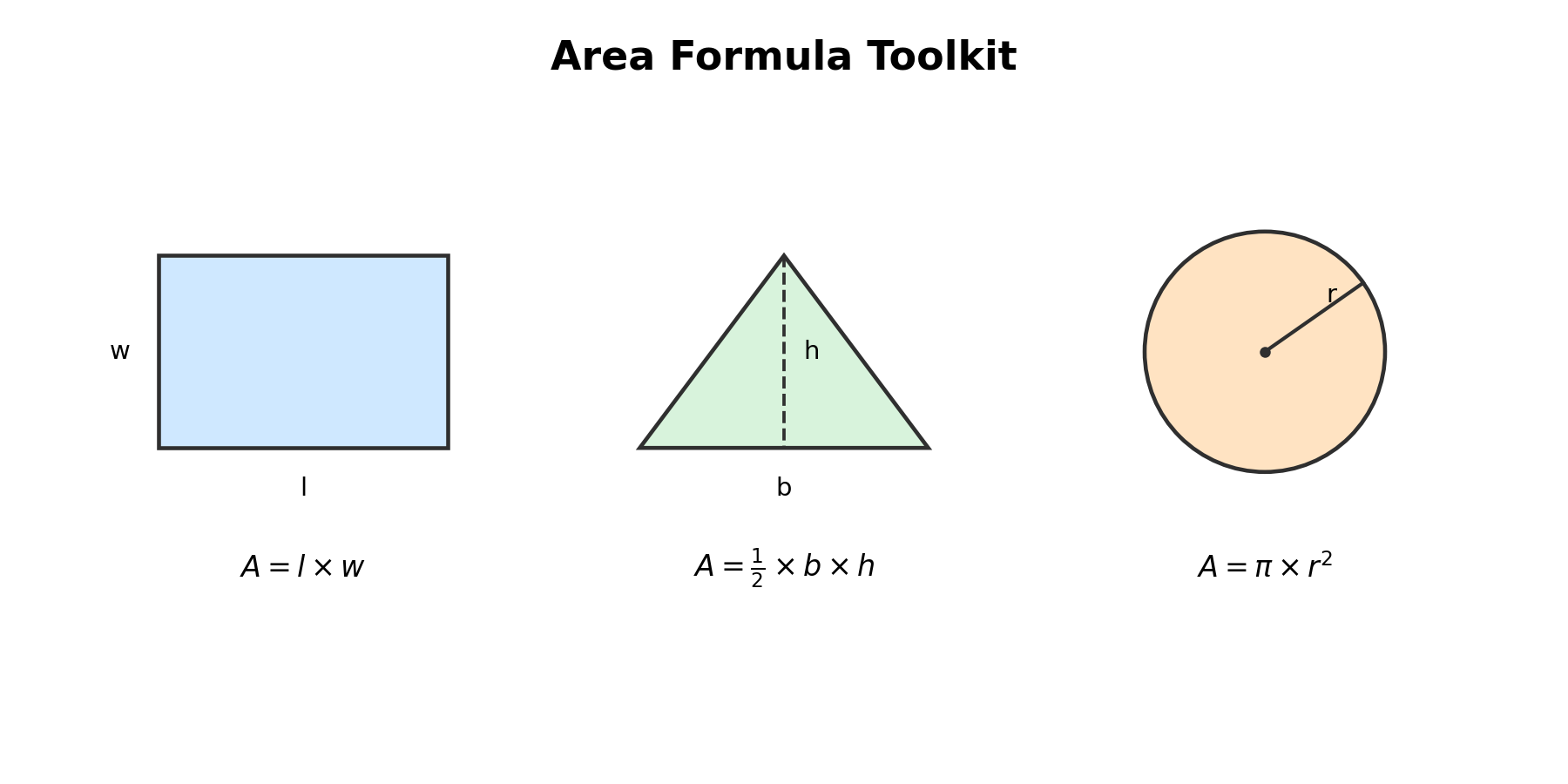
Keep this table in mind as your go-to reference. The rest of this lesson focuses on when and how to use each formula in realistic situations.
🔍 Spotting the Shape in Real Life
The first step in any area problem is reading the situation carefully and identifying the underlying shape. Here are a few clues that help:
- Rectangular shapes appear in floors, walls, tabletops, and book covers. Look for words like length, width, long, and wide.
- Triangular shapes show up in gable ends of roofs, sail panels, decorative wall sections, and flower beds tucked into corners. Look for three sides or references to base and height.
- Circular shapes appear in patios, tabletops, pool covers, and manhole lids. Look for words like round, diameter, radius, or across.
Example 1: A gardener says, "I am pouring a large triangular garden stone. The base of the stone is and the distance from the base to the opposite point is ." The phrase triangular garden stone and the mention of base and a perpendicular distance point directly to the triangle formula:
The gardener needs square feet of concrete for the stone.
Example 2: You want to buy a glass top for a round patio table that measures across. The word round tells you this is a circle, and across means the diameter is , giving a radius of :
You need a glass piece covering about square feet. Notice how a quick keyword scan — round, across — was all it took to land on the right formula.
🧩 Breaking Down Irregular Shapes
Not every surface is a single neat shape. Many rooms, floor plans, and walls are L-shaped, T-shaped, or otherwise irregular. The strategy is straightforward: split the shape into the common shapes you already know — rectangles, triangles, and circles (or parts of them) — find the area of each piece, and add them together. Alternatively, you can calculate the area of a larger surrounding shape and subtract the missing section.
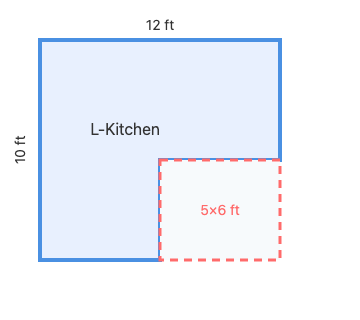
L-shaped kitchen example: Imagine a kitchen that is long and wide overall, but a section is missing from one corner. Calculate the full rectangle and subtract the missing piece:
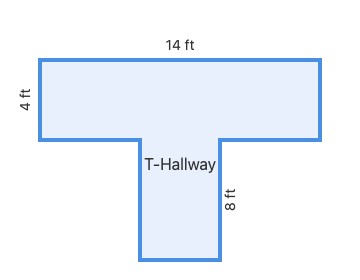
T-shaped hallway example: A hallway has a long horizontal section that is and a vertical section extending from its center that is . Since the two rectangles do not overlap, simply add their areas:
The key idea is the same in every case: any irregular shape can be broken into simpler shapes you already know how to solve. The examples above split cleanly into rectangles, but the same logic applies when a surface combines different shapes — a rectangular wall topped with a triangular gable, or a rectangular patio with a rounded end, for instance. If the shape is made of several visible sections, you can find each area and add them together. If the shape looks like a larger shape with a piece cut out, you can find the full area first and subtract the missing part. Either way, the goal is to avoid guessing by turning the irregular shape into familiar shapes. Pick whichever approach makes the dimensions easiest to work with, and be careful not to double-count or leave out any section.
🏠 Calculating Paint for a Gable Wall
A strong answer to a real-world area problem has four parts: the correct formula, an accurate calculation, the right square units, and a brief interpretation of what the number means. Let's walk through a full example that combines two different shapes.
Scenario: You are redecorating a child's bedroom. One wall has a rectangular section that is wide and tall, plus a triangular gable section above it with a base of and a height of . How much paint coverage do you need for the entire wall?
- Identify the shapes. The wall has two parts: a rectangle and a triangle.
- Choose the formulas. Rectangle: . Triangle: .
- Calculate each area.
- Combine and interpret.
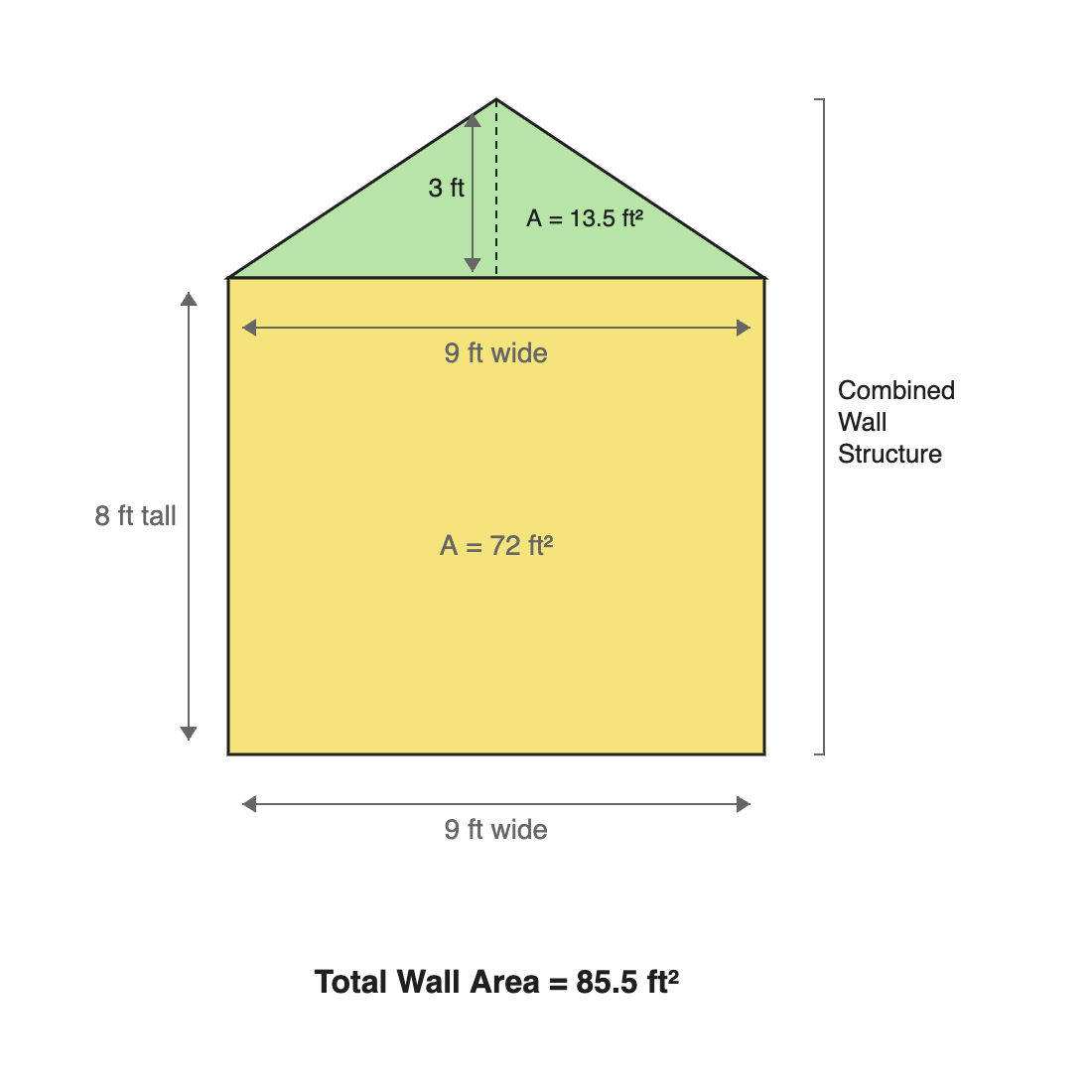
Interpretation: You need enough paint to cover square feet of wall surface. If a can of paint covers , one can will be sufficient.
Notice how the final step goes beyond the number. Stating what the result means — how much material to buy, whether one can is enough — confirms that area was the right measurement and that the answer makes practical sense.
🚧 Common Mistakes to Watch For
When solving area problems in context, a few errors come up again and again. Keeping them on your radar will save you time and frustration:
- Choosing the wrong formula. A round table requires , not . Always match the formula to the shape you actually see.
- Using mismatched dimensions. For triangles, the height must be perpendicular to the base. A slanted side length is not the height.
- Forgetting to split or subtract. For irregular shapes like an L-shaped room, skipping the split leads to an area that is too large or too small.
- Dropping the square units. An answer of " feet" sounds like a length. Writing makes it clear you are talking about surface coverage.
- Skipping the interpretation. In real situations, a bare number is not very helpful. Always state what the area means: how much tile, paint, fabric, or sod you actually need.
Conclusion and Next Steps
In this lesson, you learned how to read a real-world situation, identify the shape involved, select the matching area formula, and carry the calculation through to a meaningful result. You also practiced breaking irregular floor plans — like L-shaped kitchens and T-shaped hallways — into simpler rectangles that you can add or subtract.
You now have a complete area toolkit covering rectangles, triangles, circles, and composite shapes. Up next is a set of practice exercises where you will match scenarios to formulas, spot hidden errors in sample calculations, and work through full problems on your own — let's put these skills to the test!
