Vertical Shifts in Functions
Introduction
Welcome back to Vertical Shifts: Moving Graphs Up and Down. You have the four parent graphs and their anchor points in hand, and that puts you at the second of three lessons in this course—the one where those graphs finally start to move.
Here is the situation we are about to solve. Suppose someone hands you and then hands you . You could build a fresh table of values and plot the second curve from scratch, or you could notice that it is the same curve at a new height and get there in seconds. This lesson is about earning that second option: predicting the new picture, sketching it, tabulating it, and evaluating a shifted function no matter how the original one is presented.
Adding After the Function Happens
Think of a ride-share app that quotes a fare based on distance, then tacks on a flat $3 service fee at the very end. The distance calculation is untouched; the fee lands on the result. Every trip, short or long, ends up exactly $3 more expensive than before.
That is precisely what does. The input goes into exactly as it always did, and only afterward do we add to whatever came out.
Because every output changes by the same amount, no part of the graph gets stretched or bent relative to any other part. The whole picture lifts or drops as one rigid piece, like a photo slid up a wall.
The Transformation Rule
Here is the rule we will lean on for the rest of this course. If the point sits on the graph of , then the graph of contains the point
Read it carefully: the -coordinate does not budge, and the -coordinate gains . We call this a rigid vertical translation—rigid because the graph slides without bending, stretching, or flipping, and vertical because only heights change.
The sign of carries the direction. A positive moves the graph up by units, a negative moves it down by units, and leaves it exactly where it was.
Sliding a Parent Graph
Let us shift up by , giving . From the previous lesson, the parabola's three key points are the vertex plus the references and . Adding to each output is all the work there is.
| Point on | Role | Point on |
|---|---|---|
| Vertex (anchor) | ||
| Reference | ||
| Reference |
Plotted together, the two curves make the three-unit slide easy to see.
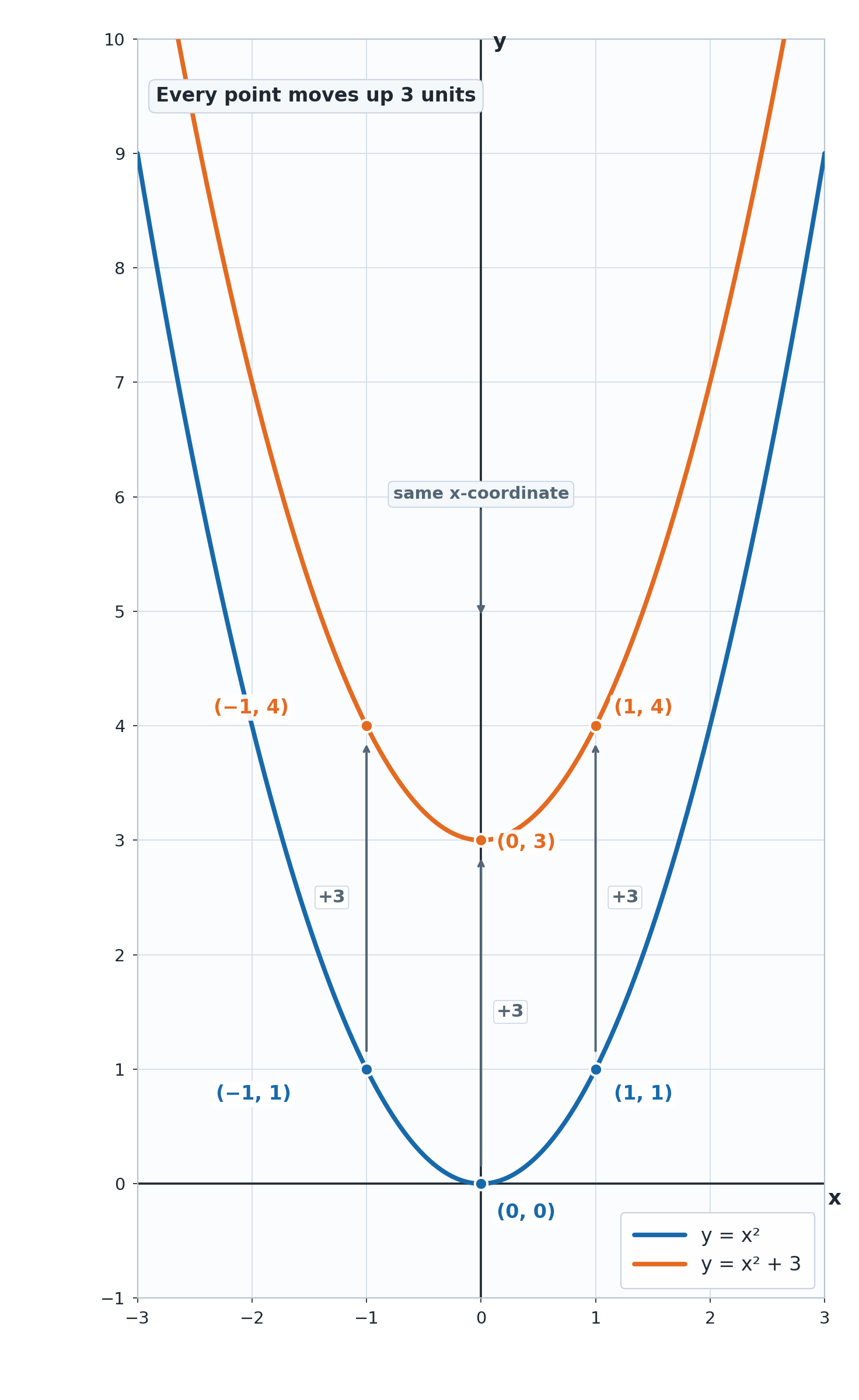
Notice what survived the trip: the U still opens upward, it is still the same width, and the reference points still sit one unit left and right of the vertex and one unit above it. So the sketching routine is short—shift the anchor, shift the reference points, then redraw the same shape around them.
