Vertical Shifts Foundations
Introduction
Welcome to Vertical Shifts: Moving Graphs Up and Down! This is the first of three lessons in the course, so we are starting right at the foundation.
Before we can move a graph up or down, we need something to move. That "something" is a small family of basic graphs called parent functions, and the trick that makes moving them easy is tracking just a few well-chosen points instead of the whole curve.
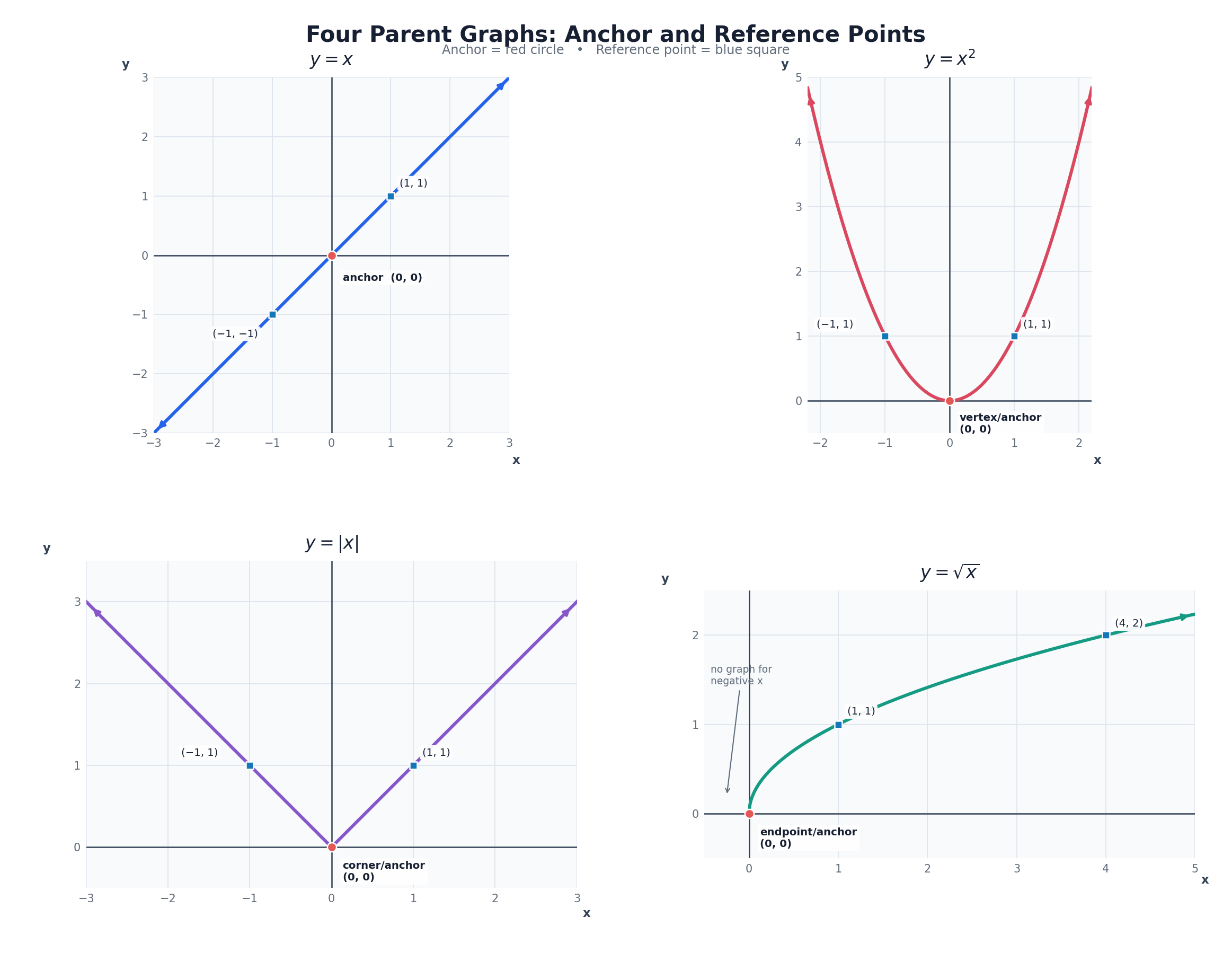
In this lesson, we will meet four parent graphs, learn to recognize each one by shape, name a single anchor point for each, and add one or two nearby reference points so that we can rebuild the curve from memory.
Why Track Points Instead of Whole Curves
Imagine describing where a couch sits in a room. You do not measure every edge; you say "the left front leg is two feet from the door," and the rest of the couch follows along. Graph transformations work the same way: when a curve slides, every point on it moves by the same rule, so tracking one or two easy points tells us where the whole picture went.
That is why anchor points matter. An anchor point is the one point on a parent graph that is easiest to spot and easiest to follow: the corner, the tip, the endpoint, or the natural starting spot.
Reference points are one or two nearby points that pin down the shape around the anchor. They tell us how steeply the curve rises and whether it bends, which is the information a lone anchor cannot carry.
The Four Parent Graphs
Here are the four shapes we will use for the rest of this learning path. Think of each function as a rule that turns an input into an output .
| Function | Name | Shape | Domain (allowed inputs) |
|---|---|---|---|
| Identity (linear) | A straight line through the origin, rising at 45° | All real numbers | |
| Squaring (quadratic) | A U-shaped curve called a parabola | All real numbers | |
| Absolute value | A sharp V, made of two straight rays | All real numbers | |
| Square root | Half of a sideways parabola, starting at one endpoint | only |
Two quick reminders on how these rules work. The absolute value strips off the minus sign, so and . The square root asks "what non-negative number squared gives ?", and since no real number squared is negative, simply has no output when is negative.