The False Positive Paradox
Introduction
Welcome back to Updating Beliefs and Surprising Results! You are now on lesson two of five in this course, and you are building real momentum. In the previous lesson, we saw how a single change in the prior can swing a posterior from slim to near-certain, even when the test itself stays exactly the same. That idea is important on its own, but it also sets the stage for one of the most famous and most misunderstood results in all of probability.
This lesson zooms in on a specific case of that prior-driven behavior: the false positive paradox. We will work through a scenario where a highly accurate test delivers a positive result for a rare condition, and yet the chance of actually having the condition remains surprisingly low. By the end, you will not only be able to compute this result but also explain why it happens and why the math is right even when intuition protests.
The Trap of "99% Accurate"
Imagine you read a headline: "New screening test is 99% accurate!" Most people would assume that a positive result from such a test is nearly a guarantee. After all, the test is wrong only 1% of the time. How bad can it be?
The catch is that accuracy alone does not tell us what a positive result means. We also need to know how common the condition is in the first place. As we explored last lesson, the prior does much of the heavy lifting. When the condition is rare, something counterintuitive happens, and understanding exactly what that is forms the heart of this lesson.
A Screening Scenario
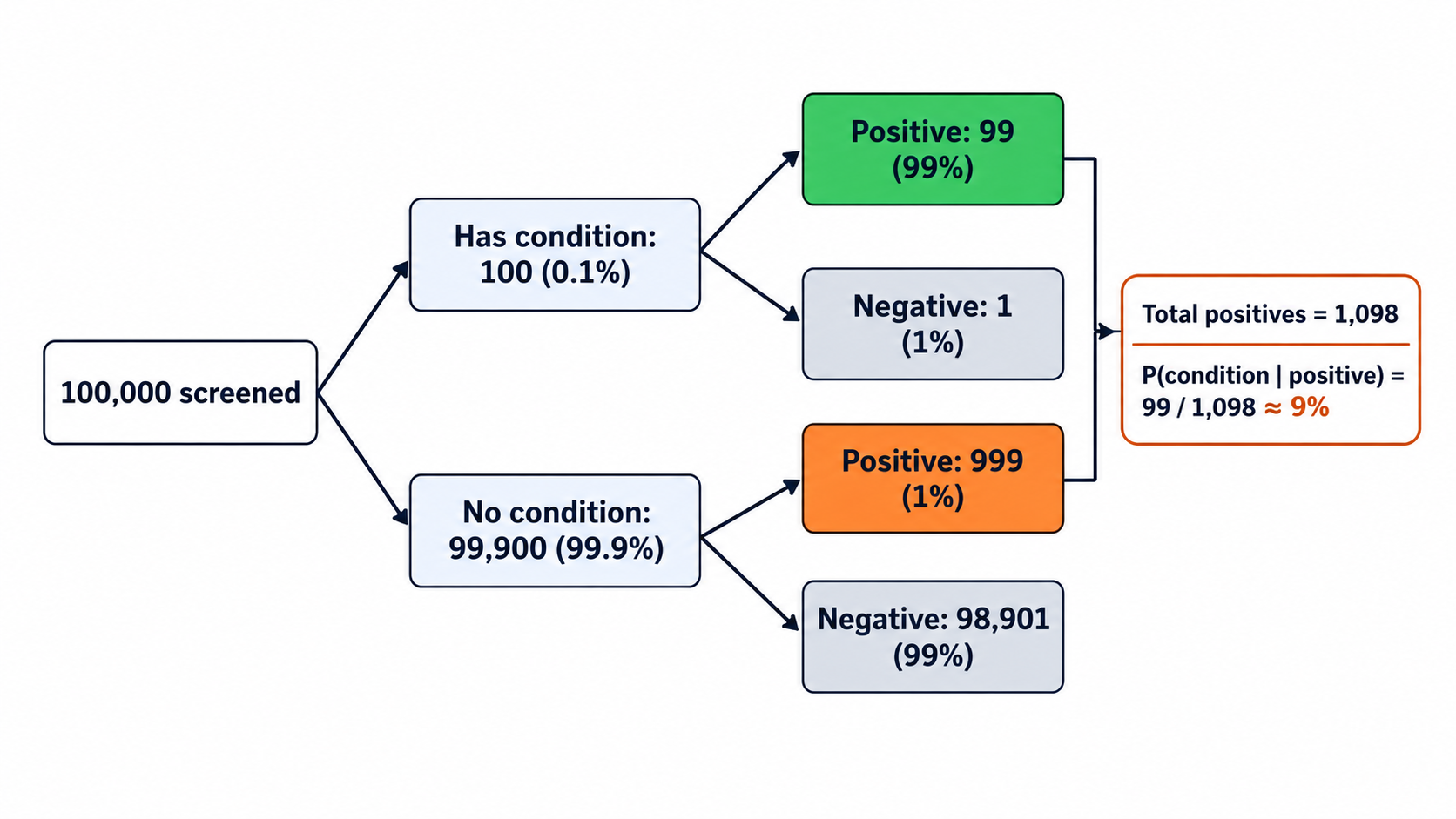
Let us set up a concrete example. Suppose a certain medical condition affects 1 in every 1,000 people in the general population. A screening test for this condition has the following performance:
- Sensitivity (true positive rate): 99%, meaning
- False positive rate: 1%, meaning
These numbers look excellent. The test catches 99 out of 100 people who truly have the condition and incorrectly flags only 1 out of 100 healthy people. Now suppose you take this test and receive a positive result. What is the probability that you actually have the condition?
Before we calculate, take a moment to form a gut estimate. Many people guess somewhere around 90% or higher. Let us see what the math says.