Priors Shaping Posteriors
Introduction
Welcome to Updating Beliefs and Surprising Results, the third course in our Bayesian reasoning learning path! If you have been following along, you have already built a solid foundation: you know how to treat probability as a degree of belief, and you can compute posteriors fluently using Bayes' theorem. That toolkit puts you in a great position for what comes next.
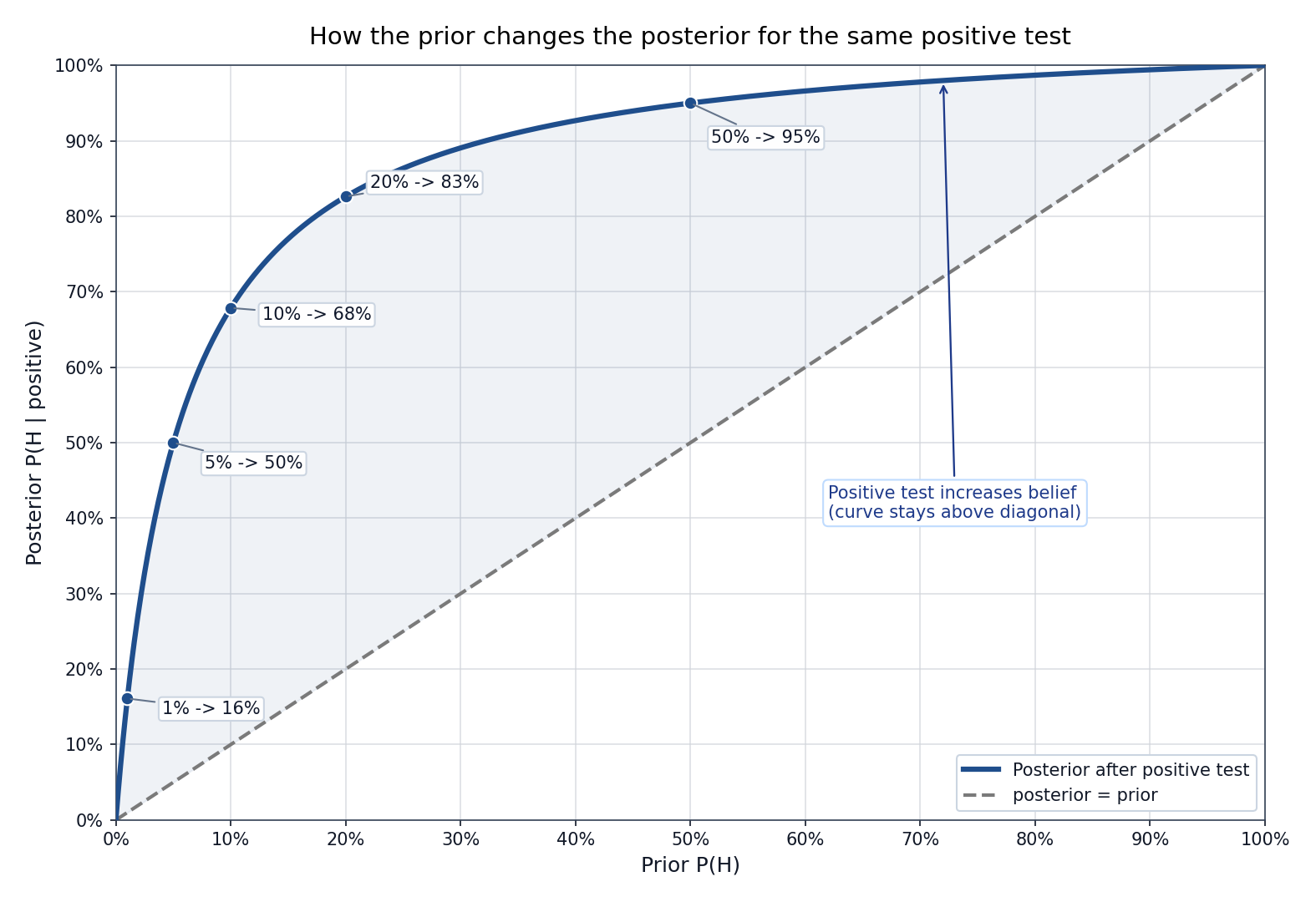
In this first lesson, we shift our attention from how to calculate posteriors to why those posteriors sometimes behave in surprising ways. We start by exploring a simple but powerful idea: the prior probability you begin with has an enormous influence on where you end up after seeing evidence. The same test result, the same piece of news, or the same medical symptom can lead to very different conclusions depending on your starting belief.
Bayes' Theorem in One Glance
As you may recall from the previous course, Bayes' theorem tells us how to update a belief after observing evidence:
Here is a quick reminder of what each piece represents:
- is the prior, our belief in the hypothesis before seeing the evidence.
- is the likelihood, the probability of observing this evidence if the hypothesis is true.
- is the total probability of the evidence, computed across all possible hypotheses.
- is the posterior, our updated belief after the evidence arrives.
In this lesson, we are going to hold and the false positive rate steady and change only . By doing so, we can isolate exactly how much work the prior is doing behind the scenes.
Same Test, Two Different Worlds
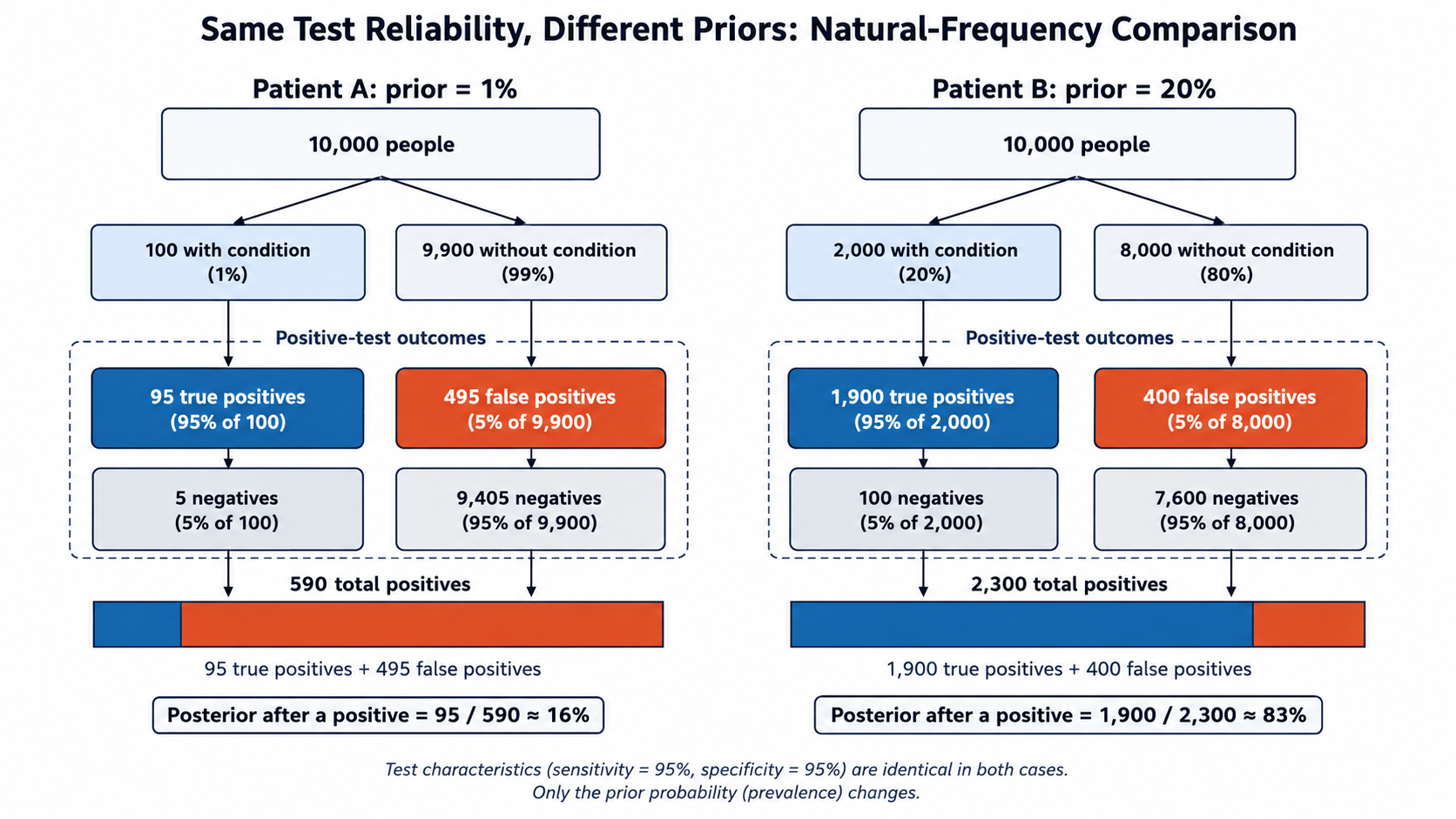
Imagine a rapid diagnostic test for a particular medical condition. The test has a true positive rate (sensitivity) of 95%, meaning , and a false positive rate of 5%, meaning . These numbers stay the same no matter who takes the test.
Now consider two patients who both receive a positive result. Patient A comes from the general population, where only 1% of people have the condition. Patient B belongs to a known high-risk group, where 20% of people have the condition.
The test is identical. The result is identical. The only thing that differs is the prior, the base rate of the condition in each patient's group. Let us see what happens when we compute the posterior for each.