Spotting Base Rate Neglect
Introduction
Welcome back to Updating Beliefs and Surprising Results! You have reached lesson three of five in this course, and each lesson has been adding a new layer to the same core idea. In lesson one, we discovered how much power the prior holds over the posterior. In lesson two, we saw that power at work in the false positive paradox, where a 99% accurate test paired with a rare condition produced a posterior of only about 9%.
Those lessons gave us the math. This lesson gives us the skill: learning to spot base-rate neglect in the reasoning people actually use, and knowing how to correct it. By the end of this lesson, you will be able to recognize when an argument ignores the base rate, explain why that matters, and show how restoring the missing base rate changes the conclusion.
From Paradox to Pattern
The false positive paradox is a striking result, but the mistake that makes people fall for it is not limited to medical tests. Anytime someone jumps from a piece of evidence to a strong conclusion without considering how common or rare the hypothesis is, they are committing base-rate neglect. It shows up in courtrooms, news headlines, hiring decisions, and casual conversation.
Why is this mistake so common? Evidence tends to be vivid and immediate — a test comes back positive, an alarm goes off, a detector flags a document. Base rates, by contrast, are abstract background statistics that rarely command our attention. When a dramatic piece of evidence lands in front of us, it crowds out the quieter question of how likely the hypothesis was before that evidence appeared. This tendency affects experts and novices alike, which is why learning to spot it is one of the most practically useful skills in probabilistic thinking.
What Base Rate Neglect Sounds Like
Base-rate neglect often hides inside confident-sounding statements. Consider these three arguments:
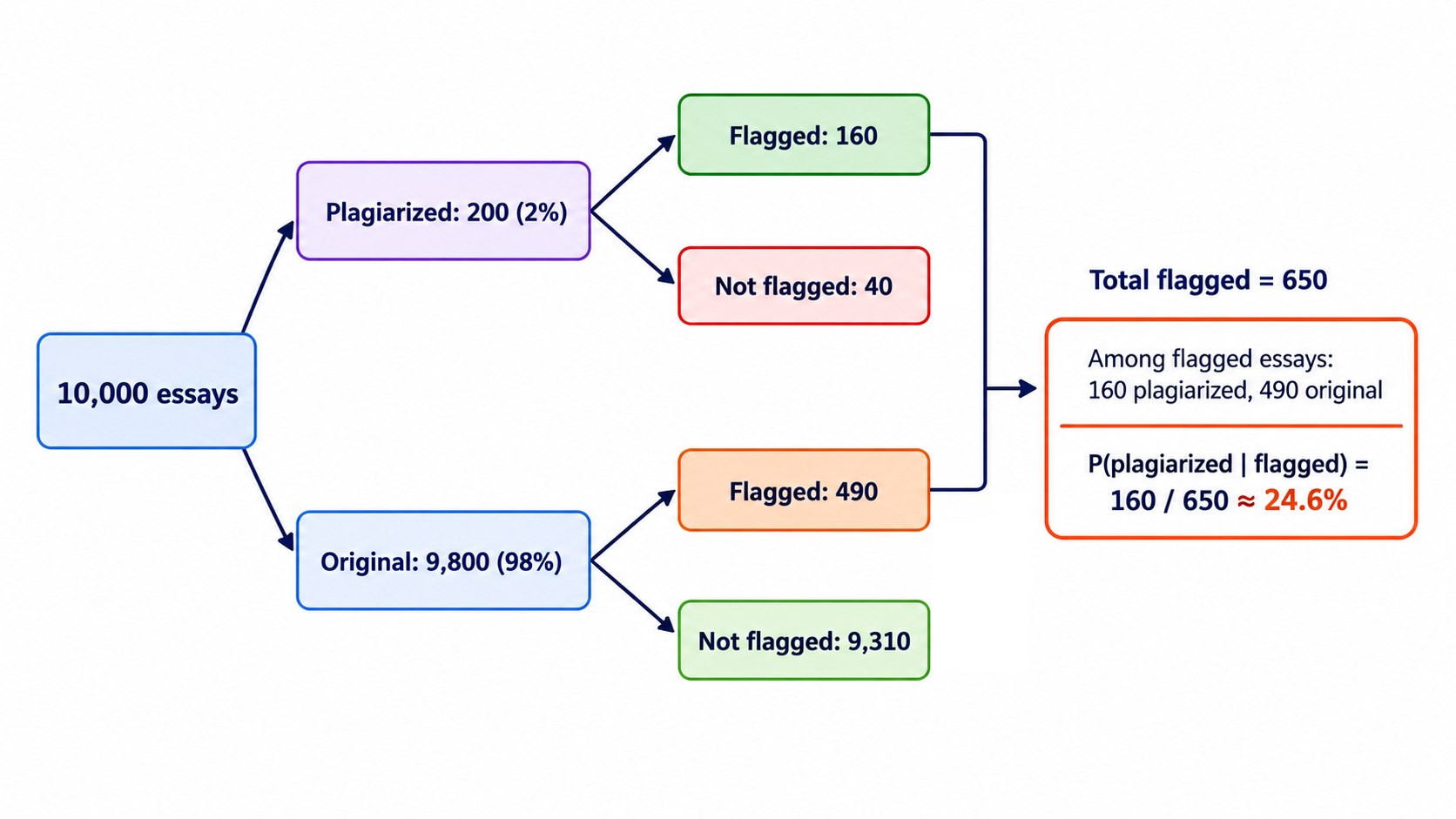
- "The plagiarism detector flagged this essay, so the student probably cheated."
- "He fits the profile of a smuggler, so we should detain him."
- "She tested positive on a rapid screening, so she almost certainly has the infection."
Each one jumps from evidence (a flag, a profile match, a positive test) straight to a conclusion about the hypothesis, without asking a critical question: How common is this hypothesis in the first place? Notice the shared structure: the speaker presents evidence that sounds convincing on its own and treats it as if it settles the matter. What is missing is the prior probability of the hypothesis — the base rate. Without it, the conclusion can be wildly off.