Understanding Squared Deviations
Introduction
Welcome back to Understanding Standard Deviation! You are now on lesson three of five, and the foundation you have built so far is about to pay off. Lesson one gave you signed deviations — the raw gaps between each data value and the mean. Lesson two showed you what standard deviation means at a conceptual level: the typical distance a value falls from the mean. Today we confront a practical hurdle that stands between concept and calculation. Because positive and negative deviations cancel to zero when added, we need a mathematical tool that keeps every gap's contribution alive. That tool is squaring, and understanding why it works is the goal of this lesson.
Why We Cannot Use Raw Deviations Directly
You already know the punchline from lesson one: the sum of raw deviations is always zero. That perfect cancellation is not a quirk of one dataset — it is a built-in property of the mean. Any formula that simply adds up deviations will hit the same dead end.
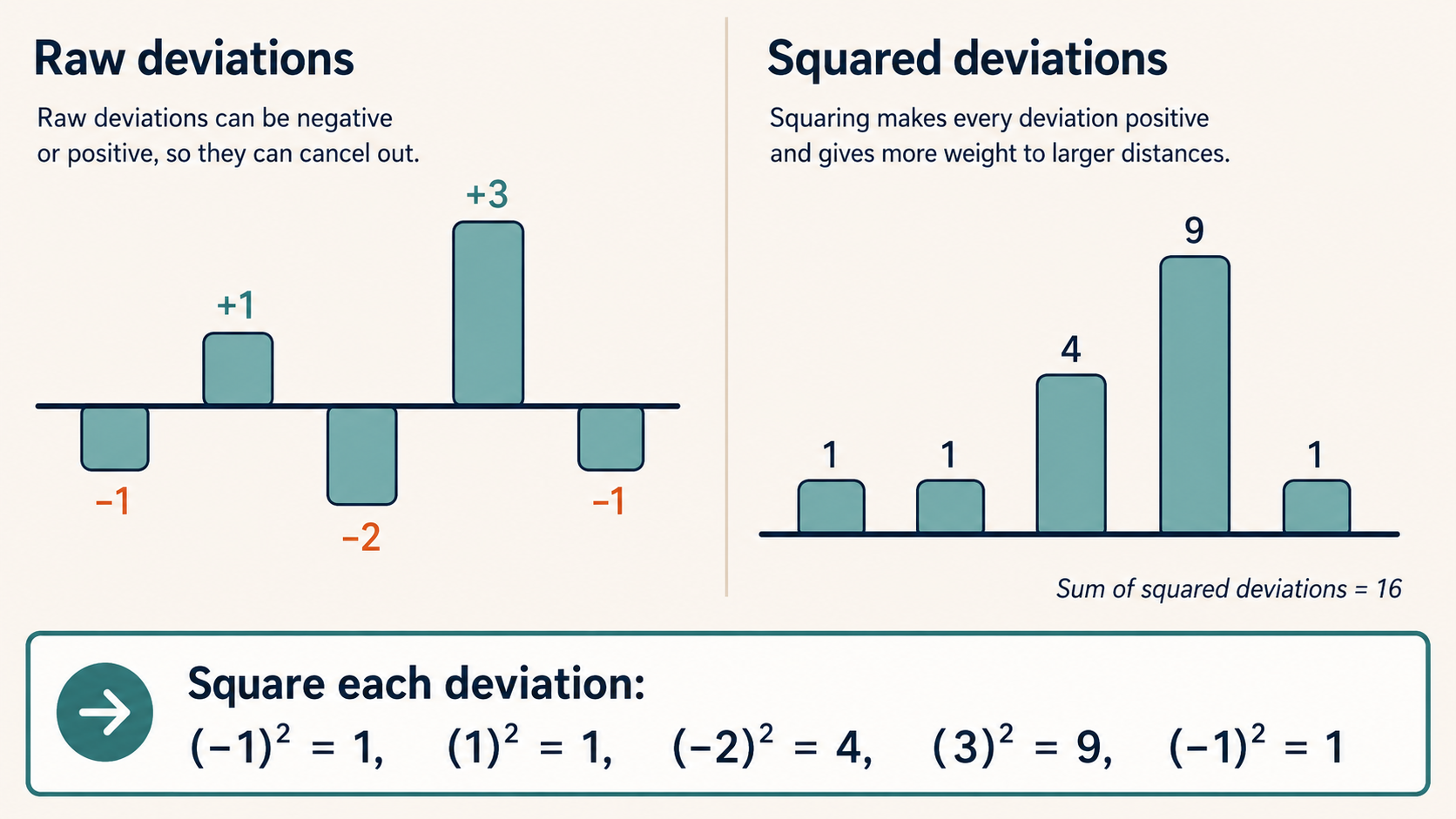
Last lesson, we sidestepped this by imagining the signs stripped away so we could think about pure distances. That mental shortcut was great for building intuition, but a formula needs a concrete operation, not a thought experiment. Squaring each deviation is that operation, and it delivers two benefits at once: it makes every result non-negative, and it gives extra weight to values far from the mean. Let us walk through both ideas with a fresh example.
Squaring Each Deviation Step by Step
Consider a student's scores on five short quizzes, each out of 10 points: 6, 8, 5, 10, 6. The mean is:
We first compute each deviation , then square it to get :
| Quiz | Score | Deviation | Squared Deviation |
|---|---|---|---|
| 1 | 6 | ||
| 2 | 8 | ||
| 3 | 5 | ||
| 4 | 10 | ||
| 5 | 6 |
The mechanics are straightforward: take each deviation and multiply it by itself. For Quiz 3 the deviation is , so . For Quiz 4 the deviation is , so . Notice that every result is zero or positive, no matter what sign the original deviation carried.