Welcome back to Understanding Inequalities! You are now on the third lesson of the course, and your symbol toolkit is already looking strong. In the first two lessons, we learned the four inequality symbols — <, >, ≤, and ≥ — and explored how to decide whether a boundary value should be included or excluded. Now comes a skill that ties everything together: translating the everyday phrases people actually say and write into the correct mathematical symbol. Phrases like "more than," "at least," and "no more than" appear constantly in rules, requirements, and descriptions, and each one maps to a specific symbol. By the end of this lesson, you will be able to move confidently in both directions, from words to symbols and from symbols back to words.
Why Words Matter
Math problems rarely hand us a neat symbol on a silver platter. Instead, we encounter sentences like "You must be at least 13 to create an account" or "This package weighs less than 50 pounds." Before we can do any math, we need to decode the comparison phrase hiding inside the sentence and convert it to the right symbol.
Getting this translation wrong — even by mixing up "less than" with "at most" — can change whether the boundary value is included or excluded. That small difference, as we saw in our previous lesson, can matter a great deal in real situations like weight limits, age requirements, and spending caps.
Phrases for Strict Inequalities
Some comparison phrases tell us the boundary value is not part of the deal. These phrases map to the strict symbols < and >, which do not allow equality.
"Less than" and its close relatives point to <. If a recipe says "cook for less than 10 minutes," then exactly 10 minutes is too long. We write:
t<10
Other phrases that work the same way include fewer than, under, and below. They all exclude the boundary.
"More than" and its synonyms point to >. If a job posting says "more than 3 years of experience required," then exactly 3 years does not qualify. We write:
y>3
Phrases like greater than, over, and above carry the same meaning. In every case, the boundary value itself is left out.
Phrases for Inclusive Inequalities
Join the 1M+ learners on CodeSignal
Be a part of our community of 1M+ users who develop and demonstrate their skills on CodeSignal
Other phrases specifically invite the boundary value in. These map to ≤ and ≥.
"At least" means the value can equal the boundary or go higher, so it maps to ≥. A sign that reads "you must be at least 18 to vote" allows exactly 18. We write:
age≥18
"At most" means the value can equal the boundary or go lower, so it maps to ≤. If a class has room for "at most 30 students," then exactly 30 is fine. We write:
students≤30
A helpful way to remember: at least sets a floor (nothing below), and at most sets a ceiling (nothing above). Both include the boundary itself.
A few phrases trip people up because the word no or not adds a layer of negation. Let's slow down and unpack them.
"No more than" means the quantity does not exceed a value. If a carry-on bag must weigh no more than 22 pounds, then 22 is acceptable but 22.1 is not. That is the same as saying the weight is less than or equal to 22:
w≤22
"No fewer than" (or "no less than") works in the opposite direction. If a course requires no fewer than 12 credits, then 12 credits is enough but 11 is not. This is the same as greater than or equal to:
credits≥12
The trick with these phrases is to read them carefully and ask: Is the boundary allowed? With "no more than 22," test 22 — can the bag weigh exactly 22? Yes. So the boundary is included, and we use ≤. This "test the boundary" habit from our previous lesson remains our most reliable tool.
Here is a reference table that gathers everything in one place:
Phrase
Symbol
Boundary Included?
less than, fewer than, under, below
<
No
greater than, more than, over, above
>
No
at most, no more than, up to
≤
Yes
at least, no fewer than, no less than
≥
Yes
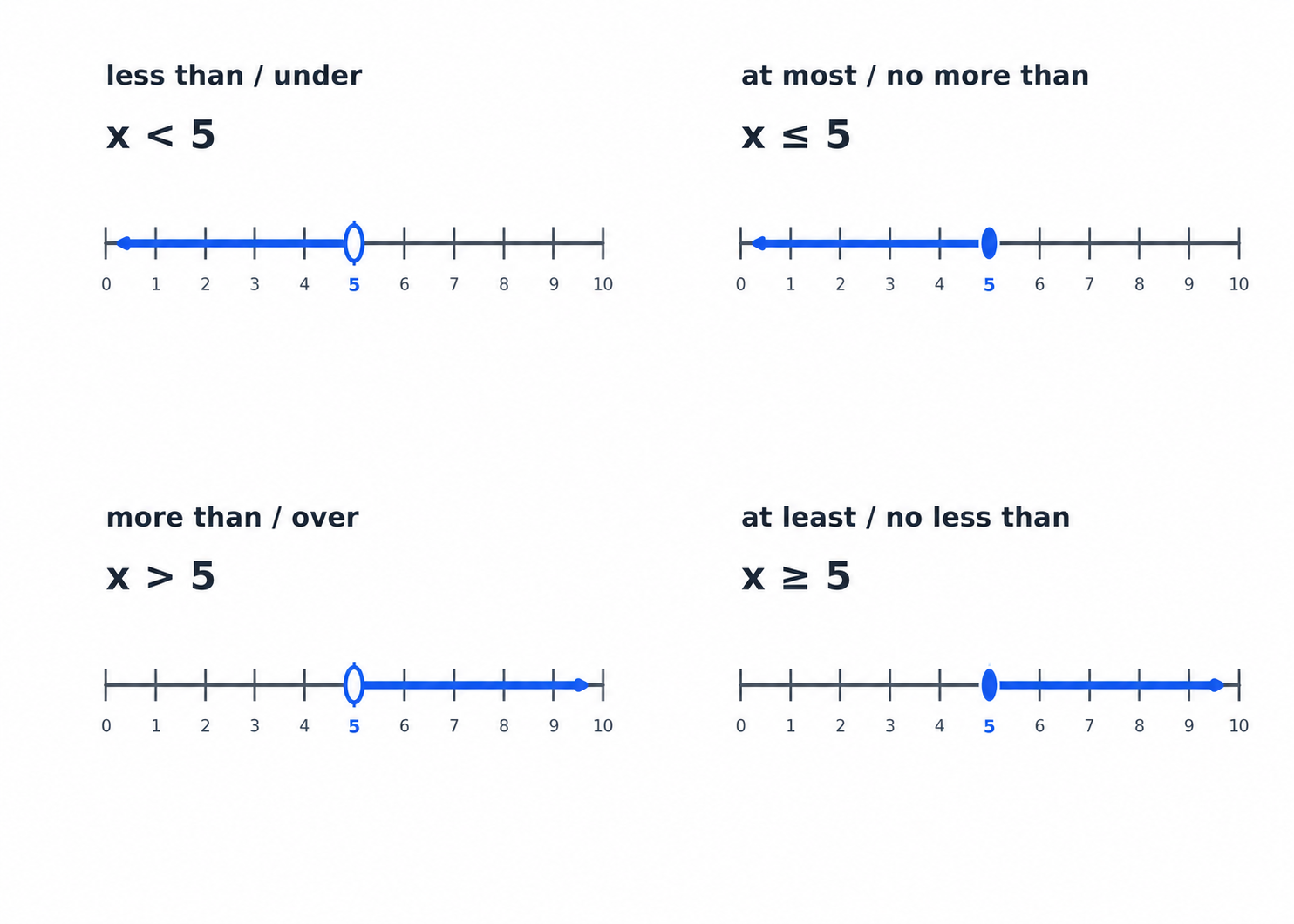
A quick visual summary can help reinforce both the direction of the inequality and whether the boundary point is open or closed:
You do not need to memorize every phrase individually. Instead, notice the pattern: if the phrase allows equality with the boundary, use an inclusive symbol (≤ or ≥). If it excludes the boundary, use a strict symbol (< or >).
Translation works in both directions. Given n≥5, we might say "n is at least 5" or "n is no less than 5." Both are correct because both convey that 5 is included and every value above 5 also qualifies.
When converting a symbol to words, pick the phrasing that sounds most natural in context. For instance, if n represents the number of guests at a dinner party, saying "there are at least 5 guests" reads more smoothly than "the guest count is greater than or equal to 5." The math is identical, but clear language helps others understand the rule at a glance.
Now consider the opposite direction. Suppose we see p<20, where p is a price in dollars. We could say "the price is less than $20" or "the price is under $20." Both versions correctly exclude 20 from the allowed values.
Confusing "at least" with "more than." "At least 10" includes 10 (≥10), while "more than 10" excludes it (>10). These two phrases look similar at first glance, but they land on different symbols.
Misreading "no more than" as "more than." The word no flips the meaning entirely. "More than 50" means >50, while "no more than 50" means ≤50. Always watch for that small but powerful word.
Forgetting to check the boundary. When in doubt, plug the boundary value in and ask, "Should this specific value be allowed?" That single test will point you to the correct symbol every time.
In this lesson we built a bridge between everyday language and mathematical symbols. We learned that phrases like less than and more than map to the strict symbols < and >, while phrases like at least, at most, and no more than map to the inclusive symbols ≥ and ≤. We also saw how to read symbols back into natural language. The key habit remains the same: when a phrase feels tricky, test the boundary value and ask whether it should be included.
Up next, you will put these translation skills into action through a set of hands-on practice tasks. You will match phrases to symbols, decode tricky wording, and write your own inequalities from real-world rules. Jump in and see how quickly these translations start to feel like second nature!