Welcome back to Understanding Inequalities! We have reached the fourth lesson of this six-lesson course, which means we are past the halfway mark of building our inequality toolkit. In the first three lessons, we mastered the four inequality symbols, learned when to include or exclude a boundary value, and practiced translating everyday phrases into mathematical notation. All of that work prepared us to ask a bigger question: once we solve an inequality, what kind of answer do we actually get? If you have spent most of your math experience working with equations, the answer might surprise you. In this lesson, we will explore how inequality solutions differ from equation solutions and why that difference is so important.
A Shift in How We Think About Answers
Up to this point, our focus has been on understanding what inequality symbols mean and how to choose the right one. That foundation matters, but there is a conceptual leap just ahead. Most math you have encountered before likely revolves around equations, where the goal is to track down one specific number that makes a statement true. Inequalities play by different rules. Their solutions do not look like a single number waiting to be found. Instead, they describe something much bigger, and understanding that bigger picture is the key to everything that follows in this course.
Equations Pin Down a Single Value
Let us start with familiar territory. Consider the equation:
x+1=5
Subtracting 1 from both sides gives x=4. That single number is the only value that makes the equation true. Plug in 3 and the left side gives 4, not 5. Plug in 6 and the left side gives 7, not 5. No matter how many numbers we try, only x=4 works.
This is the hallmark of the simple, one-variable linear equations we are studying: they have exactly one solution. The answer is a single point on the number line, and once we find it, we are done.
Inequalities Describe a Range of Values
Now let us change that equals sign to a greater-than sign:
x+1>5
Subtracting 1 from both sides gives us x>4. Watch what happens when we start testing values. Is x=5 a solution? Since 5>4, yes. What about x=10? Since 10>4, yes again. What about x=4.001? Still yes, because 4.001>4.
There is no single "right answer" here. Instead, every number greater than 4 satisfies the inequality. The solution is not one point — it is an entire range of values stretching endlessly to the right of 4 on the number line. That range never stops, which means the simple inequalities we are working with have infinitely many solutions.
Join the 1M+ learners on CodeSignal
Be a part of our community of 1M+ users who develop and demonstrate their skills on CodeSignal
For the simple, one-variable expressions we are working with, placing an equation and an inequality next to each other makes the contrast crystal clear:
Equation: x+1=5
Inequality: x+1>5
Solution
x=4
x>4
How many values?
Exactly one
Infinitely many
Answer type
A single point
A range
Example values
4 (and only 4)
5, 10, 100, 4.1, …
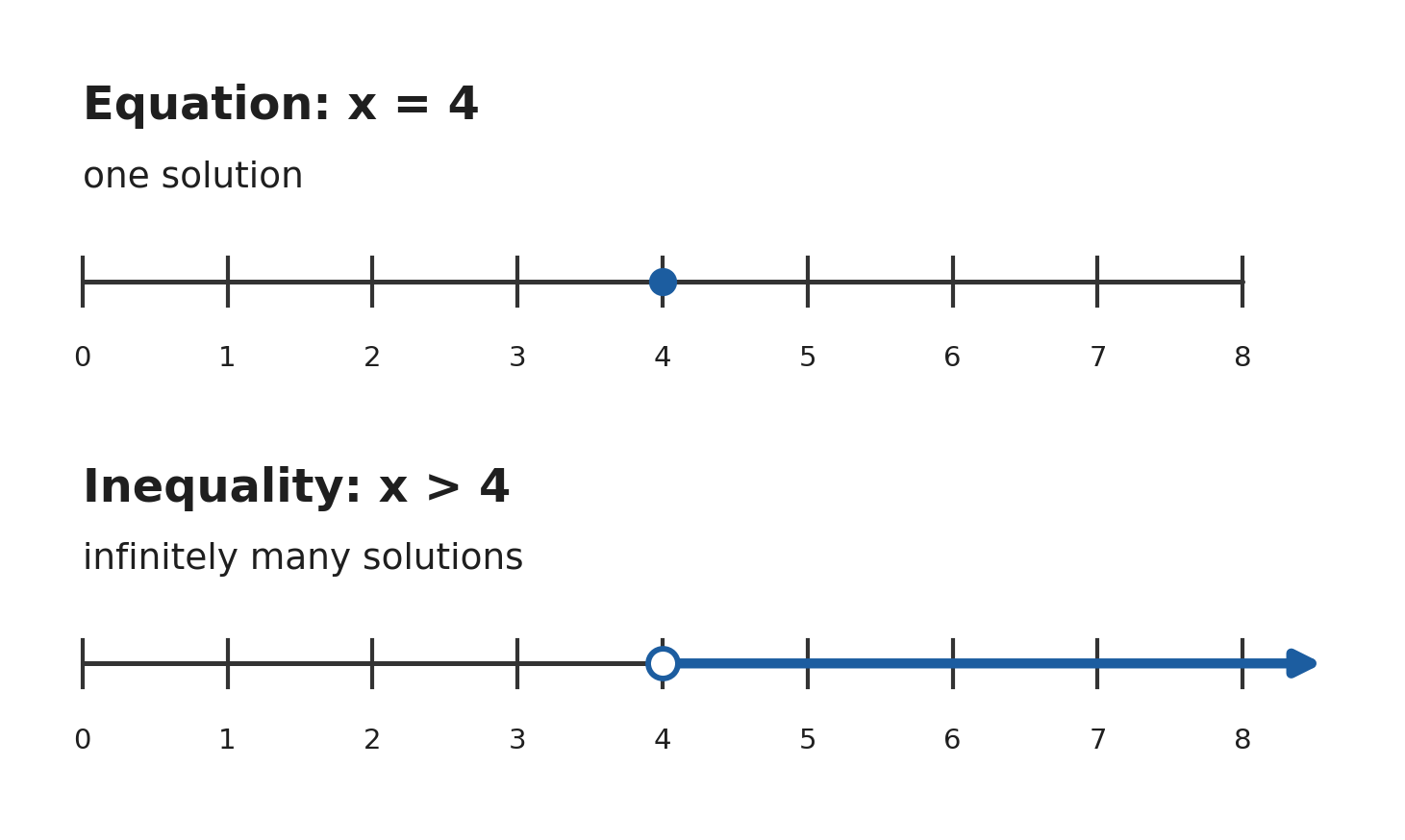
In these examples, the equation locks us into one number, while the inequality opens the door to every number in a given direction. This is the central idea of today's lesson: an equation gives a point, but an inequality gives a range.
On a number line, the difference is easy to see. The equation's solution is a single dot, while the inequality's solution is an arrow that keeps going:
A common early mistake is to treat an inequality as if it were an equation. For instance, when asked to solve x>4, someone might write "x=5" and stop. While 5 does satisfy the inequality, calling it the solution leaves out 6, 7, 100, and every other number greater than 4. A single value misses the vast majority of the solution set.
Think of it this way: if someone asks, "What temperatures are above freezing?" and you answer "40°F," you are not wrong — but you have not captured the full picture. The real answer is every temperature above 32°F. In the same way, the solution to an inequality must be described as a complete range, never reduced to just one example.
Imagine you are shopping for a haircut and your budget is no more than $30. From our previous lesson, we know "no more than" translates to ≤:
price≤30
Could the haircut cost $25? Yes. Could it cost $18? Yes. Could it cost $30 exactly? Yes, because the boundary is included. Could it cost $0 — a free cut from a friend? Technically, yes!
There are many acceptable prices, not just one. This is exactly the kind of situation where an inequality shines. An equation like price=25 would single out one specific amount, but the inequality captures the entire range of prices that fit the budget. Real-world constraints like spending limits, speed limits, and minimum requirements almost always involve ranges rather than fixed answers, which is why inequalities are so useful in everyday life.
In this lesson, we uncovered a fundamental difference between the types of equations and inequalities we are using in this course. For these problems, an equation like x+1=5 has exactly one solution — a single point. An inequality like x+1>5 has infinitely many solutions — an entire range of values. We also saw why a single number can never fully represent an inequality's solution set, and we explored how real-world situations naturally produce ranges rather than fixed answers.
Now it is time to put this understanding into action with a set of practice tasks. You will compare equations and inequalities side by side, count how many values satisfy a given inequality, and explain in your own words why everyday scenarios call for ranges instead of single numbers.