You have made it to lesson five of six in Understanding Inequalities — we are in the home stretch! Over the first four lessons, we built up the four inequality symbols, learned when to include or exclude a boundary value, translated everyday phrases into mathematical notation, and discovered that inequalities produce entire ranges of values rather than single answers. That last idea was a big conceptual shift. Today, we put it to practical use by learning a simple but powerful skill: checking whether a specific value belongs to an inequality's solution set. The technique boils down to one word — substitution.
Why Would We Need to Check?
In our previous lesson, we saw that an inequality like x>4 has infinitely many solutions. That is a lot of numbers! But in real life, we often care about just one number at a time. Suppose a store offers free shipping on orders of at least $35, and your cart totals $34.99. Does your order qualify? You are not solving the whole inequality from scratch — you just need to know whether that one particular value passes the test.
This kind of membership check is something we do all the time, often without realizing it. Today, we will turn it into a clear, repeatable mathematical procedure.
The Substitute-Then-Evaluate Procedure
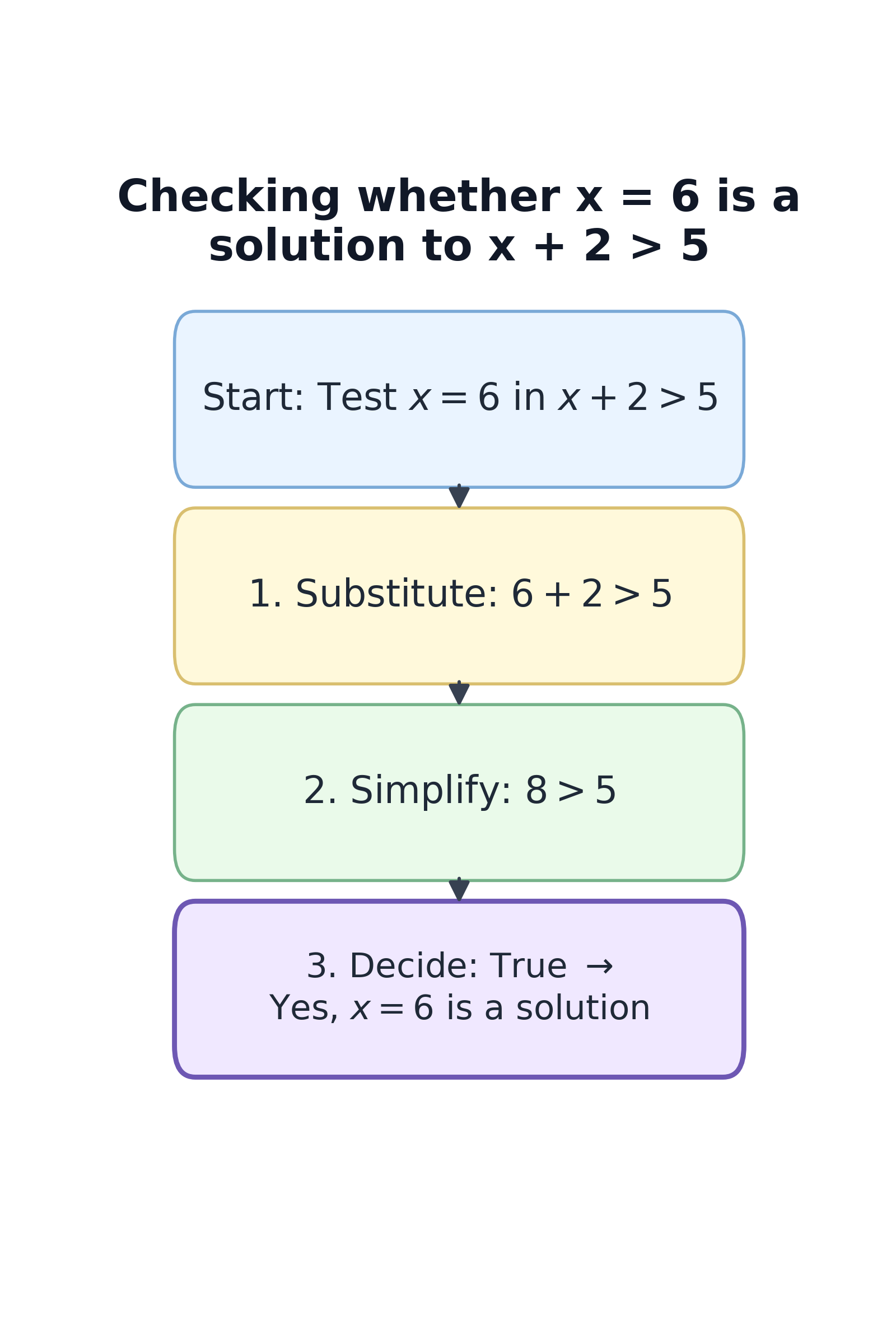
The process for checking a value has three short steps:
Substitute the given value in place of the variable.
Simplify both sides of the inequality to plain numbers.
Decide whether the resulting numerical comparison is true or false.
If the comparison is true, the value is a solution. If it is false, the value is not a solution. Let us see this in action with an example. Suppose we want to test whether x=6 is a solution to:
x+2>5
Step 1 — Substitute: Replace x with 6 to get 6+2>5.
Step 2 — Simplify: The left side becomes 8, so the statement is 8>5.
Step 3 — Decide: Is 8>5 true? Yes, it is. So x=6is a solution.
That is the entire method. No matter how complicated the inequality looks, the process stays the same: plug in, simplify, and read the result.
Join the 1M+ learners on CodeSignal
Be a part of our community of 1M+ users who develop and demonstrate their skills on CodeSignal
Walking Through More Examples
The Boundary Makes All the Difference
Checking Solutions in Everyday Situations
Conclusion and Next Steps
In this lesson, we learned a straightforward three-step technique: substitute the value, simplify to get a numerical comparison, and decide whether that comparison is true or false. We practiced on several inequalities, paid special attention to the tricky boundary case where the choice between strict and inclusive symbols determines the answer, and applied the same method to real-world situations.
Up next, you will put this technique to work in a set of hands-on practice tasks — from completing a guided walkthrough to making quick yes-or-no judgment calls on real-world rules. Let us see how sharp that substitution instinct has become!
Let us build confidence by applying the same three steps to a few more checks.
Example 1: Is x=3 a solution to 2x≤10? Substituting gives 2(3)≤10, which simplifies to 6≤10. Since 6≤10 is true, x=3is a solution. ✓
Example 2: Is x=9 a solution to x−4<2? Substituting gives 9−4<2, which simplifies to 5<2. Since 5<2 is false, x=9is not a solution. ✗
Example 3: Is x=0 a solution to 3x+1≥7? Substituting gives 3(0)+1≥7, which simplifies to 1≥7. Since 1≥7 is false, x=0is not a solution. ✗
Notice that the procedure never changes. Each time we follow the same three steps, and the final true-or-false judgment gives us a definitive answer.
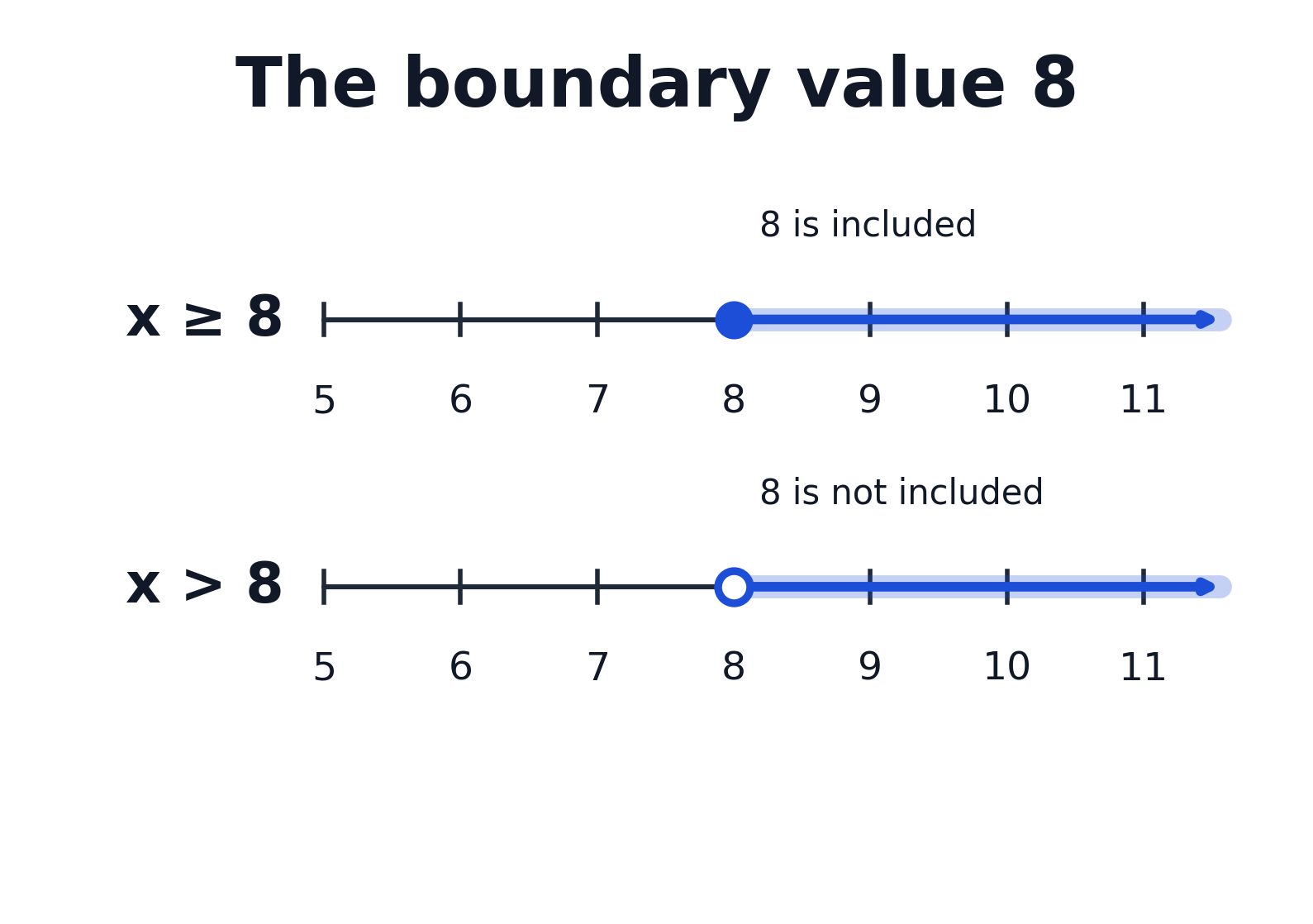
There is one situation where we need to be especially careful: testing a value that sits right at the boundary. As you may recall from lesson two, the difference between strict (<, >) and inclusive (≤, ≥) symbols determines whether the boundary value itself is part of the solution set. Let us see how this plays out with substitution.
Consider two inequalities that look almost identical:
Test
Inequality
Substitution
Result
Solution?
x=8
x≥8
8≥8
True
✓ Yes
x=8
x>8
8>8
False
✗ No
Same value, same boundary number, but different answers. With ≥, the statement "8 is greater than or equal to 8" is true because equality counts. With >, the statement "8 is strictly greater than 8" is false because 8 is not greater than itself.
Whenever you are testing a value that equals the boundary, pause and check which symbol the inequality uses. That small detail changes the outcome entirely.
This substitution skill appears naturally in daily life. Let us walk through two quick scenarios.
Scenario 1: A store offers free shipping on orders of at least $35. We can write that rule as order≥35. If your cart totals $40, substitute to get 40≥35, which is true — free shipping applies. If your cart totals $35 exactly, substitute to get 35≥35, which is also true because "at least" includes the boundary.
Scenario 2: A weather service issues a heat advisory when the temperature is above 95°F. That rule translates to temp>95. If the forecast says 97°F, then 97>95 is true — the advisory is issued. But if the forecast says exactly 95°F, then 95>95 is false — no advisory, because "above" is a strict comparison that does not include 95 itself.
In both cases, we used the exact same three-step procedure. The math works whether we are checking prices, temperatures, or any other quantity against a rule.