Catching Decision Cues
Catching Decision Cues ⚾
In the last lesson you learned to test whether your gut had earned the right to speak. But here's the catch: even a well-earned instinct can be the wrong tool for the moment. Some decisions carry features that should make you slow down no matter how confident you feel. This lesson hands you a quick scan to catch those features before you commit, so you switch into deliberate reasoning on purpose rather than by luck.
In this lesson, you will learn to:
- Catch the decision features that call for slower, more deliberate thinking
- Notice when your own state, such as fatigue or time pressure, is degrading your judgment
- Build a bounded deliberation plan that slows down only what truly needs it
The Cues That Should Make You Slow Down 🐢
When a decision lands on you and your instinct fires, run it through the Slow-Down Trigger Scan before you move.
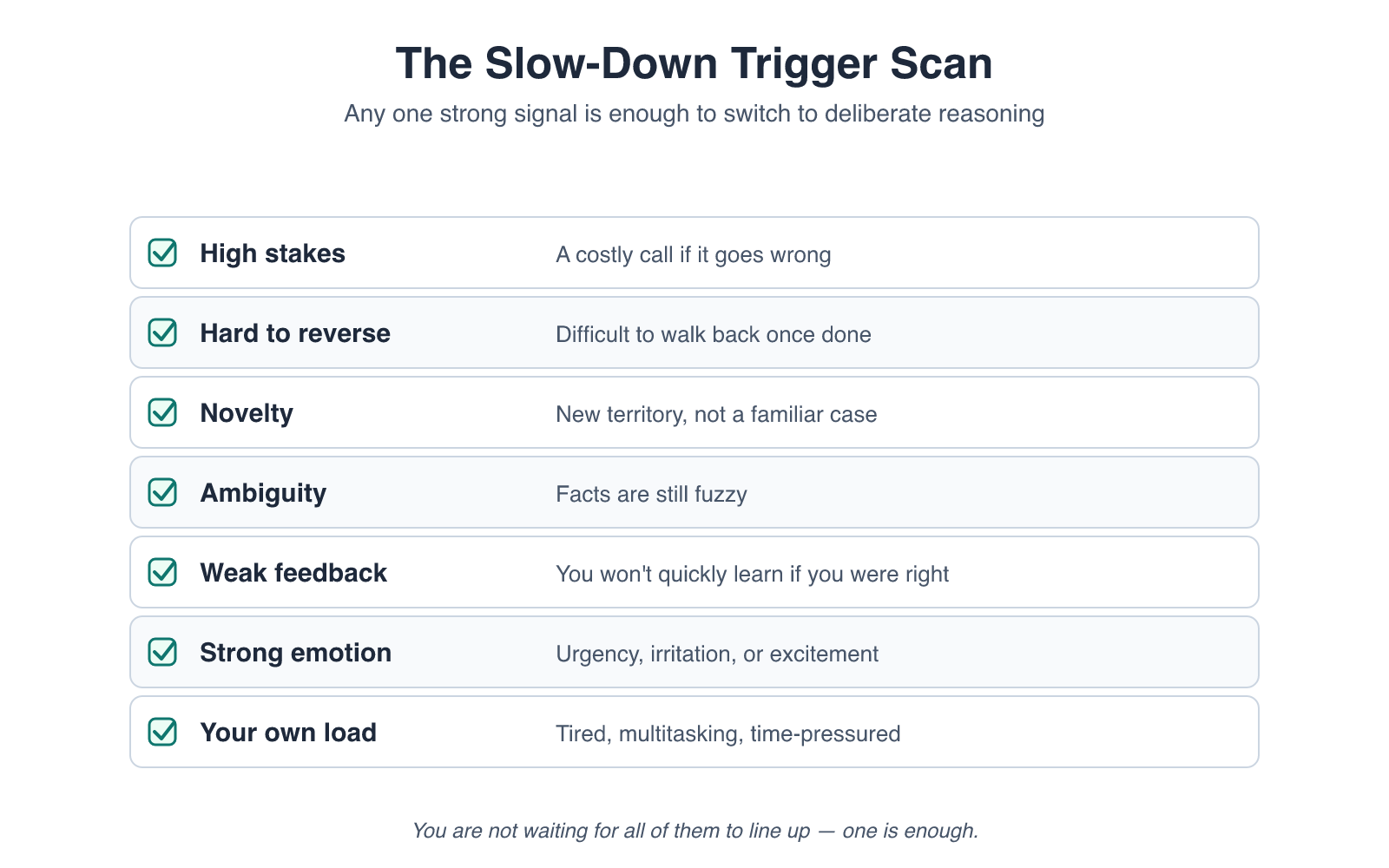
The scan walks through a short list of features of the decision:
- High stakes — a lot rides on getting this one right.
- Hard to reverse — you can't easily undo it once it's done.
- New territory — this is unfamiliar, not something you've handled many times before.
- Ambiguous facts — the situation is fuzzy and the facts aren't settled yet.
- Weak feedback — you won't quickly find out whether you were right.
- Strong emotion — urgency, irritation, or excitement is pulling you toward a snap answer.
- Your own load — fatigue, juggling too much, or time pressure is quietly draining your judgment.
One strong cue is enough to move the call toward slow, deliberate reasoning. You are not waiting for all of these triggers to line up: one high-stakes, hard-to-reverse call in unfamiliar territory deserves a closer look even when your gut feels certain, because certainty tells you nothing about how well the decision fits your fast-thinking machinery.
That last cue, your own state, is the one managers skip most. Even a routine call gets risky when you're running on empty. Think of late afternoon on a packed day: your phone is buzzing with three other fires, someone is standing over your desk wanting a yes in twenty minutes, and your gut has never felt more certain or been less trustworthy. Fatigue, multitasking, and time pressure don't announce themselves. They just quietly bend your judgment.
So say it out loud. Something like, "I'm fried and being pulled in five directions, so I don't fully trust my read on this right now." That isn't weakness, it's control. Once you've named the load, you can treat your instinct as a suspect rather than a witness — and protect the few checks that actually matter before you commit.
Building a Bounded Deliberation Plan ⏱️
Slowing down does not mean stalling. The person pushing you usually has a genuine reason to keep things moving, so the goal is to reach a good decision quickly rather than sink into endless analysis. A bounded deliberation plan is what lets you do both at once. You name the specific pieces of evidence that truly must be checked before you can responsibly approve, and nothing beyond that. You give each of those checks a clear owner. You set a firm time limit and a decision deadline so the momentum holds. And you say plainly what can move ahead provisionally in the meantime, as long as it doesn't create unacceptable risk.
Here is what that sounds like in practice. Marcus wants an instant yes on an urgent supplier switch, and Meredith walks him through a quick bounded plan instead of either rushing or stalling.
- Marcus: The current supplier just missed another shipment. I want to switch to the new one by end of day.
- Meredith: I hear the urgency, and we may well switch. Before we lock it in, what's the one thing we absolutely have to verify first?
- Marcus: Honestly, whether the new supplier can actually hit our volumes. We've never run them at scale.
- Meredith: Good. So let's check exactly that by noon tomorrow. You pull their capacity numbers, I'll call two of their current clients. Everything else can wait, and we hold the current orders steady until then.
- Marcus: That works. We move fast on the one thing that matters and don't stall on the rest.
In under a minute, Marcus and Meredith protected the single check that actually mattered, the new supplier's real capacity, gave it an owner and a deadline, and let everything low-stakes keep moving. That is what a bounded plan buys you, real rigor where it counts and speed everywhere else.
Whether to slow down isn't really about how sure you feel — it's about the shape of the decision in front of you and the state you're in when you face it. Next up, you'll do a quick pattern-spotting exercise, matching real managerial situations to the slow-down cue most strongly at play, so that when a fast yes is being pulled out of you, running the scan becomes the first thing you reach for.
