Pausing Automatic Judgments
Pausing Automatic Judgments ⏸️
In the last lesson you learned to read the decision itself — its stakes, reversibility, and novelty — and to flag when your own load is degrading your judgment. This lesson turns the lens inward one more notch. Sometimes the loudest signal isn't in the decision at all; it's in you. A snap judgment can grab the wheel before you've even noticed, and the trick is to catch it in the moment and interrupt it on purpose.
In this lesson, you will learn to:
- Spot the signs that a snap judgment has quietly taken over
- Run the Pause-and-Check Routine to interrupt it before you commit
- Separate your first reaction from your checked conclusion when you communicate the call
Spotting the Signs a Snap Judgment Has Taken Over 🕵️
Your automatic mind rarely announces itself, but it leaves fingerprints, and four of them show up again and again:
- Urgency — a sudden pull to decide right now, even when nothing external actually demands it.
- Defensiveness — the flash of irritation when someone questions your call, so you start defending the answer instead of examining it.
- Certainty — you feel completely sure, and that very sureness starts to feel like proof.
- Fixation — you lock onto one option or one recent event and stop seeing the fuller picture.
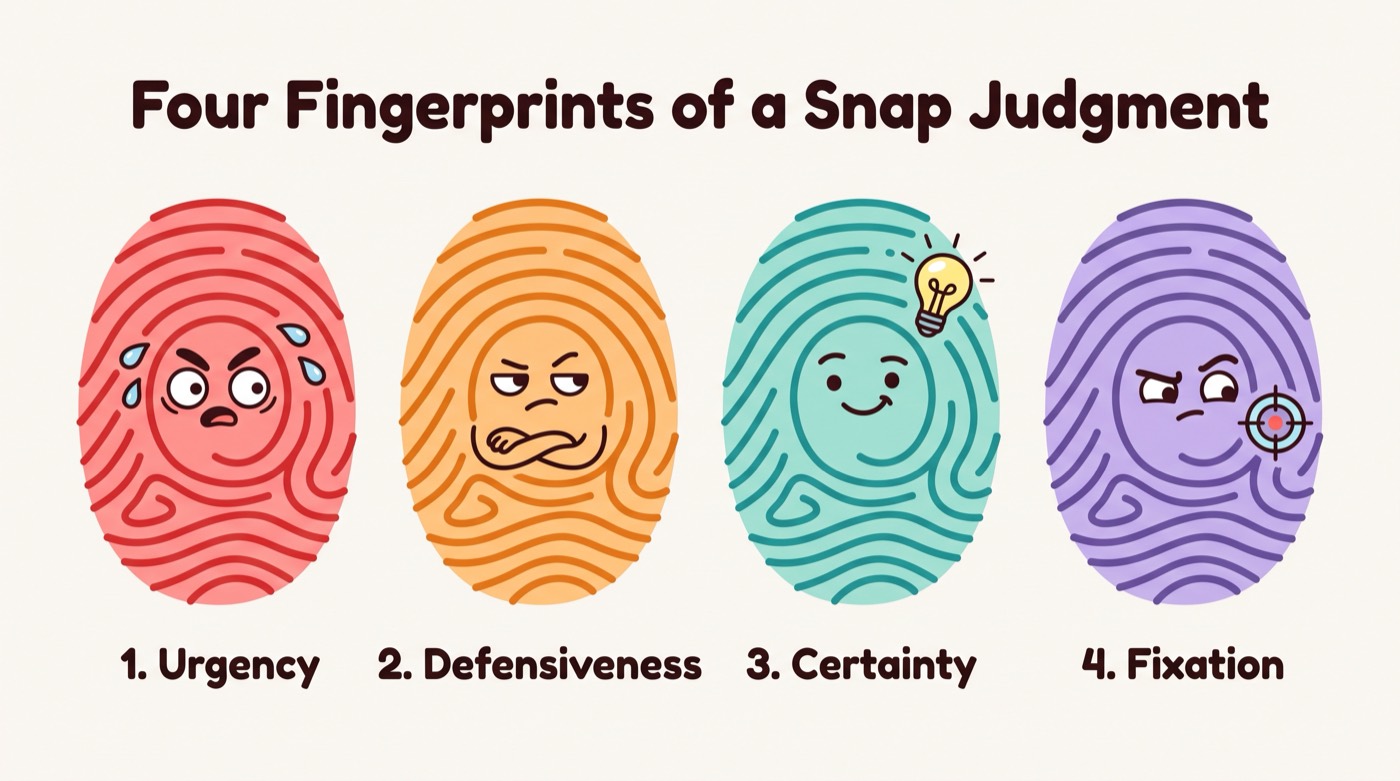
Here's the tricky part: none of these fingerprints tells you whether you're actually right. Picture a general manager who declares "we obviously cut that supplier" after a single bad delivery, then bristles the moment a colleague asks why. In that one reaction you can spot three fingerprints at once: certainty, defensiveness, and a tight fixation on the latest incident. And that is exactly where the danger lives. The stronger the feeling of being sure, the more quietly it talks you out of the very check the decision needs.
Running the Pause-and-Check Routine 🔁
When you catch one of those tells you just learned to spot, run the Pause-and-Check Routine. It has four moves:
- Pause and name it. Stop your response and say the initial judgment out loud or write it down, something like "My instinct is to pull the contract." Naming it turns an invisible reflex into something you can actually examine.
- Ask: gut or reasoned? Be honest about whether this is a fast gut call or a conclusion you genuinely reasoned your way to. Most snap judgments quietly fail this question.
- Check four things. Quickly test the read against the evidence behind it, the assumptions you're making, the stakes if you're wrong, and how reversible the decision is.
- Choose deliberately. Either proceed fast because the check held, or slow down and reason it out before you act. Either way, it's now a choice rather than a reflex.
- Ryan: I want to pull the contract from that vendor today. They missed the delivery window again.
- Jessica: Okay, pause a second. What's the judgment you just made?
- Ryan: "Fire them, they're unreliable." And honestly, I'm certain.
- Jessica: That certainty after one bad week is the tell. Is that a gut call or a reasoned one?
- Ryan: Gut. I haven't checked whether the misses were on them or on our late purchase orders.
- Jessica: Then check the evidence and the reversibility before you send anything. Cutting them mid-quarter isn't easy to walk back.
Notice Jessica never argued for the vendor. She named the tell, forced the gut-versus-reasoned question, and pointed Ryan at evidence and reversibility. That's the whole routine in under a minute.
Separating Your First Reaction From Your Checked Conclusion ✂️
Once you've run the check, the last discipline is to keep your first reaction and your checked conclusion visibly separate when you communicate the call. Say what your gut told you, then say what the evidence, assumptions, stakes, and reversibility actually supported, and then state your decision. That separation isn't confession — it's what lets a boss or a peer see your reasoning rather than just your verdict, and trust that the call didn't flip on the emotion of one bad day.
The one idea to carry: certainty is a feeling, not evidence, so the moment you feel sure and rushed is exactly the moment to pause and name the judgment before you commit to it. Next, a quick self-check will put a handful of manager reactions in front of you and ask which fingerprint — urgency, defensiveness, certainty, or fixation — is showing, so spotting the tell becomes automatic before you practice the full routine live.
