Trusting Earned Intuition
Trusting Earned Intuition 🏅
In the last lesson you learned to tell your fast, gut-level reactions apart from slow, deliberate reasoning. Naming which mode is driving you is step one but the harder question is this: when your gut speaks with total confidence, should you believe it? As a manager you hear "trust your instincts" constantly, and sometimes your instincts are gold. But confidence is not the same as accuracy. This lesson gives you a simple way to separate earned intuition from a confident hunch before you bet a hire, a vendor, or a forecast on it.
In this lesson, you will learn to:
- Tell genuinely earned intuition apart from a confident hunch
- Run a quick reliability check on a gut call, whether it's yours or a colleague's
- Decide whether to trust the read, run a limited check, or reason it out in full
When Your Gut Has Actually Earned the Right to Speak 🎤
Intuition is really just fast pattern-matching. Your brain has seen something like this before, so it hands you an answer without ever showing its work. That is powerful when the patterns behind it are real, and dangerous when they aren't. Decision researchers have found that gut feel becomes trustworthy only under two conditions, which together make up the Two Conditions for Trustworthy Intuition.
First, the environment has to be regular and predictable enough that stable patterns actually exist. For example, a seasoned nurse reading a patient, or a floor manager sensing a rush before it hits, works in a world where the same cues reliably lead to the same outcomes. Guessing which startup will win over the next five years does not, because that world is simply too noisy for any dependable pattern to form.
Second, you need prolonged practice with fast, accurate feedback. For example, a manager who makes hiring calls often and sees how each hire actually works out within a few months gets that tight feedback loop, so the lessons stick. Feedback that is slow, rare, or muddy never teaches the lesson, no matter how many years you have logged.
Miss either condition and what feels like intuition is really just a guess that happens to feel certain.
Watch how this plays out. Dan has a strong gut read on a vendor, and his colleague Nova tests it against the two conditions before anyone acts.
- Dan: I've got a strong gut feeling this vendor's going to miss our deadlines. Let's cut them now.
- Nova: Fair, but is that a pattern you've actually watched play out, or a first impression? How many vendors like this have you run long enough to know how it ends?
- Dan: Honestly? Two, maybe three. And this market is nothing like the last one.
- Nova: Then it's a hunch, not a read. Thin experience, and the conditions have shifted. Worth a quick check before we act on it.
Notice Nova never attacks Dan's judgment. She just tests his gut against the two conditions, and the gap shows itself.
Telling Earned Expertise From Noise 📣
When a confident call crosses your desk, whether it is your own or a teammate's, run it through the Intuition Reliability Check: four quick questions drawn straight from those two conditions.
- Repeatable patterns? Are there stable, repeating patterns here, or is this really a one-off situation?
- Deep, relevant experience? Does the person hold substantial, directly relevant experience with this exact kind of case, not just a long tenure in general?
- Timely, accurate feedback? On past calls like this one, did clear results come back quickly enough for the lessons to actually stick?
- Conditions still match? Do today's conditions closely resemble the ones where that pattern was first learned?
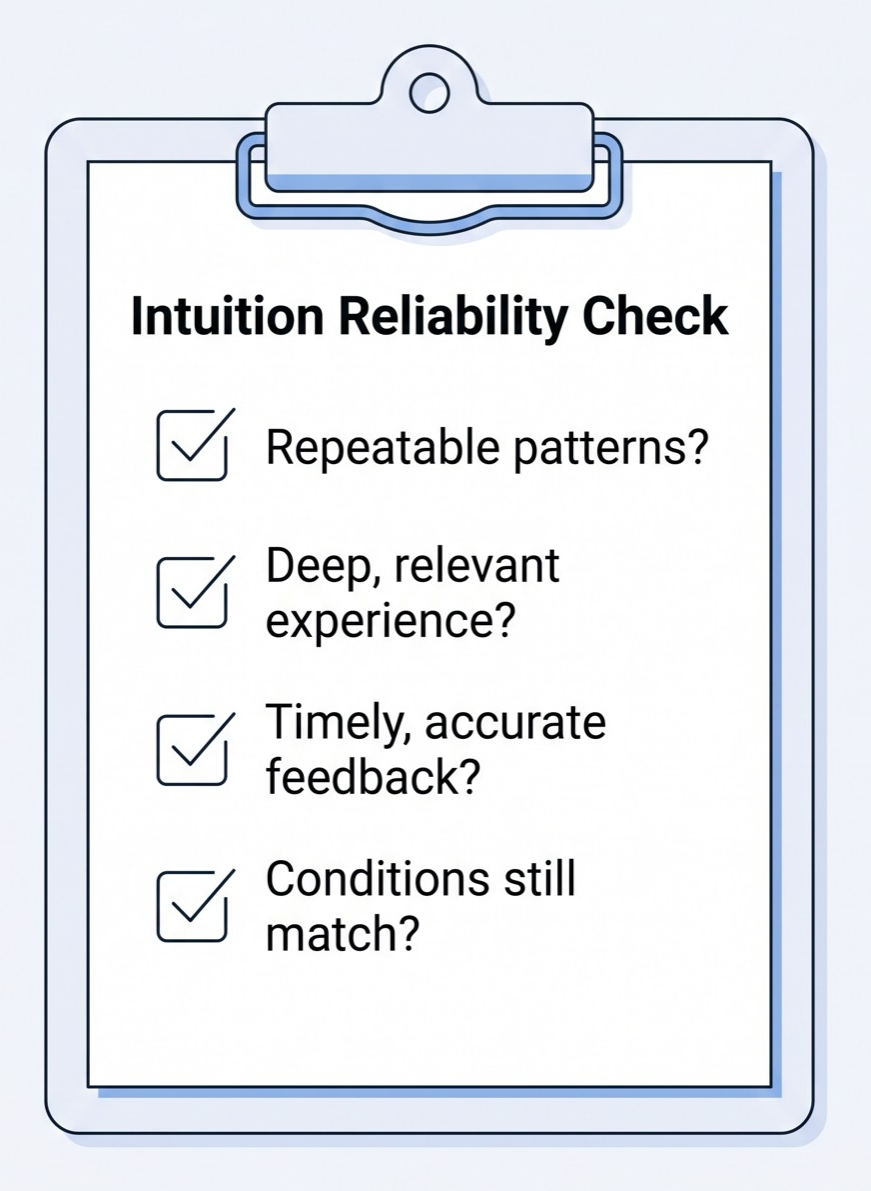
The trap to watch for is treating confidence, tenure, or a strong reputation as if they settle the question. They don't. A ten-year veteran's certainty about a market that just shifted is real experience aimed at the wrong target. Your move is to gently separate the person from the pattern: "You clearly know this space well, so help me see how close this case is to the ones you've called before." That keeps the conversation on the evidence, not on anyone's ego.
Once you've run the check, you have three honest options:
- If all four conditions hold — stable patterns, deep experience, clean feedback, and matching conditions — trust the read and move. This is exactly what your gut is for, so don't drown a good fast call in needless analysis.
- If some conditions hold but one or two are shaky — say the experience is deep but the situation itself has changed a lot since those lessons were learned and run a limited check. A limited check means picking the single cheapest test that would confirm or break the read: pull the actual numbers, sample a few recent cases, or call one customer. You are just spot-checking the weakest link.
- And if the pattern barely exists, the experience is thin, or the feedback was never real, shift to full deliberation. Treat the gut feel as one input, not the verdict, and reason it out with evidence before you commit.
Certainty tells you how sure someone feels, not how right they are, and only the two conditions tell you whether a gut call is truly earned. Next up, you'll run a quick pattern-spotting self-check, sorting several managers' gut calls into earned intuition versus confident noise, so that the next time a bold read crosses your desk, running those four questions before you nod becomes your reflex.
