Supportive Self Talk
🫶 Coaching Yourself Like a Good Friend
In the last lesson you practiced catching the good and letting it land. Now you'll turn that same attention inward, to the running commentary in your head when something goes sideways. Whenever we slip up—miss a number, fumble a presentation, send an email we wish we could pull back—a voice pipes up fast to pass judgment. For most of us, that voice is harsh, not kind. This lesson is about noticing that voice and deliberately answering it the way a good friend would.
In this lesson, you will learn to:
- Catch your inner critic's harsh, absolute line in the moment
- Swap it for a kind, specific, forward-looking coach line
- Build a pocket card of ready lines for your toughest recurring moments
🎣 Catch the Critic Before It Runs the Show
The first move is simply to hear the exact sentence your critic just said. The harsh inner voice is your inner critic, and it tends to deal in absolutes and blame — often pinning the fault squarely on you. "I always mess this up." "I'm hopeless at this." "Everyone could tell I was unprepared." Notice the giveaway words: always, never, hopeless, everyone. They feel true in the moment, but they are almost never accurate.
Why does catching it matter? Because the critic does not just make you feel bad, it steers your next move. Hear "I always drop the ball on follow-ups" after one missed email, and you either avoid the inbox or fire off a defensive over-apology. The harsh sentence quietly becomes the harsh action. But when you say that sentence out loud or jot it down, you open a small gap, and in that gap you get to choose your response instead of reacting on autopilot.
The next time your energy dips after a stumble, ask yourself, "What did I just say to myself?" Name the exact sentence. That naming is the catch.
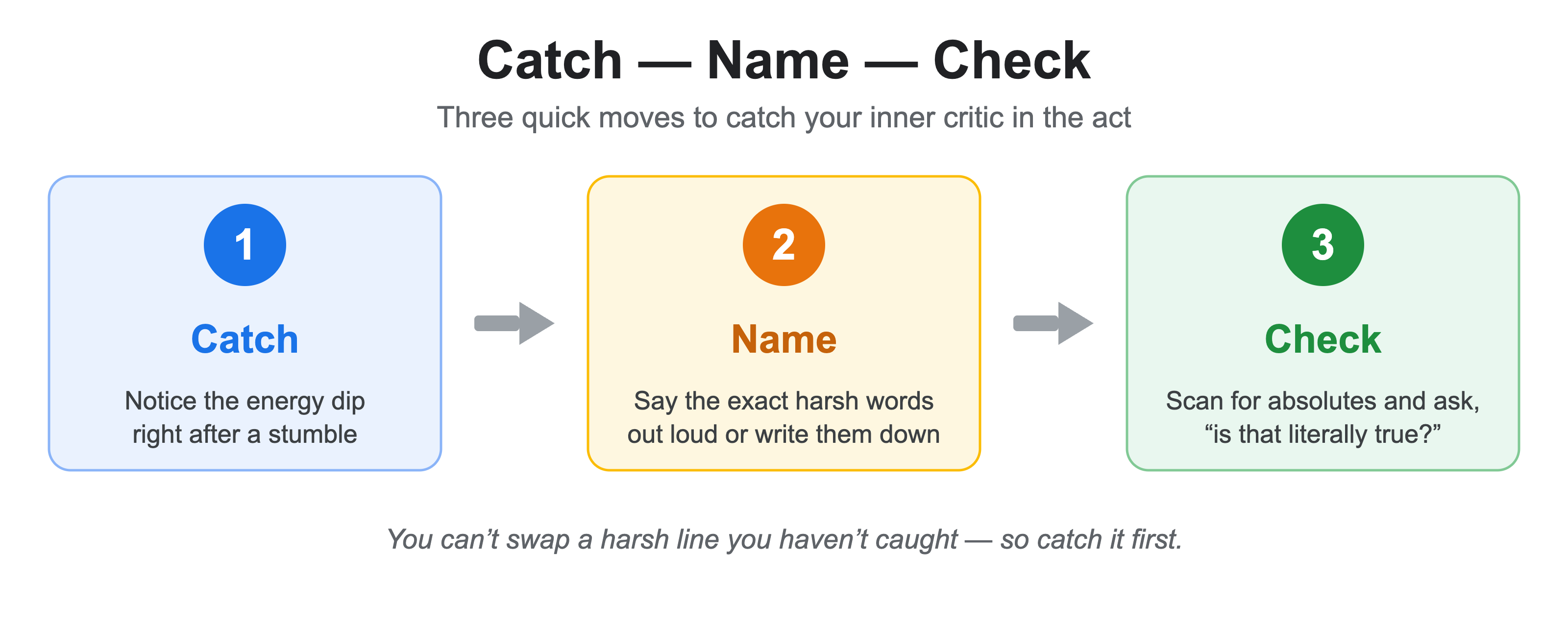
A simple three-move method makes this repeatable — call it Catch–Name–Check. First, catch the moment: notice the energy dip the instant it hits. Then name the sentence: say the exact harsh words out loud or jot them down. Finally, check those words against the giveaway absolutes — always, never, hopeless, everyone — and ask whether they are literally true. More often than not, they are not.
🔄 Swap in the Coach Voice
Once you have caught the critic line, you swap it. The Self-Talk Swap is straightforward: take the harsh line and replace it with the line you would offer a good friend in the same spot. Not fake cheer, not "you're amazing," but the honest, steadying thing a friend actually says. A good coach line has three qualities:
- Kind — no name-calling
- Specific — it names the actual thing, not your whole character
- Forward-looking — it points to a next step
Watch the difference play out. Here's Milo, fresh off a rough budget review, talking it through with Victoria, a colleague he trusts:
- Milo: I completely botched that budget review. I'm hopeless at presenting.
- Victoria: Hopeless? You lost your place on one slide. What would you tell me if I said that about myself?
- Milo: I'd say, okay, you got tangled on the forecast section. That's one part, not the whole thing.
- Victoria: Right. So say that version to yourself.
- Milo: Fine. "I got tangled on the forecast slide. I'll add a cue note and run it once more before Thursday."
Notice that Victoria never told Milo he was great. She challenged the absolute word ("hopeless"), got specific ("one slide"), and nudged him toward a next step. That is the whole swap in action: kind, specific, forward-looking.
The friend test is your shortcut here. If a line is too harsh to say to a colleague you respect, it is too harsh to say to yourself.
🃏 Build a Pocket Card of Ready Lines
There is a catch to doing this in real time: pressure is exactly when good words are hardest to find. The moment the critic flares is the moment your mind goes blank on anything kinder. That is why the best move is to build a small kit in advance, before you need it.
Think about the moments that reliably set off your critic. For most people running a team, they cluster around five recurring triggers. Write one coach line for each ahead of time, so it is ready the moment the trigger hits. Here is what a worked example looks like:
| Trigger | A ready coach line |
|---|---|
| Getting criticism | "That feedback stings, but it's about one report, not my judgment. What's the one fix worth making?" |
| Making a mistake | "I missed a step — that's this task, not who I am. I'll fix it and add a checkpoint for next time." |
| Hitting a delay | "The timeline slipped, and panicking won't speed it up. What's the one thing I can move in the next hour?" |
| Feeling buried under overload | "I can't do all of it right now. What are the two things that actually move the needle today?" |
| Speaking under pressure | "I lost my place, not the whole talk. I'll add a cue note and run it once more before I present." |
Keep every line short enough to say to yourself in the middle of a hard moment, and always point it at a next step rather than a hollow "I'm fine."
The heart of this lesson is one habit: catch the critic's absolute, punishing line, then swap in the fair, specific, forward-looking thing you'd tell a good friend. Start noticing your critic's favorite phrase today, and have your first swap ready before the next stumble arrives. Next up, you'll put the swap into practice: a quick fill-in-the-blanks to pin down the parts of a strong pocket coach card, a live conversation where you help a teammate catch and reframe their own inner critic, and a short writing task where you rewrite three harsh inner-critic lines into kind, specific, forward-looking ones.
