Spreading Positive Energy
✨ Spreading Positive Energy in Conversations
The last lesson turned your kind attention inward, coaching yourself like a good friend after a stumble. This lesson points that same skill outward. The harsh, absolute commentary you learned to catch in your own head is running in your teammates' heads too, and when one of them hits a wall, your response either adds real fuel or quietly drains it. So the aim here is simple: become the voice that leaves people steadier and more capable, without pretending everything is fine.
In this lesson, you will learn to:
- Tell real, honest energy from empty cheerleading
- Run the Acknowledge-Appreciate-Advance flow with a teammate who's struggling
- Write a short follow-up that keeps the encouragement alive on paper
🎭 Tell Real Energy from Empty Cheerleading
Picture the everyday version of this. A teammate tells you a launch slipped, or a number came in low, and you want to lift them. Two responses come out almost automatically, and both feel positive while backfiring. The first is vague praise: "You're great, don't worry about it." The second is empty cheerleading: "Just stay positive!" They sound supportive, but they float right over the actual problem.
Here's why that matters. When you skip past the reality, the other person hears one of two things: either you weren't really listening, or their concern isn't worth taking seriously. Both quietly drain the energy you were trying to build. Real energy does the opposite. It names the hard thing honestly and still points somewhere useful. The quick test is this: does your response touch what actually happened, or does it hover above it? "Don't stress, it'll be fine" dismisses. "The slip is real and it's frustrating, and the good news is you caught it early, so here's what we can still do" steadies. Same warmth, completely different effect.
Here are a few more, side by side:
| Empty cheerleading | Real, steady energy |
|---|---|
| "You're a rockstar, this is nothing!" | "This one's genuinely hard. You've untangled worse, though — where do you want to start?" |
| "Just stay positive, it'll sort itself out." | "It might not sort itself out, so let's name the one blocker and tackle it together." |
| "Don't even worry about the numbers." | "The numbers are down, and that's worth facing. What did we learn that we can act on?" |
🤝 Run Acknowledge-Appreciate-Advance
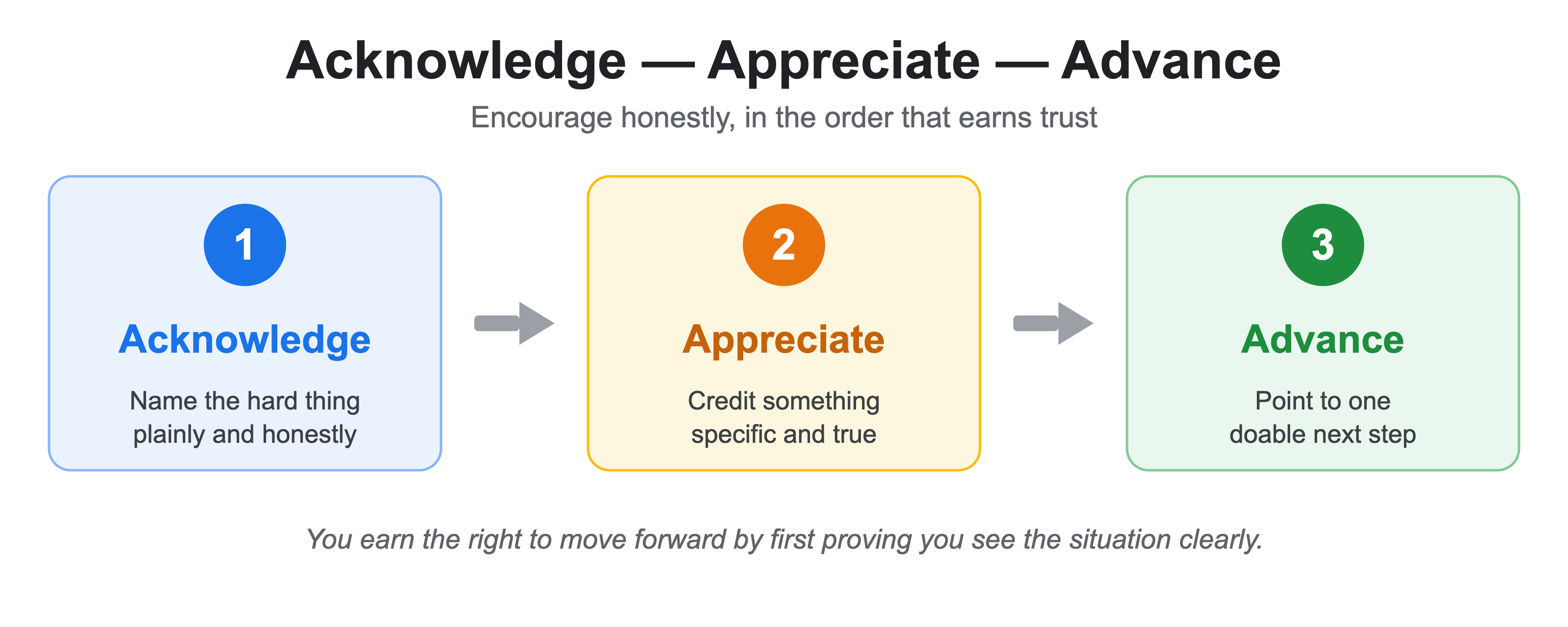
The move that keeps you honest and encouraging at once is a three-step flow called Acknowledge-Appreciate-Advance:
- Acknowledge the current reality by naming the hard thing plainly.
- Appreciate a specific effort or strength, something true rather than generic.
- Advance the conversation with encouragement or a constructive next step.
Notice the order: you earn the right to move forward by first proving you see the situation clearly.
Here's Simone checking in with Dan, a teammate braced for a pile-on after his report ran a day late:
- Dan: I finally got the vendor numbers in, but the report's going out a day late. I feel pretty bad about it.
- Simone: Yeah, a day late is annoying, no way around it. But you flagged the bad data before it hit the client deck, right?
- Dan: ...I did, actually. Caught it Tuesday.
- Simone: That's the part that saved us here. So what's the one thing that gets the report out clean tomorrow?
- Dan: Let me lock the vendor totals tonight, then it's just formatting in the morning.
Watch how Simone names the reality before anything else, so Dan stops bracing. The appreciation is the key move: "you flagged the bad data" is specific and true, which is why it lands as recognition rather than flattery. A generic "nice work" would have slid right off. Only then does she advance, and by that point Dan is problem-solving instead of apologizing.
📖 Read the Moment Before You Advance
One caution before you run the flow: sometimes the best first move isn't advancing at all. This is the difference between encouraging and listening first. If someone is genuinely upset, or just needs to let off steam, leaping to a next step can feel like being rushed out the door. A short permission question sorts this out fast: "Want to think it through together, or just vent for a minute?" Let their answer tell you whether to advance or simply reflect back what you heard.
Two more reads matter. If you're the more senior person in the room, hold the advice a beat longer, because your "next step" can land as an instruction rather than encouragement. And know the edge of everyday support: when something crosses into safety, harassment, or a mental-health crisis, the caring move is to point the person toward the right resource, not to cheer them up.
The same flow travels into writing, too. A short follow-up that names genuine progress, admits what's still hard, and restates the agreed next step gives a discouraged teammate something steadying to reread while they're heads-down fixing things. That is Acknowledge-Appreciate-Advance on paper, and it keeps the encouragement alive after the conversation ends.
The heart of this lesson is one habit: encourage by naming the real thing, crediting something specific and true, then pointing to a next step — never by papering over the problem. Next time a colleague brings you bad news, try leading with what's real before you reach for anything hopeful. Next up, you'll put honest encouragement into practice: a quick quiz to sharpen your ear for real energy versus hollow cheer, a live conversation where you steady a discouraged teammate with the Acknowledge-Appreciate-Advance flow, and a short follow-up note that keeps that encouragement alive on paper.
