Banking the Good
📣 Welcome to the Course
Welcome to Train Everyday Positivity Habits! As a manager, your mood is contagious. Whether the floor feels steady or frantic often traces straight back to you, and on a packed day the good moments — a smooth shift, a solved complaint, a target quietly hit — slip past before you can register them. This first lesson is about banking the good: noticing the wins that are already happening around you and actually making them count.
In this lesson, you will learn to:
- Match the right banking-the-good tool to the moment it fits
- Savor a real win out loud instead of racing past it
- Close your day with a Three Good Things entry that captures the why
🏦 Three Ways to Bank the Good
You have three simple tools here, and each fits a different moment in your day. The trick is knowing which one to reach for.
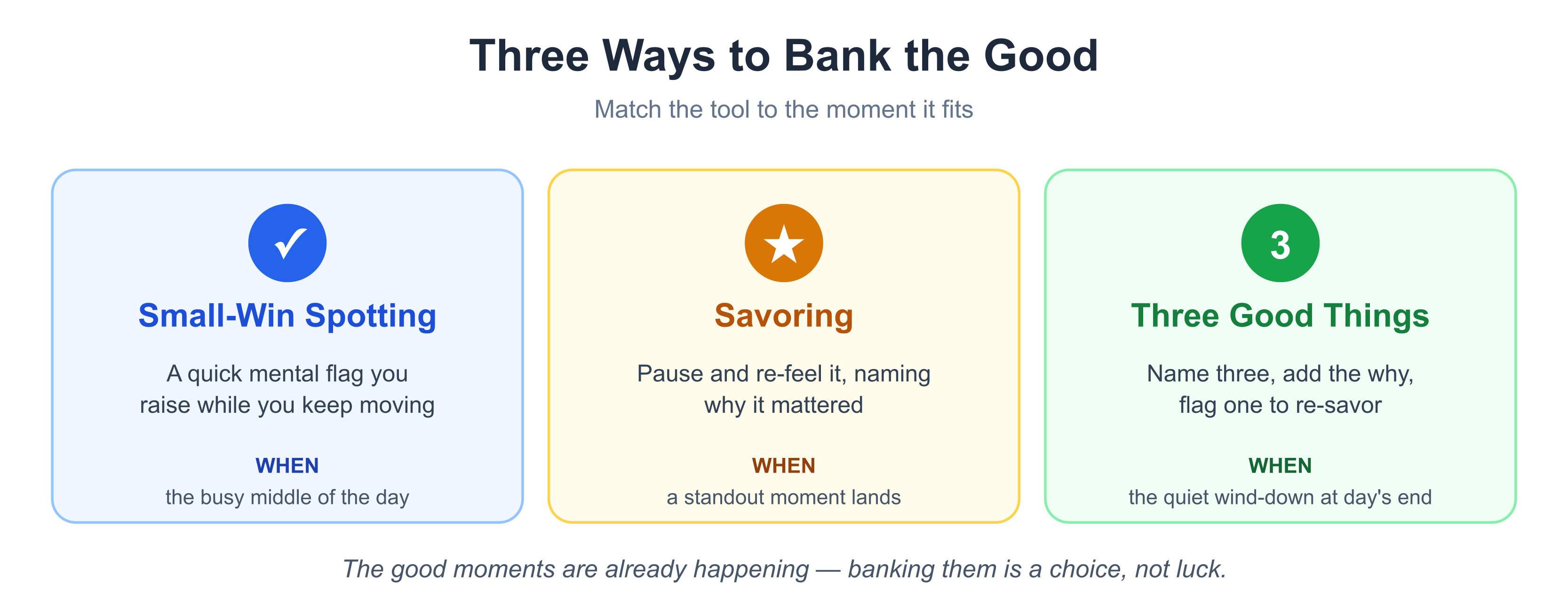
Small-win spotting is a quick mental flag you raise in the middle of the action. A tricky handover goes smoothly, a new hire handles their first rush without flapping, and you simply notice it: "that went well." No pause required, just a flicker of attention while you keep moving. It fits the busy middle of the day when you genuinely can't stop.
Savoring is a step up. When a moment is better than a passing win, you pause and re-feel it for a few extra seconds instead of racing on. It fits a standout moment: the report that finally runs clean, the customer who leaves smiling, the team that pulls together under pressure.
Three Good Things is your wind-down ritual. At the end of the day, you name three good things (big or tiny) and, for each, note why it happened or why it mattered. It fits the quiet moment when the shift is done and you're closing up.
Small-win spotting keeps you afloat mid-chaos, savoring makes a good moment land, and three good things closes the loop at day's end.
😌 Savoring Before You Race On
Of the three, savoring is the one you'll use most and skip most. Your instinct as a manager is to lunge at the next fire the second one is out. Savoring is the deliberate act of resisting that lunge. You pause, name specifically what went well, and say out loud (or to yourself) why it mattered, holding the feeling for a few extra seconds before you move on.
Naming what happened is just a checkbox. Naming why it mattered is the whole engine — it is what makes the good moment stick and teaches your brain to look for more of it.
Here's Ryan, a general manager, moments after saving a refund that nearly became a one-star review — and Nova, a coach who refuses to let him sprint off before the win lands:
- Ryan: Refund's sorted, customer's happy, on to the schedule mess.
- Nova: Hang on. Two minutes ago that customer was ready to walk out and leave a one-star review. What actually turned it around?
- Ryan: I let her finish, owned the mix-up, and fixed it on the spot.
- Nova: That's the exact thing you keep saying your team struggles with. How does it feel to have just modeled it?
- Ryan: Honestly? Pretty good. I don't usually stop to notice.
- Nova: That's the whole trick. Give it five more seconds before you dive into the schedule.
Notice how Nova blocks the rush and won't let Ryan move until he says why the win mattered, not just that it happened. That's savoring in real time.
🌙 Closing the Day with Three Good Things
At day's end, three good things turns a scattered day into three moments you actually keep. Name three good things from the day, and for each one, write why it happened or why it mattered. The "why" is what separates this from a hollow gratitude list. "Grateful for my team" is vague and forgettable; "the closing shift covered for each other without me asking, because we practiced it last week" is specific, and it tells you what to repeat.
Then flag one of the three as worth re-savoring tomorrow: a single moment good enough to pause and re-feel again when you have a spare minute. Keep them honest and grounded, big or tiny. A quiet coffee before the doors opened counts as much as a target hit.
The one idea to carry from this lesson is simple: the good moments are already happening around you, and banking them is a deliberate choice, not luck. So here's your one behavior to try: next time a win lands, catch yourself mid-lunge and give it five seconds and one honest "why it mattered" before you move on. Next up, you'll put banking the good into practice: a quick matching activity to lock in which tool fits which moment, a live conversation where you savor a real win out loud instead of racing past it, and a short writing task where you close your day with three good things and the why behind each.
