Square Roots and Irrationality
Introduction
Welcome back to The Real Number System and Irrationality! This is Lesson 3 of 5, so we are well past the halfway mark. So far, we have defined irrational numbers by their non-terminating, non-repeating decimals and then studied two celebrity examples — π and e. Those constants are fascinating, but they might leave us wondering: are irrational numbers a rare curiosity, or are they hiding all around us?
In this lesson, we answer that question by turning to an entire family of irrational numbers: square roots. You will learn a single, reliable test — based on whether or not a number is a perfect square — that lets you classify any square root of a positive integer as rational or irrational in seconds. We will also practice writing clear justifications for our answers, a skill the upcoming exercises will put to the test.
From Two Constants to Infinitely Many Irrationals
π and e are special because they appear in countless formulas, but their fame can create a misleading impression — that irrational numbers are exotic outliers. In truth, irrational numbers are far more plentiful than rational ones, and you do not have to search the world of circles or compound interest to find them. One of the richest and most accessible sources is something we meet early in math: square roots.
Think about a simple, everyday situation. A carpenter measuring the diagonal of a square tile that is foot on each side will find, by the Pythagorean theorem, that the diagonal measures feet. That length is irrational — it cannot be expressed exactly as a fraction of inches or feet. As we will see next, nearly every positive integer produces an irrational square root, making square roots a practically unlimited supply of irrational numbers.
Perfect Squares and Their Square Roots
Before we can classify square roots, we need to be comfortable recognizing perfect squares. A perfect square is a positive integer that equals some whole number multiplied by itself. For example, is a perfect square because , and is a perfect square because .
Here are the perfect squares you will encounter most often:
| Integer () | 1 | 4 | 9 | 16 | 25 | 36 | 49 | 64 | 81 | 100 |
|---|---|---|---|---|---|---|---|---|---|---|
| 1 | 2 | 3 | 4 | 5 | 6 | 7 | 8 | 9 | 10 |
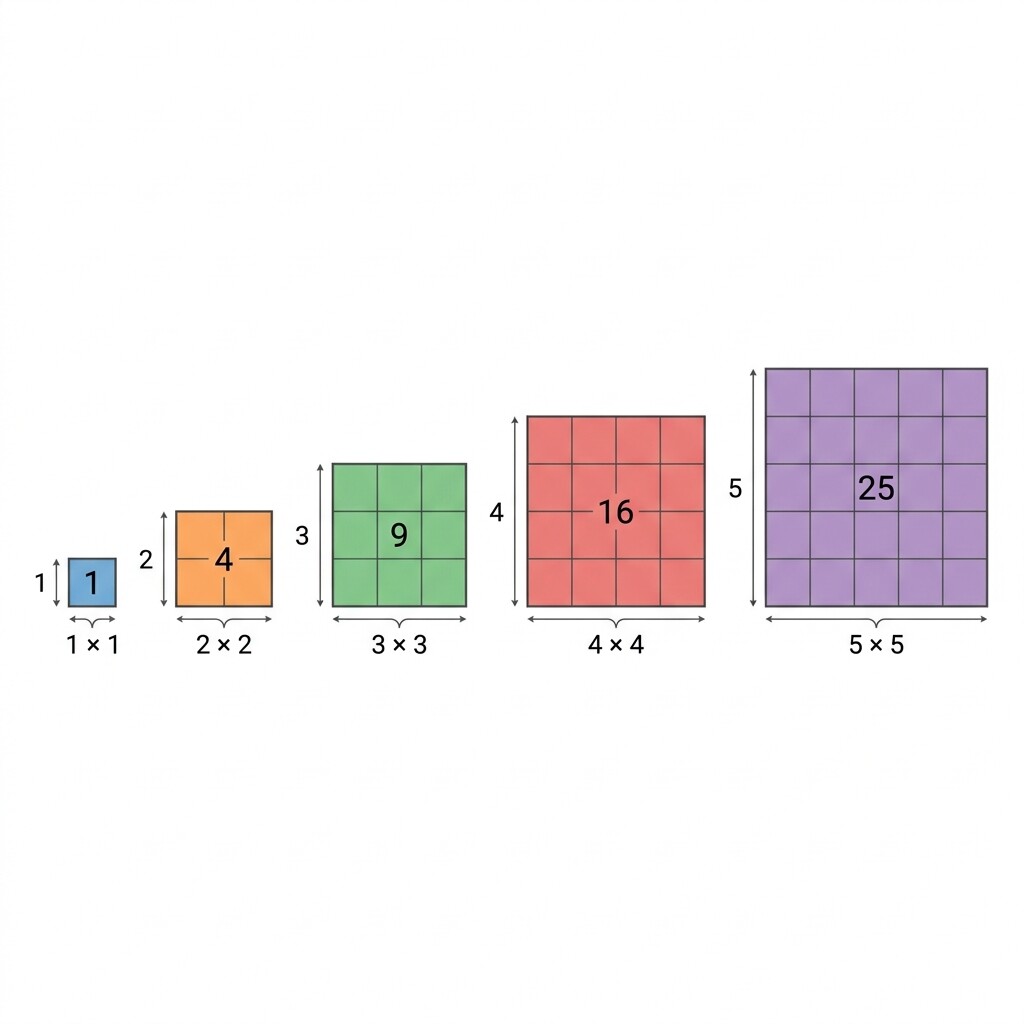
When is a perfect square, is a whole number. Every whole number is rational because it can be written as a fraction — for instance, . So the square root of any perfect square is rational. Memorizing the table above (at least through ) will make the classification process almost instant.
When the Square Root Is Irrational
What happens when the number under the radical sign is not a perfect square? Consider . There is no integer whose square equals — we know and , so falls somewhere between and . Its decimal expansion begins:
Those digits continue forever without settling into a repeating cycle. Mathematicians have proven that is irrational, and the same is true for , , , , , and every other square root of a non-perfect-square positive integer. This gives us a clean, two-part rule we call the perfect-square test:
- If is a perfect square, then is rational (it equals a whole number).
- If is a positive integer but not a perfect square, then is irrational.
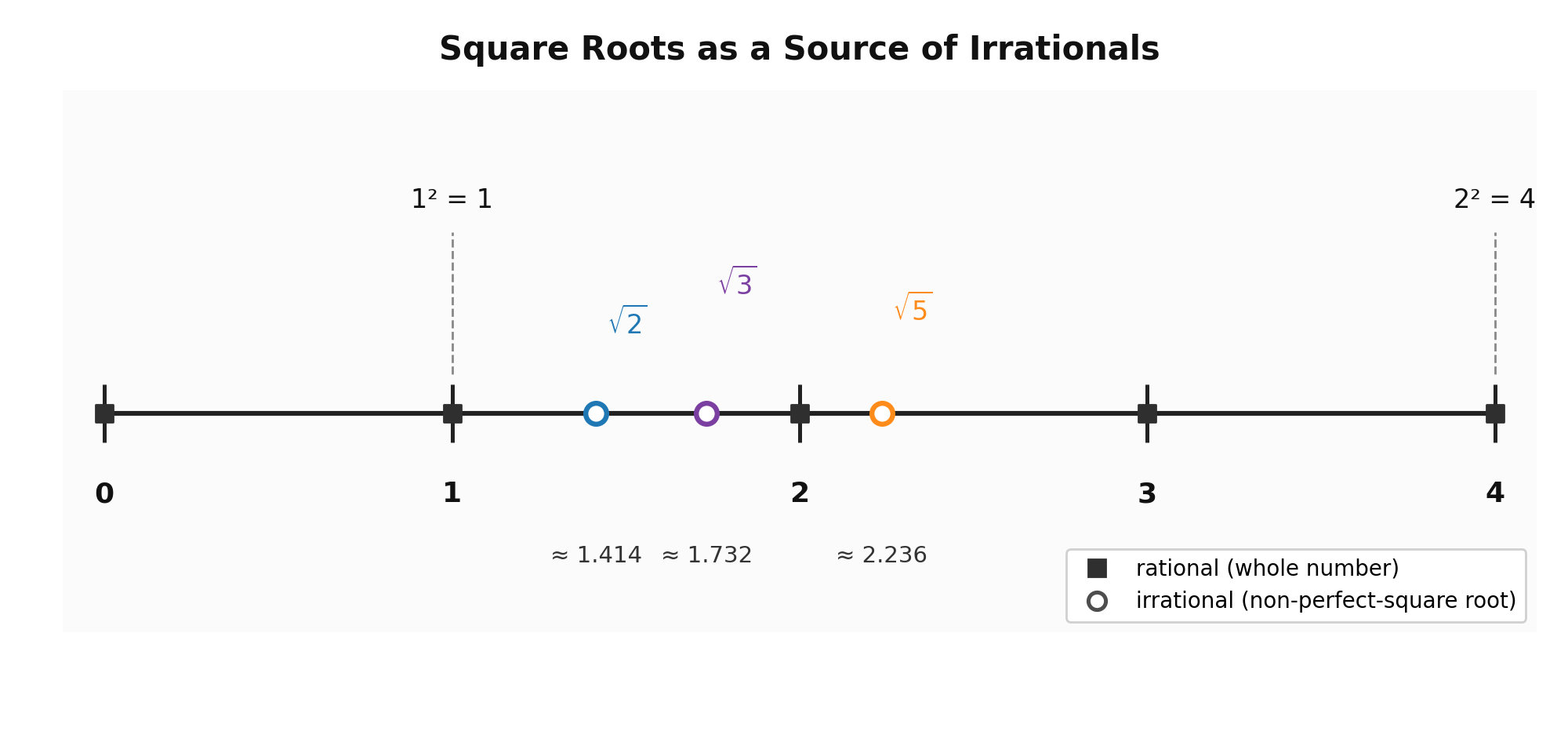
Notice how the number line above fills in the gaps between whole numbers with irrational square roots. This is a visual reminder of what we discussed in Lesson 1: irrational numbers exist precisely to fill the holes that rational numbers leave behind.
Applying the Perfect-Square Test
The test in practice boils down to one question: Is there a whole number whose square equals the given integer? Let's walk through several examples using the flowchart below.
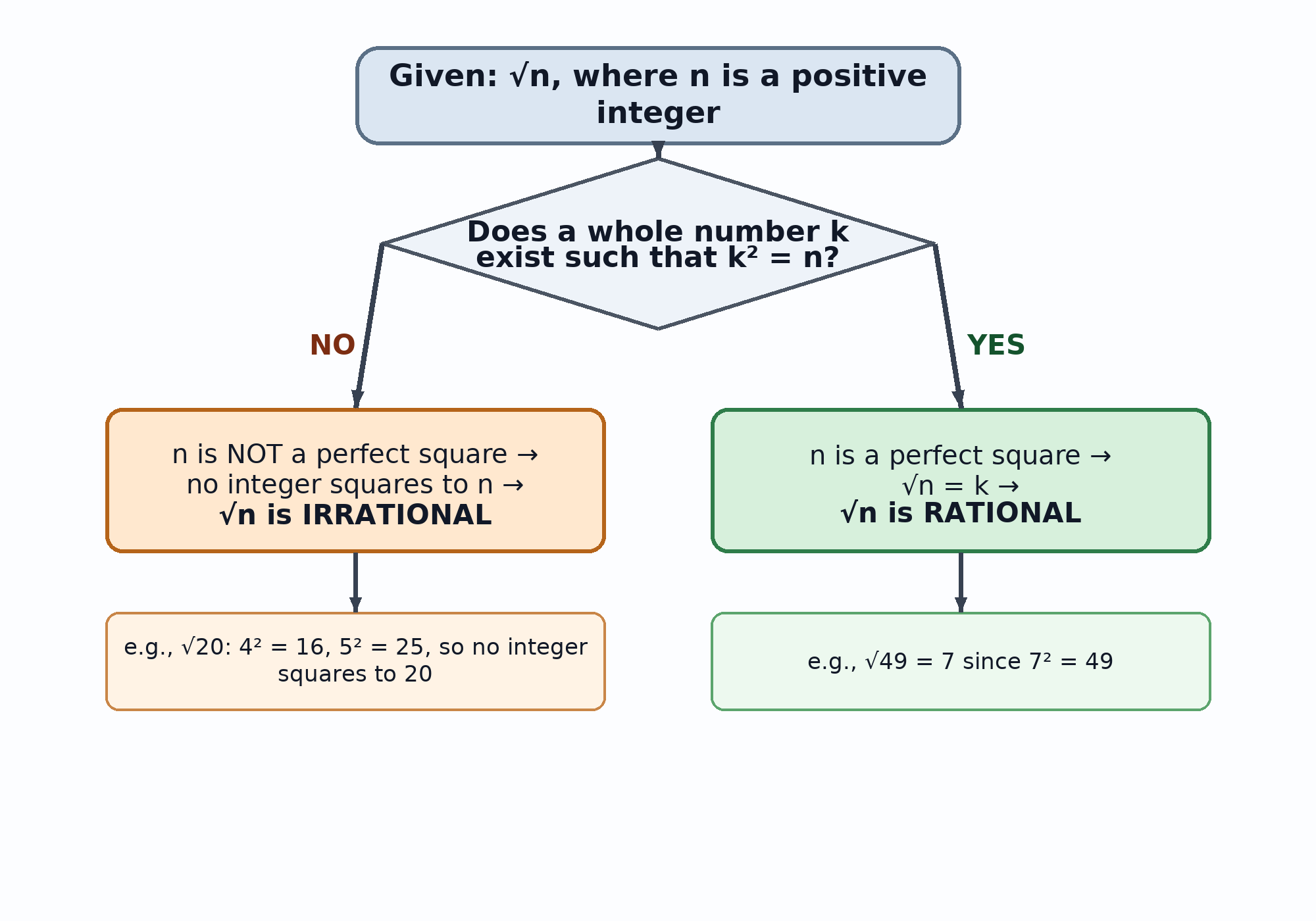
Example 1 — : Is there an integer with ? Yes — . So , which is rational.
Example 2 — : We check nearby perfect squares: and . Because sits between and and equals neither, no whole number squares to . Therefore is irrational.
Example 3 — : Is a perfect square? Yes — . So , which is rational.
Example 4 — : The nearest perfect squares are and . Since does not equal any perfect square, is irrational.
The pattern is straightforward: consult your list of perfect squares. If the number appears on that list, the square root is rational. If it does not, the square root is irrational. No calculator or decimal expansion is needed.
Writing a Clear Justification
Being able to classify a square root is one thing; explaining why is just as important. A strong justification is short and anchored to the definition. Here is a model response for a non-perfect square:
" is irrational because is not a perfect square. The closest perfect squares are and , so no integer multiplied by itself equals . Therefore cannot be expressed as a ratio of integers, and its decimal expansion neither terminates nor repeats."
For a perfect square, the justification is even simpler:
" is rational because , so , which is an integer and therefore rational."
In both cases the key move is the same: state whether or not an integer exists whose square equals the given number. As we saw in the previous lesson when comparing π with the repeating decimal , vague observations like "the decimal looks random" never prove irrationality. Always ground your reasoning in the perfect-square test.
Conclusion and Next Steps
In this lesson, we discovered that square roots are one of the most abundant sources of irrational numbers. The rule is elegantly simple: if the positive integer under the radical is a perfect square, its square root is a whole number and therefore rational; if it is not a perfect square, its square root is irrational. We also practiced writing concise justifications that point directly to the perfect-square test.
Up next are four practice exercises where you will identify perfect squares, match integers to the rational or irrational status of their square roots, classify a mixed set of square-root expressions, and write your own justification for a specific case. Let's put this test to work!
