Famous Irrational Constants
Introduction
Welcome back to The Real Number System and Irrationality! In the first lesson of this course, you learned that irrational numbers are those that cannot be written as a ratio of integers, and that their decimals neither terminate nor repeat. With that foundation in place, we are ready to move forward.
In this second lesson, we turn from the general definition to two specific and celebrated examples: the constants π and e. These are arguably the most famous irrational numbers in all of mathematics, and every math and science student is expected to recognize them on sight. We will learn where each one comes from, commit their standard approximate values to memory, and examine exactly why their decimal behavior marks them as irrational.
Why Some Irrationals Are Famous
Not all irrational numbers are created equal. A number like is irrational, but it was invented just to illustrate a concept. Nobody uses it to design a bridge, model a bank account, or calculate the area of a park.
π and e are different. They emerge naturally from real-world phenomena — circles and continuous growth, respectively — and they appear in formulas across geometry, physics, engineering, finance, and statistics. Their importance is why mathematicians spent centuries studying their properties and ultimately proved that both are irrational. Because these constants show up so frequently, knowing their approximate values and understanding why they are irrational is practical knowledge you will use again and again.
The Number π
The constant π (spelled "pi") arises from one of the simplest shapes in geometry: the circle. If we take any circle and divide its circumference by its diameter, we always get the same number:
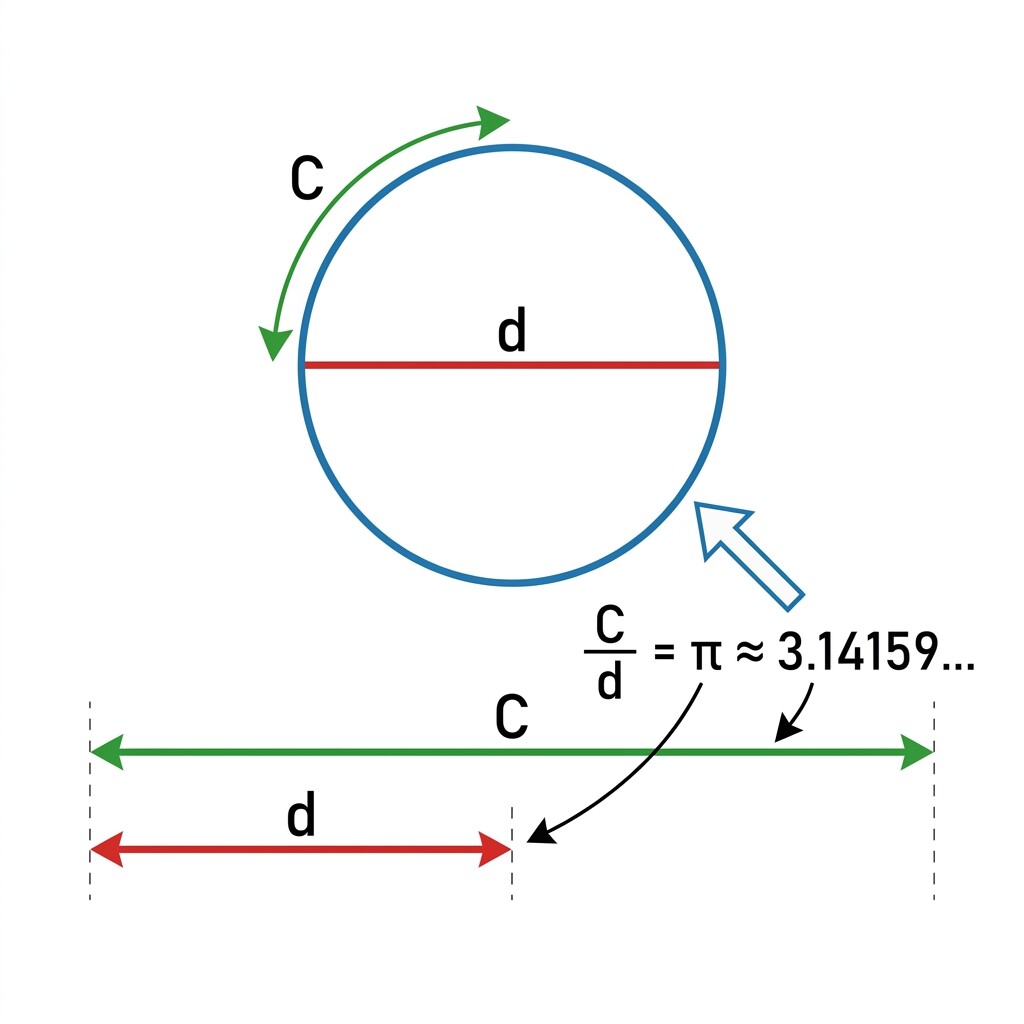
No matter how large or small the circle is, this ratio is always π. Its decimal expansion begins:
Those digits continue forever without ever settling into a repeating block. Computers have calculated trillions of digits of π, and no repeating cycle has appeared — nor will one ever appear — because π has been proven to be irrational.
For everyday work, we rely on rounded approximations. The two most common are:
- Rounded to two decimal places:
- Rounded to four decimal places:
Commit these to memory. Whenever a problem says "use ," it is asking for this standard shortcut, not the exact value.
The Number e
The constant e is sometimes called Euler's number, after the Swiss mathematician Leonhard Euler. While π comes from circles, e emerges from the study of continuous growth and appears naturally when we model compound interest, population growth, and radioactive decay.
One intuitive way to see where e comes from is to imagine investing $1 at 100% annual interest and compounding more and more frequently. As the number of compounding periods grows without bound, the total amount approaches a fixed limit — and that limit is e:
Caution: You might notice that the digits "1828" appear twice in a row at the start of the expansion (). This is just a coincidence! It does not establish a repeating cycle. If you look at the digits that follow, the pattern disappears immediately.
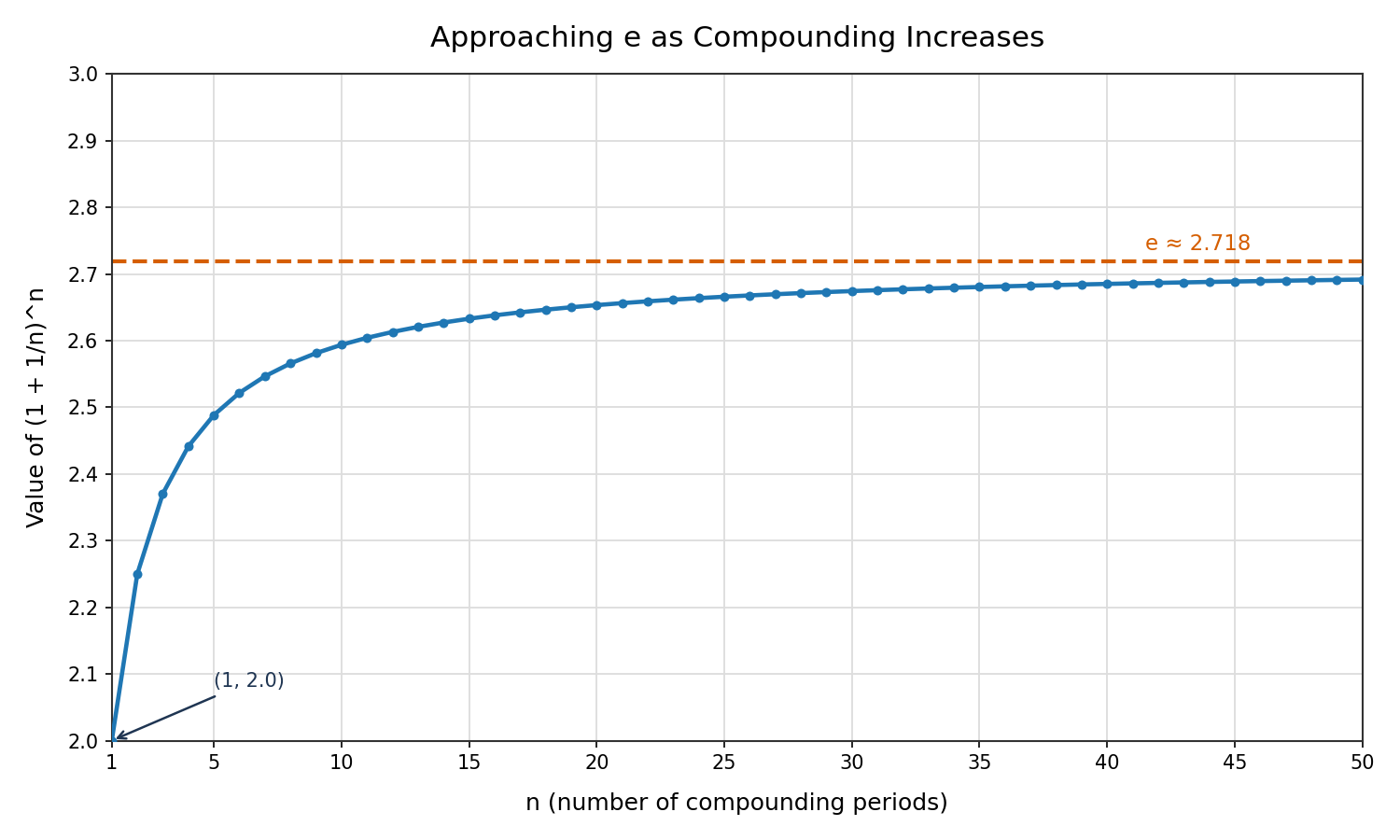
If the limit notation above is new to you, don't worry about the formula itself. The key takeaway is that e is a specific, fixed number — roughly — that shows up whenever continuous growth is involved. Like π, its decimal digits go on forever without repeating, and it has been proven to be irrational.
Here are the standard rounded values worth memorizing:
- Rounded to two decimal places:
- Rounded to four decimal places:
Approximations Are Not Exact Values
Now that we know the approximate values of both constants, it is important to address a widespread misconception: many people believe that π equals . The fraction is a handy approximation, but it is not exact. We can check by dividing:
Notice the repeating block . Because this decimal eventually repeats, is rational. Since π is irrational, the two numbers cannot be equal. In fact, while , so they already differ in the third decimal place.
The same caution applies to e. Writing is technically incorrect; the accurate statement is . Every fraction and every rounded decimal we use for π or e is just a convenient stand-in. No fraction of integers will ever equal π or e exactly.
| Statement | True or False? | Why? |
|---|---|---|
| False | is a rounded approximation | |
| False | is rational; π is not | |
| True | Correct use of the "approximately equal" symbol | |
| False | is a rounded approximation | |
| True | Correct rounding to two decimal places |
Contrasting with a Rational Decimal
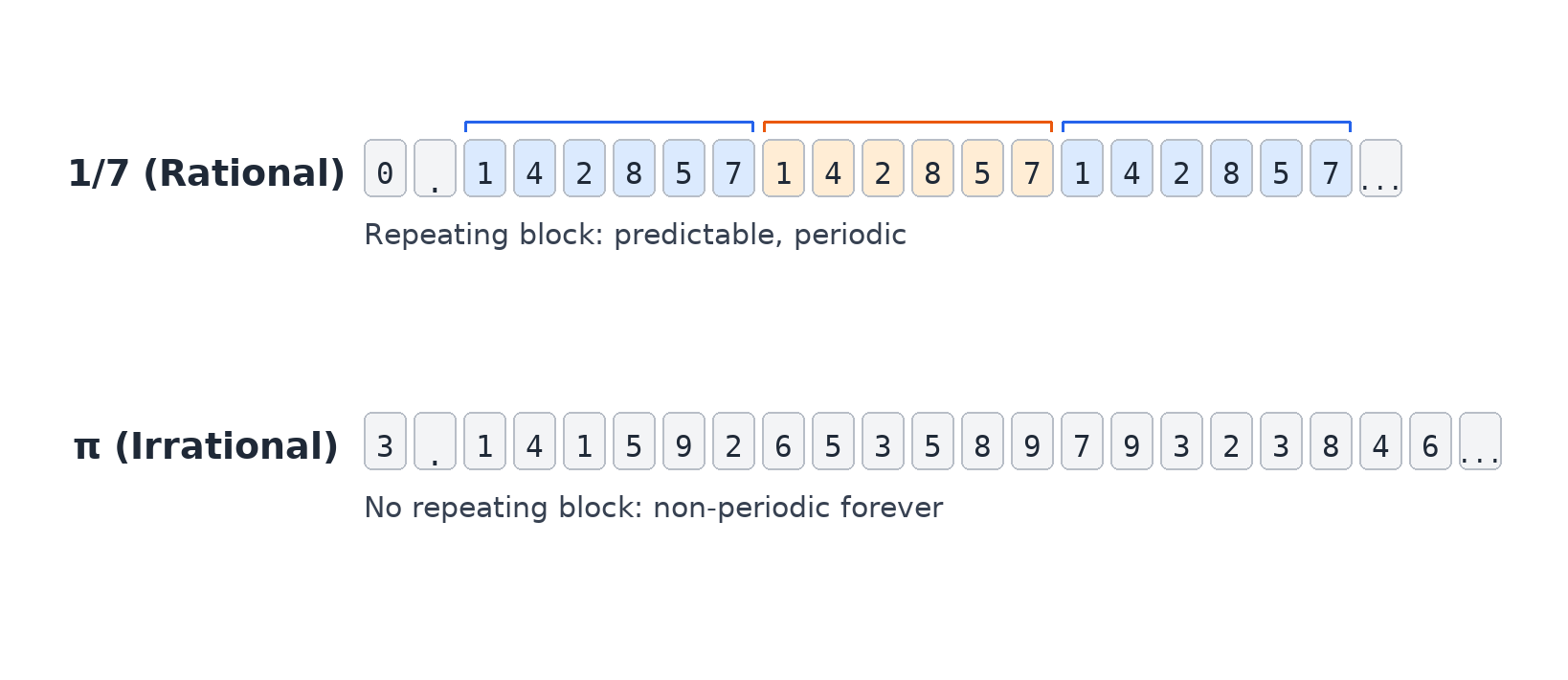
To sharpen our understanding, let's place π alongside a rational number that also has many decimal digits. Consider :
This decimal never terminates, so at first glance it might look similar to an irrational expansion. But watch closely: the six-digit block repeats over and over in an endless but perfectly predictable cycle. That repeating pattern is exactly what makes rational.
Now compare that with the first several digits of π:
No matter how far we extend this expansion, we will never find a block of digits that starts cycling. The digits keep going in a way that is entirely non-periodic. This is the hallmark of irrationality: a decimal that is both non-terminating and non-repeating. The same is true for e, whose digits likewise never lock into a repeating pattern.
Conclusion and Next Steps
In this lesson, we met two of the most important irrational constants in mathematics. π is the ratio of a circle's circumference to its diameter, approximately (or to four decimal places). e is Euler's number, tied to continuous growth, approximately (or to four decimal places). Both have decimal expansions that go on forever without repeating, and no fraction of integers can represent either one exactly.
Now it's time to put these ideas to work! In the upcoming practice exercises, you will recall the standard approximations, tackle common true-or-false misconceptions, and explain in your own words why π and e are irrational by contrasting their decimal behavior with that of a repeating decimal like .
