Understanding Deep Learning
From Machine Learning to Deep Learning 🔗
This lesson places deep learning inside the machine-learning story you already know.
In this lesson, you will learn to:
- Explain why deep learning is a development within machine learning, not a separate technology.
- Describe how stacked layers can build useful patterns from complex inputs.
- Connect data, computing power, and improved methods to the rise of practical deep learning.
You now have the core move in hand: instead of writing every rule, people supply examples, and the model is what comes out of studying them. The trouble is that in most meetings, nobody stops at "machine learning." Someone says "deep learning," someone else says "neural network," and the assumption in the room becomes that these are separate technologies with separate rules. Your job in that moment is small but useful: put deep learning back inside the story you already know.
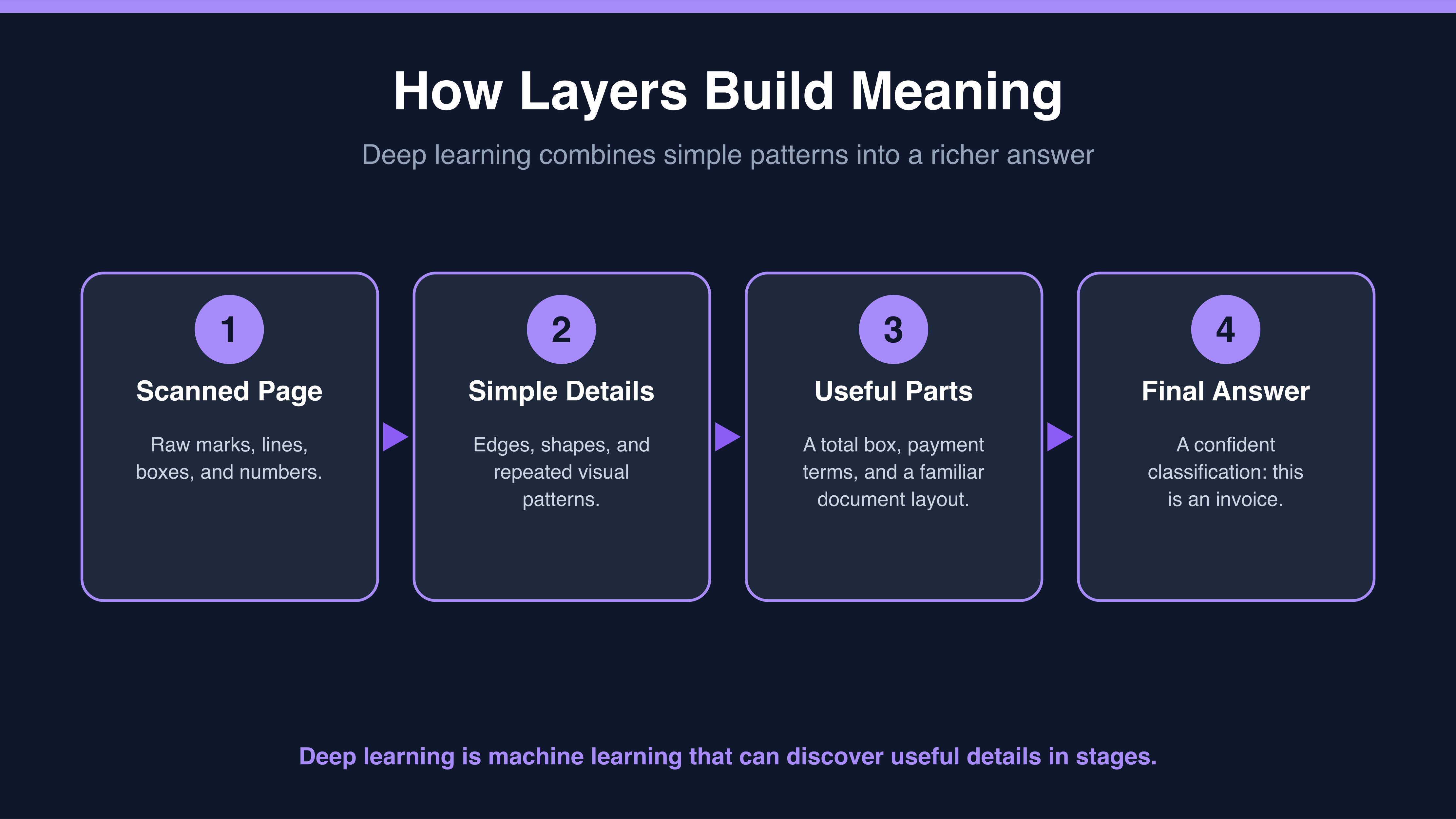
So here is the sentence to have ready before we unpack it. Deep learning is still machine learning. It still learns from examples. What changed is how much of the pattern-finding the system does for itself.
Why Deep Learning Was a Further Development, Not a Different Species 🧬
Think back to the spam example. Earlier machine learning worked well, but it needed a lot of help from people up front. Someone had to decide which features of a message were worth looking at: how many links it contained, whether the sender was known, how many capital letters appeared in the subject line. The system found the patterns, yes, but people chose what it was allowed to notice. That step has a name in the business: people call it feature engineering, deciding in advance which details the system is allowed to notice, and it can consume most of the effort on a project.
Now imagine the task is not spam but "is there a signature on this scanned contract?" What would you tell the system to look at? You cannot list the features of a signature. There is no sensible column called "loopiness." The same problem shows up with speech, with photographs, with free-text customer complaints. The information is rich, messy, and nobody can describe in advance which details matter.
That is the gap deep learning closed. Rather than depending on people to hand-pick the useful details, the system works out its own useful details from the raw material. That is the whole reason people mark it as a distinct step. Not a different philosophy, just a much smaller dependence on human beings knowing in advance what to look for.