Mapping the Modern AI Landscape
Understanding the Modern AI Landscape 🗺️
This lesson connects fixed rules, machine learning, deep learning, and modern AI into one usable mental map.
In this lesson, you will learn to:
- Place common AI capabilities on a line from fixed instructions through machine learning and deep learning.
- Explain why newer approaches extend rather than replace earlier ones.
- Ask practical follow-up questions that move an AI conversation from a label to a mechanism.
You've now walked the whole path: fixed instructions, then learning patterns from examples, then learning in layers. This last stop on the path is about carrying all of it in your head at once, because that is what actually gets tested in real meetings. Nobody will ask you to define deep learning. Someone will say "the AI does it," and you'll need a mental map clear enough to ask a useful next question.
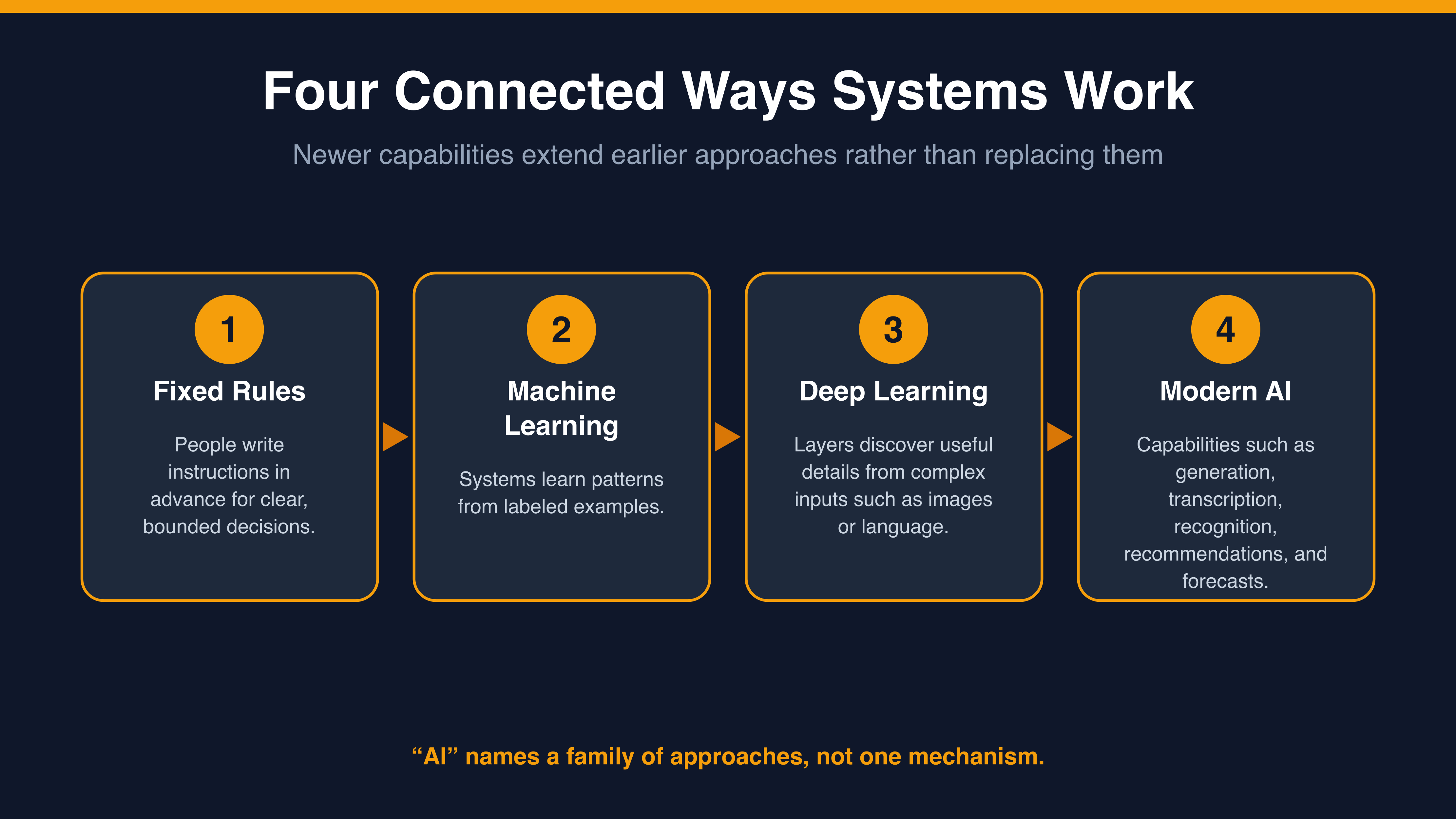
So here is the move to practise: whenever a system comes up, place it on a line rather than in a box. The line runs from instructions people wrote in advance, to patterns learned from recorded examples, to patterns learned in layers, to today's capabilities that grew out of that layered approach.
One Picture: Four Stages, One Line of Development 🧭
Say it out loud in four short beats, and you'll be understood by almost anyone.
First, fixed instructions. A person writes down exactly what should happen, and the software follows it. Payroll calculations, scheduled reminders, spending approval thresholds. Reliable, explainable, and completely dependent on someone having thought of the situation in advance.
Second, learning from examples. Instead of writing every rule, you hand the system many past cases along with what happened, and it works out the pattern that connects them. The result of that process is what your data colleagues call a model. This is where things like flagging unusual expenses or estimating which accounts are at risk of leaving become possible, because nobody could ever write a complete rulebook for them.
Third, deep learning. Still learning from examples, but organised in layers, so simple details build into richer ones. That is what made messy, unstructured things workable: images, speech, handwriting, ordinary language.
Fourth, the modern capabilities you see everywhere now. Language assistants, image recognition, speech transcription, recommendations, forecasts, and systems that generate text or images, often called generative AI because they produce new content rather than only sorting or scoring it. These are not a fifth kind of magic. They are what the layered approach became once there were enormous amounts of digital data and enough computing power to use it.
Jessica and Marcus are colleagues comparing a familiar churn model with a language assistant used in another team.
- Jessica: So generative AI is the new thing that replaced machine learning?
- Marcus: Not replaced. It sits on top of it. It's still learning patterns from examples, just with many layers and an enormous amount of text to learn from.
- Jessica: Then why does it feel so different from the churn model my team built?
- Marcus: Different capability, same family. Yours learned a pattern to score an account. That one learned patterns in language well enough to produce a sentence.
- Jessica: Okay. So one line of development, not four separate technologies.
Notice what Marcus did not do: he never corrected Jessica's vocabulary. He just kept putting each thing back on the line.
