Learning From Examples
When Machines Started Learning from Data 📊
This lesson explains the shift from writing every rule to learning patterns from examples.
In this lesson, you will learn to:
- Distinguish a system that follows written rules from one that learns from historical examples.
- Explain the flow from historical examples through training to a model and a new prediction.
- Use two practical questions to decide whether examples are likely to help with a workplace problem.
In the last lesson you saw that traditional software follows instructions someone wrote in advance, and that this works beautifully until the task gets too varied to describe completely. That is exactly where this lesson picks up. Someone on your data team is going to say the words "the model learned from the data," and you want a mental picture that holds up when you repeat it to your own team.
The Shift: From Writing Every Rule to Showing Many Examples 🔄
Here is the move to keep in your head. In the old approach, a person studies the problem, decides what the rules should be, and writes them down: "if the invoice is over ten thousand, route it to the finance director." In the new approach, nobody writes the rules. Instead, people gather a large pile of past cases where the answer is already known, and the software works out for itself which patterns tend to go with which answer.
Think about spam in your inbox. Nobody could ever finish writing the rulebook. You could block the word "free," and next week the messages say "at no cost." You could block certain senders, and new ones appear by morning. So instead, the approach flipped: collect hundreds of thousands of messages that people already marked as spam or not spam, and let the software find the combinations of signals that tend to show up in the spam pile. Note what changed. The person's job moved from writing the rules to choosing good examples.
This is why your data colleagues talk about data the way builders talk about materials. In a fixed-instruction system, the quality of the outcome depends on the quality of the rules someone wrote. In a learning system, it depends on the quality and relevance of the examples the system studied. That single sentence is worth borrowing whenever you need to explain the shift quickly.
What People Mean When They Say "the Model" 🧠
The word model sounds technical, but the plain-language definition is simple: a model is what you are left with after a system has studied a pile of examples. It is the stored result of the pattern-finding. For a technically minded reader, that stored pattern is represented mathematically inside the software, but you do not need the mathematics to use the idea. Nothing more mystical than that.
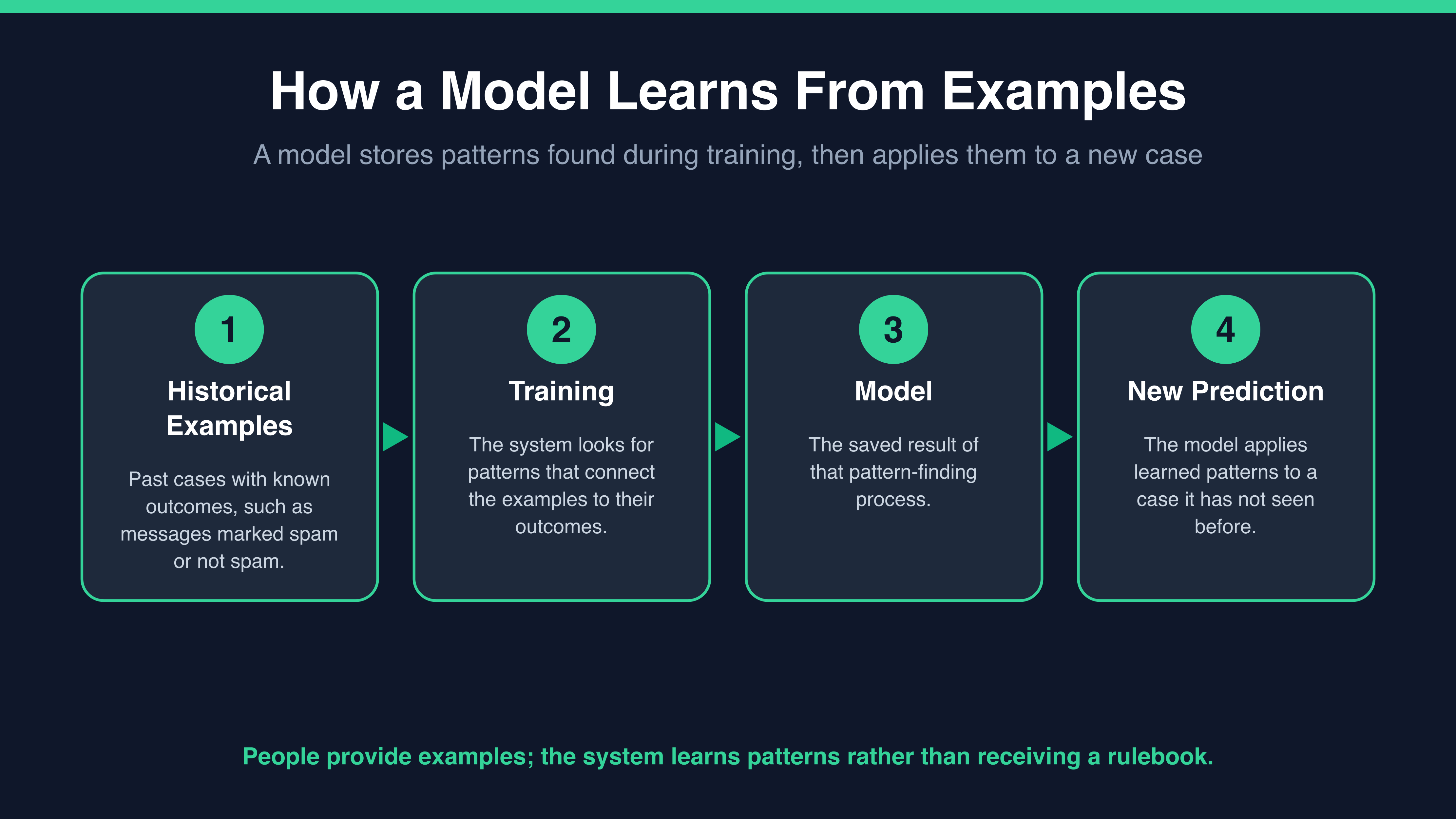
The flow has four steps, and it helps to say them out loud in order. First, historical examples: past cases where you already know what happened. Second, training: the process of working through those examples and picking up the patterns. Third, the model: the output of training. Fourth, a new prediction: hand the model a brand new case and get an answer back. If a colleague asks, "So who taught it?" the honest answer is that nobody taught it rule by rule. People supplied the examples, and the patterns came out of the examples.
Victoria, a finance manager, presses her teammate Dan, a data analyst, on what the model learned actually means.
- Victoria: So when you say the model learned from the data, someone sat down and taught it the rules for a risky expense claim?
- Dan: No, and that is the part worth pausing on. We handed it about four years of past claims, each one already marked as clean or flagged by your team. It found the patterns itself.
- Victoria: Then what is the model, exactly? A program?
- Dan: It is what came out of that study. Think of it as the accumulated pattern sense from those four years, saved so we can point it at a claim that arrived this morning.
- Victoria: And it gives me an answer on the new claim based on what resembled it in the past.
- Dan: That is it. And that is also why the examples matter so much. It only knows the kinds of claims it was shown.
Notice that Dan never defended the technology. He kept steering Victoria back to the same idea: examples in, patterns out, a model she could reuse, until she put it in her own words. That restatement is your signal that the idea landed.
