Understanding Fixed Instructions
Welcome to the Course 🎉
Machine intelligence begins with a simple distinction: some systems follow rules people wrote in advance, while others learn patterns from examples.
In this lesson, you will learn to:
- Explain how fixed instructions and automation make decisions.
- Identify workplace situations where written rules are a good fit.
- Recognize when varied cases make learning from examples more useful than adding more rules.
You will use this distinction throughout the course to move conversations beyond the vague label AI.
What "Following Instructions Written in Advance" Actually Means 📋
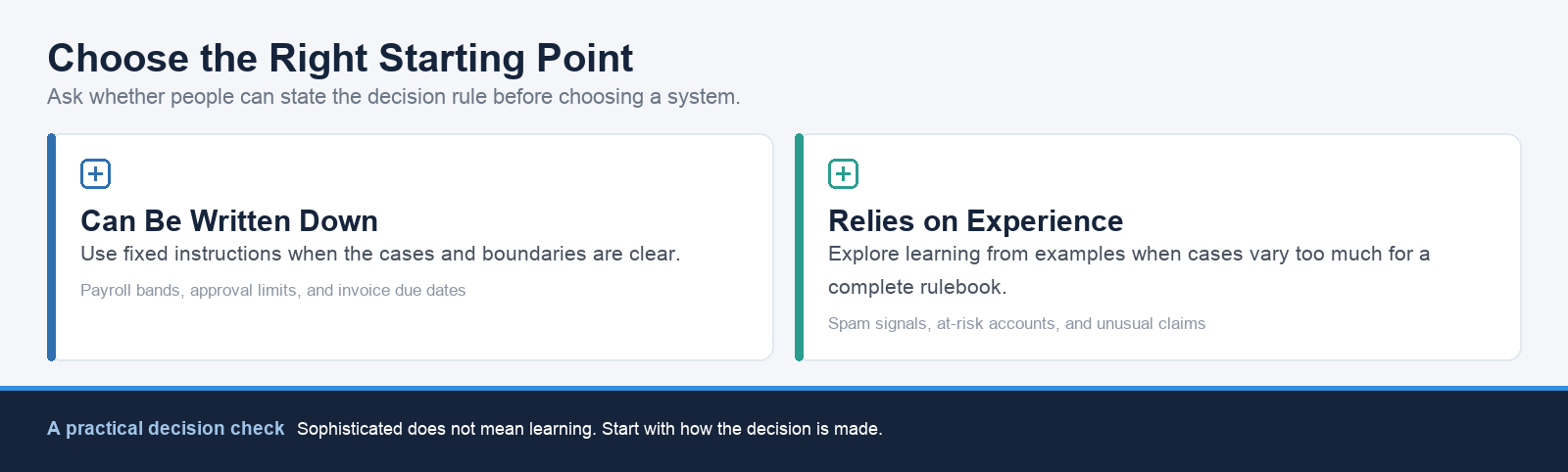
Here's the move to make whenever someone calls a system "AI": ask yourself a single question. Did a person write down, ahead of time, what this thing should do in each situation?
If the answer is yes, you're looking at traditional software. Someone sat down, thought through the situations, and wrote the instructions. The system then follows those instructions faithfully, every time, at speed. Think of a recipe. A recipe can be long, detailed, and produce something impressive, but it never invents a step. It also never notices that you're out of eggs. It does what it says, and only what it says.
Payroll is the cleanest example. Somebody wrote the rules: this tax band, this pension percentage, this overtime multiplier. The system applies them to thousands of employees in seconds. That is genuinely useful and genuinely sophisticated. It is not learning anything.
This is worth saying out loud, because it's the thing people get wrong most often: sophistication is not the same as learning. A system can be enormously complex, handle millions of transactions, and still be nothing more than a very large set of instructions someone wrote.
Jake, a budget owner, checks his assumption with Nova, a finance colleague who understands how the expense system is configured.
- Jake: Our expense system flags anything unusual. That's AI, right?
- Nova: Depends what "unusual" means. Ask the finance team how it decides.
- Jake: They said it flags anything over five hundred pounds, or anything submitted more than thirty days late.
- Nova: Then someone wrote those two rules by hand. It's following instructions. Useful, but nobody taught it what "unusual" looks like. It only knows the two things it was told.
- Jake: So if a strange claim came in for two hundred pounds, submitted on time...
- Nova: It sails straight through. The rulebook has no line for it.
Notice what Nova actually did: she didn't argue about the label. She asked how the decision gets made. That question does most of the work for you.