Multi Touch Attribution Theory
The Theory of Multi-Touch Attribution
In the last unit you learned to diagnose why buyers stall and which lever restores velocity. That work assumes you can see what moved a buyer. This unit confronts a harder question: when a purchase finally happens after a dozen scattered interactions, how do you decide what actually earned the credit? Attribution is where your understanding of the non-linear journey collides with reporting systems that want one tidy answer.
How Overlapping Touchpoints Build Cumulative Progression
The central claim of Multi-Touch Attribution Theory is that buyers rarely convert from a single interaction. Progression is cumulative: multiple, overlapping touchpoints each nudge the buyer forward, and the final action only completes a path that earlier touches built.
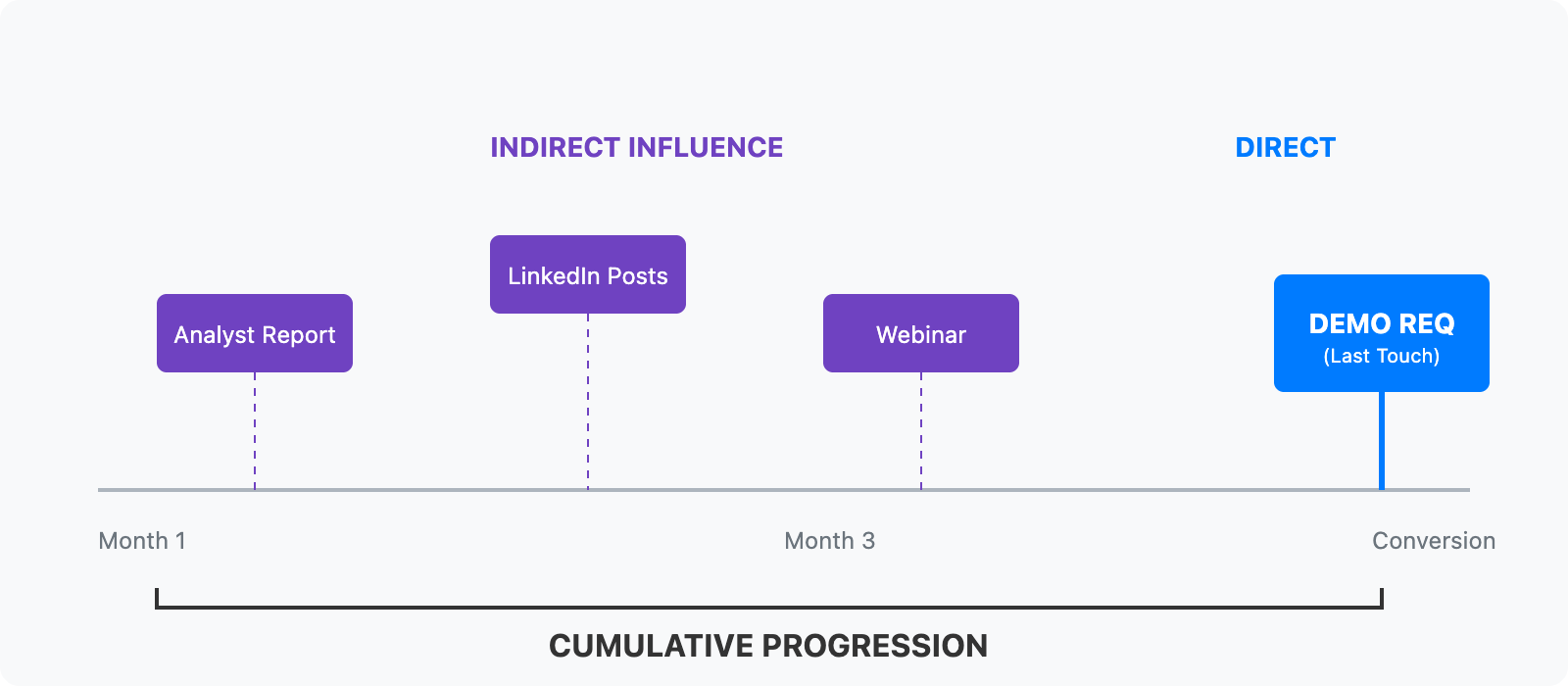
It helps to separate three kinds of influence. A direct touch immediately precedes a measurable action (the retargeting ad clicked right before a demo request). An indirect touch shapes the buyer earlier without a clean, traceable line to conversion (an analyst report read months prior, a LinkedIn post that seeded credibility). And cumulative influence is the combined effect of many touches compounding over time, which is what actually moves most B2B buyers. Miss this distinction and you will systematically over-credit whatever happens to fire last.
- Chris: The demo request converted, so that campaign gets the credit. Clean and simple.
- Jessica: But that buyer read our analyst report in March and sat in a webinar in April. The demo was just the last thing they clicked.
- Chris: Last-touch is auditable, though. How do I defend crediting a webinar someone attended months earlier?
- Jessica: You don't hand the webinar full credit. You show it contributed to progression, alongside the touches that came after it.
- Chris: So the demo didn't create the conversion, it completed a path the earlier touches built.
Notice that Jessica never denies the demo converted. She reframes it: the demo completed a path, it did not create it single-handedly.
Mapping Cumulative Influence Across the Funnel
Once you accept cumulative influence, your job is to map it honestly rather than defend a single number. Walk the actual sequence a cohort took and place each touchpoint where it contributed. An analyst mention builds early awareness and credibility (indirect, problem recognition). LinkedIn engagement and community referrals sustain consideration and supply peer proof. Nurture content keeps the buyer warm across the weeks they go quiet. The demo request then captures intent the earlier touches produced.
The discipline is crediting contribution without overclaiming. Not every touch a buyer happened to see deserves equal weight, and any activity with no plausible evidentiary link to progression should not be counted at all. A strong map shows why last-touch under-counts the earlier touches that made the final action possible, while resisting the temptation to claim marketing caused everything. Finance-minded stakeholders trust attribution that acknowledges uncertainty and avoids double-counting far more than a model that flatters your team.
Choosing an Attribution Framework
There is no perfect model, only trade-offs you choose deliberately. Last-touch is clean, auditable, and hard to game, which is exactly why finance defaults to it, but it renders every indirect and brand touchpoint invisible. First-touch flips the same flaw. Linear spreads credit evenly and undervalues the moments that genuinely mattered. Time-decay weights recent touches more heavily; position-based (or W-shaped) rewards the first touch, the lead-creating touch, and the converting touch. Data-driven models infer weights from patterns but demand volume and trust.
Your task is not to crown a winner but to match the framework to what you need to see, then defend it with guardrails. If the goal is to surface the indirect brand touchpoints that last-touch erases, a position-based or time-decay model captures them while keeping credit bounded. Pair it with rules that prevent inflation: require an evidentiary link for any touch you count, cap how much a single indirect touch can claim, and never let credit across touches exceed the conversion itself. That combination is what turns "marketing influenced everything" into a claim a skeptic will actually accept.
The takeaway to carry: attribution is not about finding the one touch that converted, it is about crediting cumulative influence honestly enough that a skeptic trusts the number. Three practices build on this in sequence: a quick pattern-spotting exercise sorting scenarios into direct, indirect, and cumulative influence; a written mapping that traces real touchpoints across the funnel; and a live debate where you defend your framework choice against a stakeholder who would rather keep it simple.
