Decision Stage Velocity
The Dynamics of Decision and Velocity
In the last unit you traded the straight-line funnel for a truer map, one where buyers loop, skip, and evaluate where you cannot see them. Now we zoom in on two questions that map raises: what actually happens when a buyer reaches the moment of commitment, and how fast (or slow) they move to get there. This unit is about the physics of the decision stage.
The Psychology of the Final Decision
By the time a buyer reaches the decision stage, the rational case is often already made. What remains is psychological. The dominant force here is not desire for your product but fear of choosing wrong. B2B buyers are rarely rewarded for a good purchase; they get blamed for a bad one. That asymmetry produces status quo bias, where doing nothing feels safer than acting, and loss aversion, where the risk of a failed implementation looms larger than the upside of a better tool.
These are your barriers: perceived risk, lack of internal consensus, decision fatigue after a long evaluation, and the absence of a compelling reason to act now. Against them sit the accelerators: social proof from credible peers, concrete risk reduction (implementation guarantees, security documentation), a clear and defensible ROI story, and a genuine compelling event like a contract renewal or an audit deadline. Most decision-stage factors are not neutral. They are actively pushing the buyer toward commitment or away from it, and your job is to know which is which.
The Velocity of Progression Between Stages
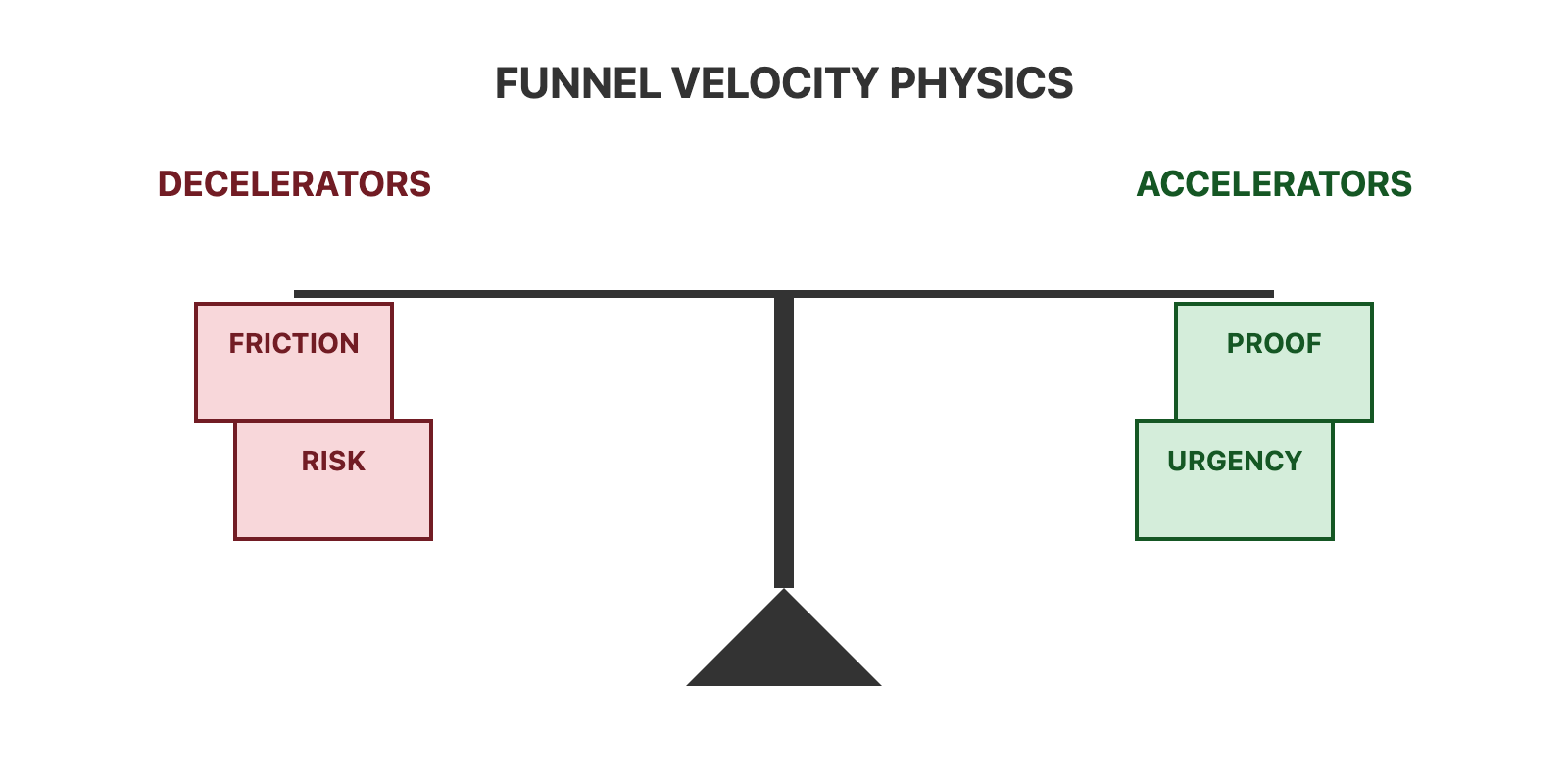
Barriers and accelerators explain the final decision. Funnel Velocity explains the pace of the whole journey: how buyers progress between stages and what speeds up or slows down that movement. Velocity is not one number; it is the net result of five recurring factors. Risk and friction tend to decelerate, while proof, urgency, and consensus can push either way depending on whether they are present or missing.
Think of it as a balance at every transition. Risk (implementation exposure, legal and security concerns) drags. Friction (a pricing model that needs a spreadsheet to decode, a legal review with no owner) drags. Proof accelerates when a buyer has decision-stage evidence they can forward internally, and stalls the deal when they do not. Urgency accelerates when a real compelling event exists; its absence lets a deal drift indefinitely. And consensus is often the hidden decelerator, because a buying group of six moves at the speed of its most hesitant member.
- Ryan: This cohort loved the demo, then just went quiet after we sent pricing. Are we losing them?
- Jessica: Look at the velocity factors, not the silence. What actually slowed after the demo?
- Ryan: Pricing went to their legal team, and there's no clear owner on their side.
- Jessica: So it's friction and missing consensus, not lost interest. The deal isn't dead, it's stuck at a transition we can help unblock.
Notice that Jessica does not treat the stall as a lost cohort. She isolates which velocity factors changed at a specific transition, which is what turns a vague "buyers are slow" into a diagnosis you can act on.
Designing Decision-Stage Interventions
Once you can name the dominant decelerator, the intervention almost writes itself, because each factor has a matching move. If risk is the drag, you supply risk-reduction proof: implementation timelines from similar customers, security and compliance documentation, references a buyer can call. If friction is the drag, you build comparison support and objection-specific content that pre-answers the legal and pricing questions clogging the review. If consensus is missing, you arm your champion with executive-alignment material they can circulate, because you are rarely in the room where the internal decision actually happens. And if urgency is absent, you connect the purchase to a real business event rather than manufacturing false scarcity.
The discipline is matching, not volume. A pile of generic content does nothing for a deal stuck in legal review; one objection-specific one-pager might. Interventions earn their place by targeting a named decelerator for a specific cohort, and prioritizing the highest-impact one beats scattering effort across all five.
The insight to carry: a stalled deal is not a lost deal, it is a diagnosable one, and velocity is the lens that tells you which lever to pull. Next you'll run a quick self-check sorting decision-stage factors into barriers, accelerators, and neutral influences, then build toward a written velocity analysis and a live conversation where you defend the interventions you would actually choose.
